A Human-Centred framework for today and beyond
In my years of working at the intersection of business development, product design, and user experience, I’ve witnessed countless methodologies come and go. Yet, one framework has consistently proven its relevance and adaptability: Design for Services.
As we navigate 2026—a year where AI agents, spatial computing, and hyper-personalization have become the norm—the need for a holistic, human-centred approach to service design has never been more critical. The circular framework developed by Meroni & Sangiorgi in 2011 remains remarkably prescient, offering a comprehensive map of the disciplines and approaches necessary to create services that truly resonate with people.
Let me break down why this framework matters now more than ever and how you can apply it to your work.
Understanding the design of the services framework
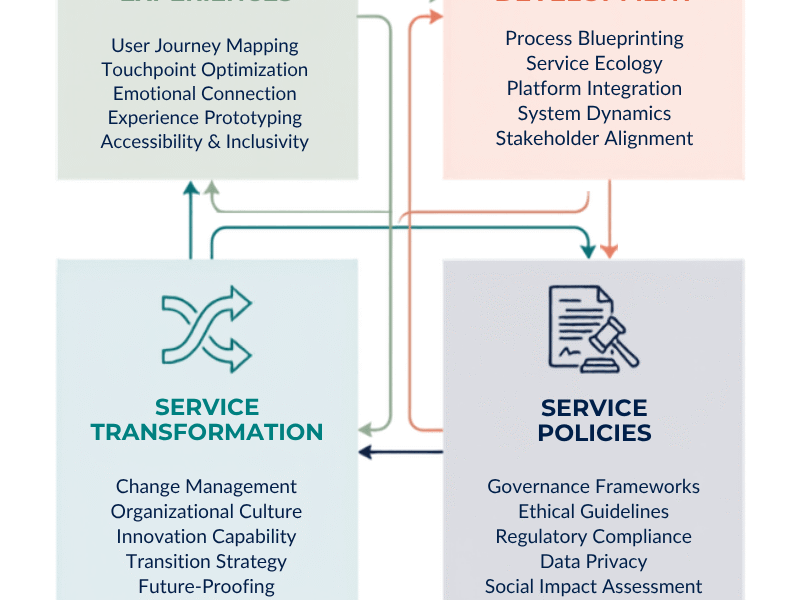
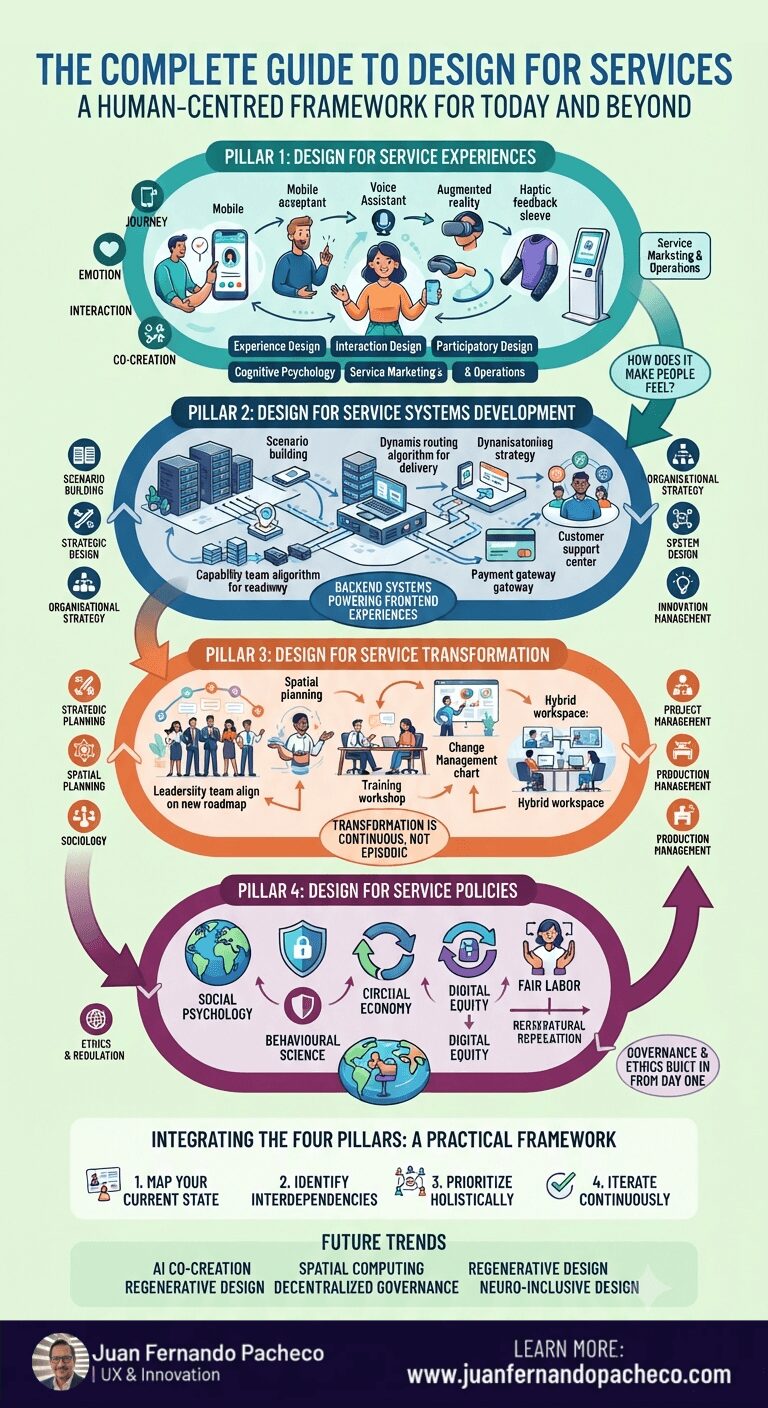
At its core, Design for Services represents a paradigm shift from traditional product-centric thinking to a systemic, human-centred approach. The framework visualizes service design as an integrated ecosystem composed of four interconnected pillars:
- 1st Design for Service Experiences
- 2nd Design for Service Systems Development
- 3rd Design for Service Transformation
- 4th Design for Service Policies
These pillars don’t operate in isolation. Instead, they form a continuous cycle where each element informs and strengthens the others, creating services that are not only functional but also meaningful, sustainable, and adaptable to change.
In 2026, where customers interact with brands across dozens of touchpoints—both digital and physical—this systemic view is essential. You can no longer design a mobile app without considering the organizational strategy behind it, the policies that govern data privacy, or the transformation required to deliver on your promises.
1st pillar: Design for Service Experiences
The first pillar focuses on what users directly encounter—their journey, emotions, and interactions with your service. This is where traditional UX design meets service design, creating experiences that feel seamless and intuitive.
Key Disciplines:
Experience Design forms the foundation. In 2026, this goes far beyond screen design. We’re crafting experiences across voice interfaces, augmented reality environments, AI-powered chatbots, and even haptic feedback systems.
The question isn’t just “Does it work?” but “How does it make people feel?”
Interaction Design ensures that every touchpoint is intuitive. With the rise of generative AI interfaces, interaction patterns are becoming more conversational and context-aware.
Users expect systems that anticipate their needs rather than requiring explicit commands.
Participatory Design has evolved from a nice-to-have to a necessity. In our hyper-connected world, users want co-creation opportunities. They expect to shape the services they use, whether through feedback loops, customization options, or community-driven features.
Ethnography provides the deep cultural understanding needed to design for diverse, global audiences. As we’ve seen with AI bias issues plaguing the industry, assuming your perspective represents your users’ reality is a fatal mistake. Ethnographic research uncovers the unspoken needs, cultural nuances, and behavioral patterns that quantitative data alone cannot reveal.
Cognitive Psychology helps us understand how people process information, make decisions, and form memories. In an age of information overload, designing for cognitive ease isn’t optional—it’s a competitive advantage.
Service Marketing and Service Operations Management ensure that the experience you promise is the experience you deliver. The gap between marketing claims and operational reality is where brands die in the social media age.
Practical Application:
When designing a banking service in the future, you’re not just creating a mobile app. You’re orchestrating experiences across:
- AI-powered financial advisors
- Biometric authentication systems
- Physical branch interactions (yes, they still matter)
- Customer support chatbots
- Educational content about financial literacy
- Community features for shared financial goals
Each touchpoint must feel cohesive while serving its unique purpose in the user’s journey.
2nd pillar: Design for Service Systems Development
While the first pillar focuses on user-facing experiences, the second pillar addresses the complex systems that make those experiences possible. This is where strategic thinking meets operational excellence.
Key Disciplines:
Scenario Building allows organizations to anticipate future needs and challenges. In today’s world, when technological change accelerates exponentially, scenario planning isn’t about predicting a single future—it’s about preparing for multiple possibilities.
- What happens when quantum computing breaks current encryption?
- How do services adapt when AI handles 80% of customer interactions?
Scenario building helps you stay resilient.
Strategic Design aligns service development with long-term business goals. It’s the bridge between vision and execution, ensuring that every feature, every process, every investment moves you toward your strategic objectives.
Organisational Strategy examines how your company’s structure, culture, and capabilities support service delivery. The most brilliant service design will fail if your organization isn’t structured to deliver it. This is particularly relevant as companies navigate hybrid work models, AI integration, and rapid scaling.
System Design provides the architectural blueprint for complex service ecosystems. Today’s services are rarely standalone—they’re part of interconnected platforms, APIs, and partnerships. System design ensures these connections are robust, scalable, and secure.
Organisational Studies offers insights into how people work together, how decisions get made, and how change happens within institutions. Understanding these dynamics is crucial for implementing service improvements.
Innovation Management creates structures for continuous improvement and breakthrough thinking. In a competitive landscape, standing still means falling behind. Innovation management ensures you’re constantly evolving your services to meet emerging needs.
The Systems Thinking Imperative:
Here’s what I’ve learned after many years in this field: you cannot design experiences in isolation. Every user-facing feature depends on backend systems, data flows, organizational processes, and technological infrastructure.
Consider a food delivery service. The seamless experience of ordering dinner with two taps requires:
- Real-time inventory management across hundreds of restaurants
- Dynamic routing algorithms for delivery drivers
- Payment processing systems that handle multiple currencies and methods
- Customer service protocols for when things go wrong
- Quality control measures for food safety
- Partnership management with restaurant owners
If any part of this system breaks, the entire experience collapses. That’s why systems development isn’t just an IT concern—it’s a strategic imperative.
3rd pillar: Design for Service Transformation
Transformation is where strategy meets reality. This pillar addresses the change management, capability building, and cultural shifts necessary to bring new services to life and scale them effectively.
Key Disciplines:
Strategic Planning translates vision into actionable roadmaps. In 2026, strategic planning cycles have compressed from annual to quarterly or even continuous planning. The pace of change demands agility without sacrificing strategic coherence.
Spatial Planning has taken on new meaning as we design hybrid physical-digital experiences. Where do virtual meetings happen? How do we design physical spaces that complement digital services? Spatial planning considers the geography of service delivery in an increasingly distributed world.
Sociology helps us understand how services impact communities, social structures, and collective behaviors. Services don’t exist in a vacuum—they reshape how people interact, work, and live. Understanding these social dynamics is crucial for responsible innovation.
Project Management has evolved dramatically with AI-powered tools, distributed teams, and agile methodologies. Yet the fundamentals remain: clear goals, defined roles, effective communication, and accountability. In 2026, project managers are orchestrating human-AI collaborations rather than just managing people.
Production Management ensures that services can be delivered consistently at scale. This is where efficiency meets quality, where automation meets human judgment. The challenge is maintaining personalization while achieving operational efficiency.
Network Organisation Studies examines how services function within ecosystems of partners, suppliers, and platforms. No company is an island anymore. Understanding network dynamics, platform economics, and ecosystem value creation is essential for competitive advantage.
The Transformation Challenge:
I’ve seen brilliant service designs fail not because of poor UX or weak technology, but because organizations couldn’t transform themselves to deliver them. Transformation requires:
- Leadership commitment – Change starts at the top
- Cultural alignment – Values must support new ways of working
- Capability development – People need skills for new roles
- Incentive restructuring – Reward systems must reinforce desired behaviors
- Communication clarity – Everyone must understand the “why” behind change
Today, transformation is continuous, not episodic. Organizations that treat change as a one-time project will be left behind. The winners are those who build transformation into their DNA.
4th pillar: Design for Service Policies
The outer ring of the framework addresses the governance, ethics, and policy considerations that shape services at a societal level. This pillar has become increasingly critical as we grapple with AI ethics, data privacy, digital equity, and environmental sustainability.
Key Disciplines:
Social Psychology examines how services influence individual and group behavior. In an era where algorithms shape what we see, buy, and believe, understanding these psychological impacts is a moral imperative. Are your services promoting wellbeing or addiction? Connection or polarization?
Behavioural Science provides tools for designing services that encourage positive behaviors while respecting autonomy. Nudge theory, choice architecture, and motivational design can help people achieve their goals without manipulation.
Service Marketing at the policy level addresses how services communicate their value and impact to society. Transparency, authenticity, and accountability aren’t just buzzwords—they’re expectations that consumers and regulators increasingly enforce.
The Policy Imperative in 2026:
Let me be direct: ignoring policy considerations is an existential risk. Consider these today’s world realities:
- AI Regulation: Governments worldwide are implementing strict AI governance frameworks. Services using AI must demonstrate fairness, transparency, and accountability.
- Data Privacy: Regulations like GDPR have gone global. Users demand control over their data, and violations carry massive penalties.
- Environmental Impact: Sustainability isn’t optional. Services must minimize carbon footprints, reduce waste, and contribute to circular economies.
- Digital Equity: As services go digital-first, we must ensure accessibility for people with disabilities, those without reliable internet, and marginalized communities.
- Labor Rights: The gig economy faces scrutiny. Services relying on contract workers must address fair compensation, benefits, and working conditions.
Design for Service Policies ensures these considerations aren’t afterthoughts—they’re built into the foundation of your service from day one.
Integrating the Four Pillars: A Practical Framework
So how do you actually use this framework? Here’s my approach after two decades of practice:
1st step: Map Your Current State
Audit your service across all four pillars:
- Experiences: What touchpoints exist? What do users actually experience?
- Systems: What infrastructure supports these experiences? Where are the bottlenecks?
- Transformation: What changes are needed? What’s your capability gap?
- Policies: What governance structures exist? What ethical considerations apply?
2nd step: Identify Interdependencies
The magic happens at the intersections. Ask:
- How do system constraints limit experience possibilities?
- What transformation is required to implement new policies?
- How do policy decisions create new experience opportunities?
3rd step: Prioritize Holistically
Resist the temptation to optimize one pillar at the expense of others. A beautiful experience backed by broken systems creates frustration. Brilliant systems with no transformation plan gather dust. Ethical policies without enforcement are just PR.
4th tep: Iterate Continuously
In 2026, service design is never “done.” User needs evolve, technologies advance, regulations change, and competitors innovate. Build feedback loops into each pillar:
- Experience metrics: NPS, satisfaction scores, usage analytics
- System performance: Uptime, latency, scalability measures
- Transformation progress: Adoption rates, capability assessments
- Policy compliance: Audit results, ethical impact assessments
The Future of Design for Services
As we look beyond into the future, several trends will reshape how we apply this framework:
AI Co-Creation: Artificial intelligence will become a design partner, not just a tool. AI will help us simulate experiences, optimize systems, predict transformation challenges, and model policy impacts before we implement changes.
Spatial Computing: As AR/VR matures, the boundary between physical and digital services will dissolve. We’ll design experiences that fluidly move across dimensions, requiring new spatial planning approaches.
Regenerative Design: Services won’t just minimize harm—they’ll actively regenerate social and environmental systems. This shifts policy design from compliance to contribution.
Decentralized Governance: Blockchain and Web3 technologies will enable new models of service ownership and governance, challenging traditional organizational structures.
Neuro-Inclusive Design: Advances in neuroscience will help us design for cognitive diversity, creating services that work for neurodivergent users as naturally as for neurotypical ones.
Your Next Steps
The Design for Services framework isn’t just academic theory—it’s a practical toolkit for creating services that matter. Whether you’re a UX designer, product manager, business strategist, or organizational leader, this framework can elevate your work.
Here’s what I recommend:
- Share this framework with your team. Create a common language for discussing service design holistically.
- Audit one service using all four pillars. You’ll discover blind spots and opportunities you’ve been missing.
- Build cross-functional teams that represent each pillar. Break down silos between UX, operations, strategy, and compliance.
- Measure what matters across all dimensions. Don’t optimize for user satisfaction while ignoring system sustainability or ethical impacts.
- Stay curious. The disciplines surrounding this framework—from sociology to behavioural science to spatial planning—offer endless learning opportunities.
Final Thoughts
In my years of experience, I’ve learned that great service design requires both depth and breadth. You need deep expertise in user research, interaction design, and experience crafting. But you also need a broad understanding of systems, strategy, transformation, and policy.
The Design for Services framework gives you both. It honors the complexity of modern service ecosystems while providing structure for navigating that complexity. It reminds us that every design decision ripples across experiences, systems, organizations, and society.
As we move through today and beyond, the services that thrive won’t be those with the slickest interfaces or the most advanced AI. They’ll be the services:
- That thoughtfully integrate human needs, technological capabilities, organizational realities, and societal responsibilities.
- Designed with intention, delivered with excellence, and governed with integrity.
- Designed for people.
And that, ultimately, is what Design for Services is all about.
What aspects of service design are you grappling with in your work? I’d love to hear your thoughts and challenges. Connect with me on LinkedIn or follow my insights on Medium.