¿Why does doing less mean achieving more? The paradox of choice in strategic leadership
In my years working with organizations and leaders across industries, I’ve witnessed a recurring pattern that separates thriving companies from those that merely survive. It’s not about having more resources, better technology, or even smarter people. The differentiator is far more fundamental:
The ability to make clear strategic choices.
We live in an era paralyzed by options. Every business leader faces an overwhelming array of possibilities—new markets to enter, products to develop, technologies to adopt, initiatives to launch. The instinct is to pursue multiple paths simultaneously, to keep options open, to avoid saying no. After all, why limit yourself when you could do it all?
Here’s the uncomfortable truth I’ve learned:
If your strategy tries to do everything, it ends up doing nothing.
The power isn’t in keeping your options open; it’s in choosing boldly and committing fully. This is the essence of clear strategic choices, and it’s the single most important skill you can develop as a leader.
Trap of weak strategic choices
Let me paint a picture you might recognize. Your organization has a strategic plan. It’s comprehensive, well-intentioned, and sounds impressive in board meetings. The goals are ambitious:
- Increase market share,
- Improve customer satisfaction,
- Drive innovation,
- Expand globally,
- Optimize operations, and
- Develop talent.
Everything is a priority. Nothing is off the table.
Six months later, you’re spinning your wheels. Resources are stretched thin. Teams are confused about what really matters. Progress is incremental at best. You’re doing a lot, but achieving little.
This is what happens when you make weak strategic choices.
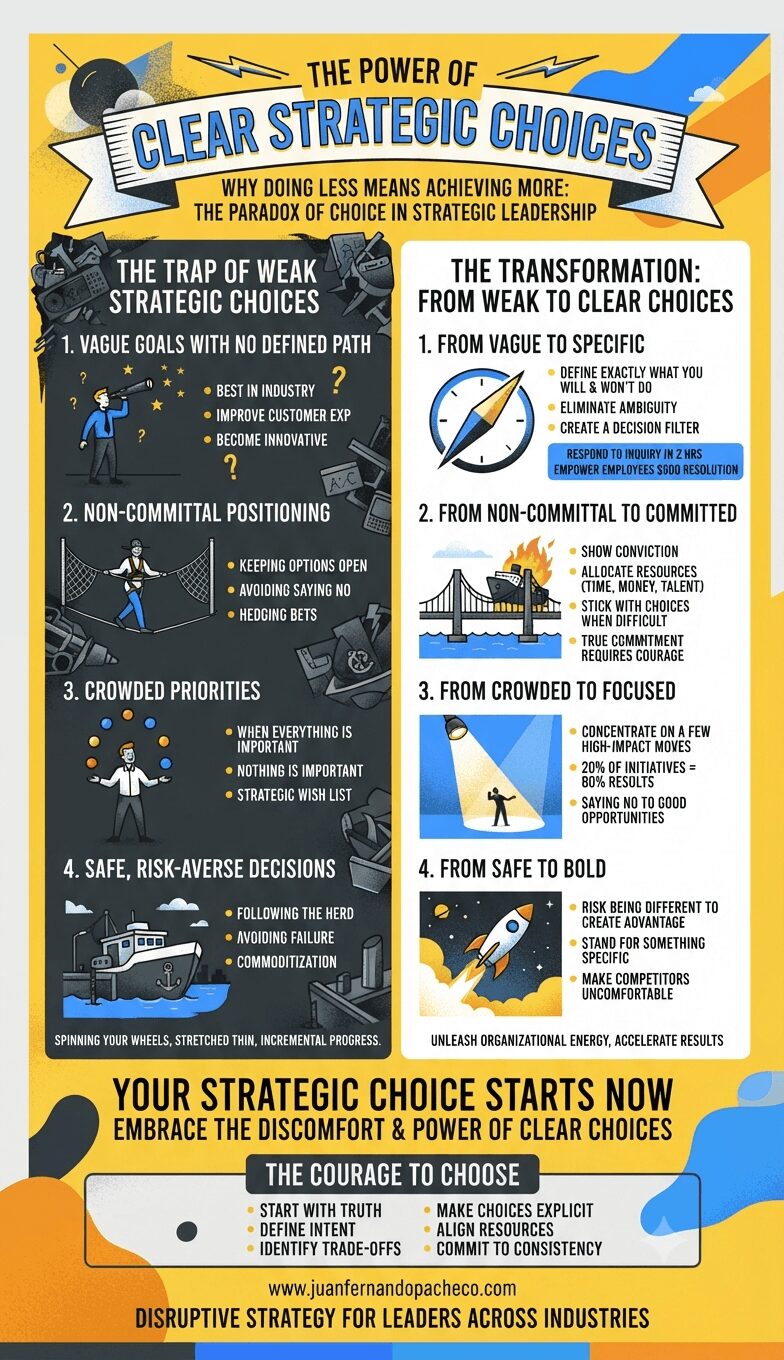
Four Characteristics of Weak Choices
1. Vague Goals with No Defined Path
“I want to be the best in our industry.” “We need to improve customer experience.” “Let’s become more innovative.”
Sounds familiar? These statements sound good, but they’re strategically useless. They lack specificity. They don’t define what you will do differently, what you will stop doing, or how success will be measured.
Vague goals create the illusion of direction while providing none of the substance.
2. Non-Committal Positioning
There’s a seductive comfort in keeping all your options open. If you don’t take a stand, you can’t be wrong. If you don’t commit to a specific path, you can always pivot when things get difficult. But this non-committal approach is a strategy for mediocrity. It signals to your team, your customers, and your competitors that you lack conviction. And conviction is contagious—its absence is equally so.
3. Crowded Priorities
When everything is important, nothing is important.
I’ve seen strategic plans with fifteen “top priorities“. Fifteen! This isn’t a strategy; it’s a wish list disguised as a plan. When you have too many priorities competing for attention, resources, and energy, you guarantee that none of them will receive what they need to succeed. You create organizational ADHD, constantly jumping from one initiative to another without ever achieving meaningful momentum.
4. Safe, Risk-Averse Decisions
Choosing the least risky path feels prudent. It’s defensible. You can’t be blamed for following the herd.
However, safe choices don’t create competitive advantage. They don’t differentiate you. They don’t inspire your team or excite your customers. Safe choices lead to commoditization, where the only differentiator is price, and margins evaporate. Playing not to lose is not a strategy for winning.
The Transformation: From Weak to Clear Strategic Choices
The good news is that you can transform weak choices into clear strategic choices. This transformation happens along four critical dimensions.
From Vague to Specific
Specific choices define exactly what you will and won’t do.
Clarity is kindness—to yourself, your team, and your organization.
When you make specific strategic choices, you eliminate ambiguity. You create a filter for decision-making at every level of the organization.
Consider the difference between:
“We want to improve customer service”
and
“We will respond to every customer inquiry within two hours during business hours, and we will empower every frontline employee to resolve issues up to $500 without managerial approval.”
The first is a nice sentiment. The second is a strategic choice that drives behavior, requires resource allocation, and can be measured.
Specificity forces you to make trade-offs. It requires you to say no to good ideas so you can say yes to great ones. This is uncomfortable, but it’s also where strategic power is born.
Action Step: Review your current strategic objectives. For each one, ask:
- What exactly will we do differently?
- What will we stop doing?
- How will we know we’ve succeeded?
If you can’t answer these questions with precision, you haven’t made a clear choice yet.
From Non-Committal to Committed
Committed choices show conviction, even when it means saying no.
Commitment is the bridge between strategy and execution.
Without it, even the smartest strategic choices remain theoretical. Commitment means allocating resources—time, money, talent—to your chosen path. It means sticking with your choices when they become difficult, which they inevitably will.
I’ve worked with leaders who made excellent strategic choices on paper but failed to commit to them.
They hedged their bets. They kept backup plans alive. They sent mixed signals to their organizations. The result? Their teams sensed the lack of conviction and responded accordingly—with half-hearted effort and divided attention.
True commitment requires courage. It means accepting that you might be wrong.
It means being willing to be different, to stand for something specific, even if it alienates some customers or critics. But here’s what I’ve observed: committed leaders attract committed teams. When people see you standing firmly behind your choices, they’re willing to invest their energy and creativity in making those choices succeed.
Action Step: Identify one strategic choice you’ve been hedging on.
- What would full commitment look like?
- What resources would you allocate?
- What would you stop doing?
Decide to either commit fully or abandon the choice entirely. Half-commitment is just delayed failure.
From Crowded to Focused
Focused choices concentrate on a few high-impact moves.
Strategy is about choice, and choice is about sacrifice.
You cannot do everything. Attempting to do so guarantees that you’ll do nothing well. Focused strategic choices require you to identify the few high-impact moves that will create disproportionate results and pour your energy into them.
This is where the 80/20 principle becomes your strategic best friend.
Twenty percent of your initiatives will drive eighty percent of your results.
The challenge is identifying which twenty percent and having the discipline to deprioritize or eliminate the rest.
I’ve seen organizations transform their performance not by doing more, but by doing less—by stopping the activities that consumed resources but didn’t create value. This requires brutal honesty about what’s working and what’s not. It means killing projects that have become sacred cows but no longer serve your strategy.
Focus also means saying no to opportunities, even good ones.
This is painful. Every opportunity represents potential revenue, growth, or learning. But remember: every yes is a no to something else. When you say yes to a non-strategic opportunity, you’re saying no to the focused execution of your strategy.
Action Step: List all your current strategic initiatives. Force-rank them by potential impact. Now, identify the top three. What would happen if you doubled down on these and paused or eliminated everything else? I’m not suggesting you do this immediately, but explore the possibility. You might be surprised by how much clarity emerges.
From Safe to Bold
Bold choices risk being different to create an advantage.
Safe strategies are invisible strategies.
They blend into the background. They don’t inspire customers, attract talent, or worry competitors. Bold strategic choices, by contrast, create distinction. They make you memorable. They give people a reason to choose you over alternatives.
Boldness doesn’t mean being reckless. It means being willing to take calculated risks in the service of creating unique value. It means accepting that not everyone will understand or appreciate your choices, but those who do will become passionate advocates.
Think about the companies you admire most. I guarantee they didn’t get there by playing it safe. They made bold strategic choices that differentiated them. They stood for something specific. They were willing to be misunderstood in the short term to create something remarkable in the long term.
The irony is that in today’s hyper-competitive environment, safe choices are actually the riskiest. They lead to irrelevance. They make you vulnerable to bold competitors who are willing to disrupt the status quo. Playing it safe is a slow path to obsolescence.
Action Step: Ask yourself: What?
- Bold choice truly differentiates us?
- Make our competitors uncomfortable?
- Excite our best people and our most valuable customers?
Don’t answer with what’s practical or easy. Answer with what would matter.
Making Clear Strategic Choices: A Practical Framework
Understanding the difference between weak and clear choices is one thing. Making clear strategic choices is another. Here’s a framework I’ve developed through years of strategic work:
1. Start with Truth, Not Aspiration
Before you can make clear choices, you need an unflinching assessment of your current reality.
- What are your actual strengths and weaknesses?
- What do customers truly value?
- What are the real dynamics of your competitive environment?
Aspirational thinking has its place, but not in the diagnostic phase. Get real with yourself first.
2. Define Your Strategic Intent
What do you want to achieve? Not in vague terms, but with specificity. What would success look like in three years? Five years? Be ambitious but concrete. This intent becomes your North Star, guiding every choice you make.
3. Identify Strategic Trade-Offs
This is where most leaders flinch. You must decide what you will not do.
- Who will you not serve?
- What features will you not build?
- What markets will you not enter?
These negative choices are as important as the positive ones. They create focus and prevent strategic drift.
4. Make Your Choices Explicit
Don’t leave your strategy implicit or buried in a document. Articulate your clear strategic choices in simple, direct language. Make them visible. Repeat them constantly. If people can’t recite your strategic choices, they’re not clear enough.
5. Align Resources Ruthlessly
Your budget, your talent, your time—these are the ultimate expressions of your strategy. If your resources aren’t aligned with your clear strategic choices, you don’t have a strategy; you have a slogan. Reallocate aggressively to support your choices.
6. Commit to Consistency
Clear strategic choices require time to bear fruit. Don’t abandon them at the first sign of difficulty or the first attractive distraction. Consistency compounds. Frequent pivots don’t.
The Courage to Choose
Here’s what I’ve learned after years of strategic work: making clear strategic choices is less about analytical brilliance and more about courage. It requires the courage to be specific when vagueness is safer. The courage to:
- Commit when hedging is more comfortable.
- Focus when expansion feels more ambitious.
- Be bold when blending in seems prudent.
But here’s the reward: when you make clear strategic choices and commit to them fully, you unlock a level of organizational energy and effectiveness that weak choices can never achieve. Your team knows what matters. Decisions become easier. Resources flow to the right places. Momentum builds. Results accelerate.
The alternative—weak, vague, non-committal, crowded, safe choices—might feel comfortable in the moment, but they lead to frustration, mediocrity, and eventual irrelevance.
Your Strategic Choice Starts Now
You have a choice to make. You can:
- Continue with the comfort of weak strategic choices, or embrace the discomfort and power of clear ones.
- Keep your options open and achieve little, or you can choose boldly and commit fully.
- Try to do everything and end up doing nothing, or you can focus on the few things that matter most and achieve extraordinary results.
The framework is simple.
The principles are timeless. The only question is whether you dare to apply them.
Make your clear strategic choices. Commit to them fully. And watch what happens when you stop trying to do everything and start doing what matters.
Your strategy—and your organization’s future—depends on it.