Why are traditional innovation models dead?
And how to survive the new reality? The death of predictable innovation. Remember when innovation followed a predictable path? When new technologies slowly trickled from early adopters to the mainstream, giving established companies years to adapt? Those days are gone.
Today, disruptions don’t knock politely at your door—they crash through the wall with the force of a supernova.
They arrive fully formed, gain millions of users overnight, and render entire business models obsolete before quarterly earnings calls can even acknowledge the threat.
This is Big Bang Disruption, and it’s rewriting the rules of competitive survival.
Unlike the gradual innovation cycles described in Clayton Christensen’s classic disruption theory, Big Bang Disruptions explode into the market with unprecedented speed and scale. They don’t:
- Follow the traditional adoption curve.
- Give you time to respond. And they certainly
- Care about your five-year strategic plan.
Understanding this new reality isn’t just academic—it’s essential for any leader who wants their organization to survive the next decade. Let’s explore what makes Big Bang Disruption different, why it’s accelerating, and most importantly, how you can protect your business from becoming the next casualty.
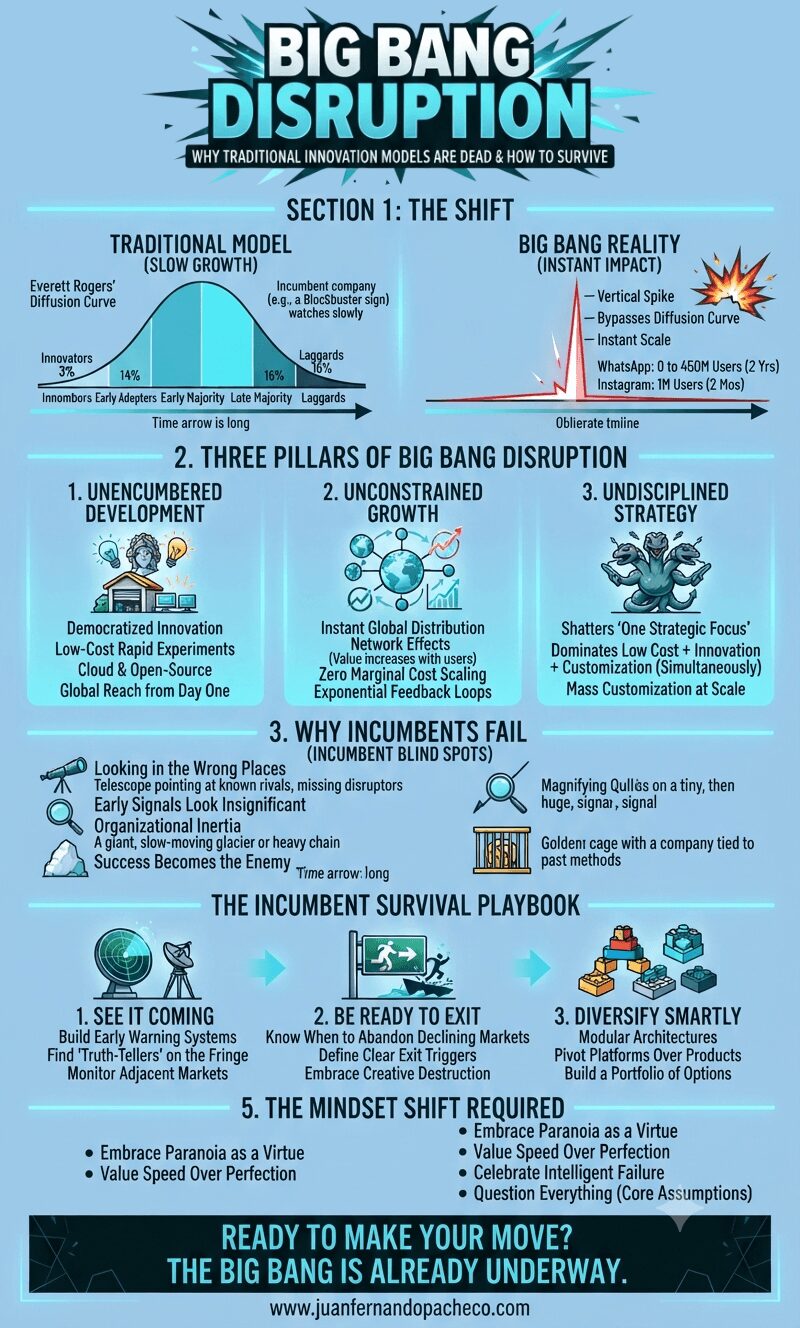
The traditional model vs. Big Bang reality
For decades, business strategists relied on Everett Rogers’ diffusion of innovations theory, which mapped out a predictable adoption curve:
- Innovators (3%) take the risk first
- Early Adopters (14%) follow once they see promise
- Early Majority (34%) join as the product proves itself
- Late Majority (34%) adopt once it becomes standard
- Laggards (16%) resist until they have no choice
This model gave incumbent companies something precious: time. You could watch innovators experiment, study early adopters’ feedback, and carefully craft your response before the mainstream even notices. Kodak had years to adapt to digital photography. Blockbuster had time to respond to streaming. Traditional taxi companies had opportunities to embrace ride-sharing.
Big Bang Disruption obliterates this timeline.
In the Big Bang model, products leap directly from Trial Users to the Vast Majority—skipping the gradual build entirely. There’s no slow climb up the adoption curve. Instead, there’s a vertical spike that looks more like a heart attack on a monitor than a growth chart.
Consider WhatsApp.
It didn’t slowly build from tech enthusiasts to business users to grandparents. It went from zero to 450 million users in roughly two years. Or Instagram, which reached 1 million users in two months and 10 million in a year. These aren’t exceptions anymore—they’re the new normal.
The implications are staggering. Traditional market research becomes useless. Pilot programs don’t predict scale. And competitive responses that would have worked in the Rogers model arrive far too late.
The Three Pillars of Big Bang Disruption
What enables these explosive market entries? Three defining features work together to create the perfect storm:
1. Unencumbered Development
We’ve entered an era where the barriers to creating and launching new products have essentially collapsed. Cloud computing, open-source software, social media marketing, and global supply chains mean that small teams can build, test, and launch products that would have required massive capital investments just a decade ago.
Low-cost, rapid experiments using readily available tools allow ideas to emerge overnight.
A small team in a garage can access the same infrastructure as a Fortune 500 company. They can deploy globally in minutes, iterate on real user data in hours, and automatically scale infrastructure as demand spikes.
This democratization of innovation means threats can come from anywhere—from any geography, any industry outsider, any unknown founder with a laptop and an idea. There’s no R&D department to monitor, no patent filings to track, no trade shows where prototypes are unveiled. Products can go from concept to global launch in complete stealth, emerging fully formed like Athena from Zeus’s head.
2. Unconstrained Growth
Perhaps the most terrifying aspect of Big Bang Disruption is how it bypasses traditional growth constraints. In the past, scaling a business required building sales teams, establishing distribution channels, training partners, and gradually expanding geographic reach. Each step took time and capital.
Today, adoption leaps directly from testers to the mass market, bypassing the slow diffusion curve entirely. Digital products can be distributed globally at near-zero marginal cost. Social networks create viral effects where users become the sales force. App stores and digital marketplaces provide instant global distribution.
Network effects amplify this unconstrained growth. The more people use a platform, the more valuable it becomes for each user.
This creates a feedback loop where growth accelerates exponentially rather than linearly. What looks like a niche product one month becomes a cultural phenomenon the next.
Traditional constraints like manufacturing capacity, retail shelf space, and sales force size simply don’t apply to digital-first businesses. They can scale to millions of users before incumbents even recognize them as competitive threats.
3. Undisciplined Strategy
Here’s where Big Bang Disruption truly breaks the rules. Traditional strategy teaches focus: choose your position, optimize for it, and defend it. You can compete on cost, or differentiation, or niche focus—but trying to do everything at once leads to mediocrity.
Big Bang winners shatter this orthodoxy. They excel simultaneously in low cost, innovation, and customization—breaking the “one strategic focus” rule that has governed strategy for decades.
How is this possible? Technology enables mass customization at scale. Data analytics allow personalization without proportional cost increases. Platform business models create ecosystems where innovation happens continuously without centralized direction.
Consider modern fintech companies.
- They offer lower costs than traditional banks (no branch overhead),
- Superior innovation (mobile-first, AI-powered features), and
- Better customization (personalized financial insights, automated savings).
They’re not choosing one strategic position—they’re dominating on all three simultaneously.
This undisciplined strategy leaves incumbents trapped in impossible positions. If you compete on price, they out-innovate you. If you compete on features, they undercut your price. If you try to serve a niche, they customize better at scale. There’s no haven.
Why Incumbents Fail to See It Coming
Given the stakes, why do established companies consistently miss Big Bang Disruptions until it’s too late? Several factors create blind spots:
They’re looking in the wrong places.
Traditional competitive intelligence focuses on known rivals, adjacent markets, and obvious threats. Big Bang Disruptions often come from completely unexpected directions—from different industries, geographies, or customer segments that seemed irrelevant.
Early signals look insignificant.
When a new product has a few thousand users, it’s easy to dismiss it as a niche toy. But in the Big Bang model, those few thousand users might be the calm before the hurricane. By the time the threat looks “material” by traditional metrics, it’s already too late to respond effectively.
Organizational inertia kills speed.
Even when threats are recognized, large organizations move slowly. Decisions require consensus. Budgets are annual. IT systems are legacy. Culture resists change. By the time an incumbent mounts a response, the disruptor has already moved to the next level.
Success becomes the enemy.
Companies that have succeeded using traditional models have deeply embedded processes, metrics, and incentives optimized for that approach. Pivoting requires admitting that what made you successful might now be what kills you—a psychologically and politically difficult realization.
The Incumbent Survival Playbook
While Big Bang Disruption is terrifying, it’s not hopeless. Established companies can survive and even thrive—if they fundamentally change how they operate. Three strategies are essential:
1. See It Coming
You can’t respond to threats you don’t see. This requires building early warning systems that go far beyond traditional competitive intelligence.
Identify “truth tellers” within your organization—people who can spot meaningful experiments early. These are often younger employees, those on the fringes of your business, or people with diverse backgrounds who notice patterns others miss. Permit them to speak uncomfortable truths without fear of retribution.
Look beyond your industry. Big Bang Disruptions often come from unexpected directions.
Monitor adjacent markets, emerging technologies, and changing customer behaviors even when they seem irrelevant to your core business.
Create mechanisms to test weak signals. Set up small experiments to explore emerging trends before they become obvious threats. It’s better to invest in ten false alarms than miss one real disruption.
2. Be Ready to Exit
This is perhaps the hardest strategic discipline: knowing when to abandon a declining market before it destroys your entire organization.
Big Bang Disruptions don’t just reduce margins—they can make entire business models irrelevant.
Clinging to dying markets wastes resources that could be deployed to new opportunities. It also creates organizational drag, keeping you focused on the past instead of the future.
Develop clear triggers for exit.
What metrics would indicate a market is in terminal decline? What competitive moves would signal a Big Bang Disruption has reached the point of no return? Define these in advance, when you’re thinking clearly, not in the panic of crisis.
When exit becomes necessary, do it decisively. Salvage what you can—brands, patents, customer relationships, talent—but don’t let sentimentality or sunk cost fallacy keep you in a losing battle. Kodak invented digital photography but couldn’t abandon film. We all know how that ended.
3. Diversify Smartly
The best defense against Big Bang Disruption is not putting all your eggs in one basket. But this isn’t about random diversification—it’s about building adaptable platforms that can evolve as markets shift.
Create modular architectures—both technological and organizational—that allow you to pivot quickly. Invest in platforms rather than products, capabilities rather than specific offerings, ecosystems rather than walled gardens.
Enter adjacent markets strategically. Use your existing strengths as a foundation, but don’t be limited by them. Amazon moved from books to everything. Netflix moved from DVD rentals to streaming to content creation. Both leveraged core capabilities while fundamentally transforming their businesses.
Build a portfolio of options. Not every experiment will succeed, but having multiple initiatives in different stages of development gives you flexibility when disruption hits. You’re not betting everything on one outcome.
The Mindset Shift Required
Surviving Big Bang Disruption requires more than new strategies—it demands a fundamental mindset shift.
Embrace paranoia as a virtue.
Andy Grove’s famous dictum, “only the paranoid survive,” has never been more relevant. Assume that disruption is coming, that it will be faster than you expect, and that it will come from directions you can’t yet see.
Value speed over perfection.
In a world of Big Bang Disruption, the cost of being late far exceeds the cost of being imperfect. Launch, learn, iterate. Don’t wait for perfect conditions that will never arrive.
Celebrate intelligent failure.
If you’re not failing occasionally, you’re not pushing far enough into new territory. Create psychological safety for experimentation while maintaining discipline about learning from results.
Question everything.
Especially your core assumptions about customers, competition, and what drives value in your industry. The answers that made you successful yesterday may be exactly what kill you tomorrow.
Your Move
Big Bang Disruption isn’t a future threat—it’s happening now, in every industry, accelerating every year. The question isn’t whether you’ll face it, but when, and whether you’ll be ready.
The companies that thrive in this environment won’t be the biggest or the most established. They’ll be the most adaptable, the most alert, and the most willing to cannibalize their own success before someone else does.
You have a choice. You can cling to traditional models, hope disruptions pass you by, and become the next case study in business school failure. Or you can embrace the chaos, build organizations that thrive on change, and write the next chapter of innovation yourself.
The Big Bang is already underway. The only question is: will you be the disruptor or the disrupted? The clock is ticking. Make your move.