Strategy feels like a mystery, doesn’t it?
You’re in a meeting, and someone drops the word “strategy” into the conversation. Suddenly, heads nod thoughtfully, jargon flows freely, but somehow you leave still unsure what actually needs to happen differently on Monday morning.
I’ve been there. We’ve all been there.
The truth is, strategy isn’t meant to be cryptic or reserved for the C-suite elite. It’s a skill—a learnable, practicable discipline that anyone can master. The problem isn’t that strategy is inherently complex; it’s that we rarely break it down into digestible, actionable levels.
That’s exactly what I want to change today.
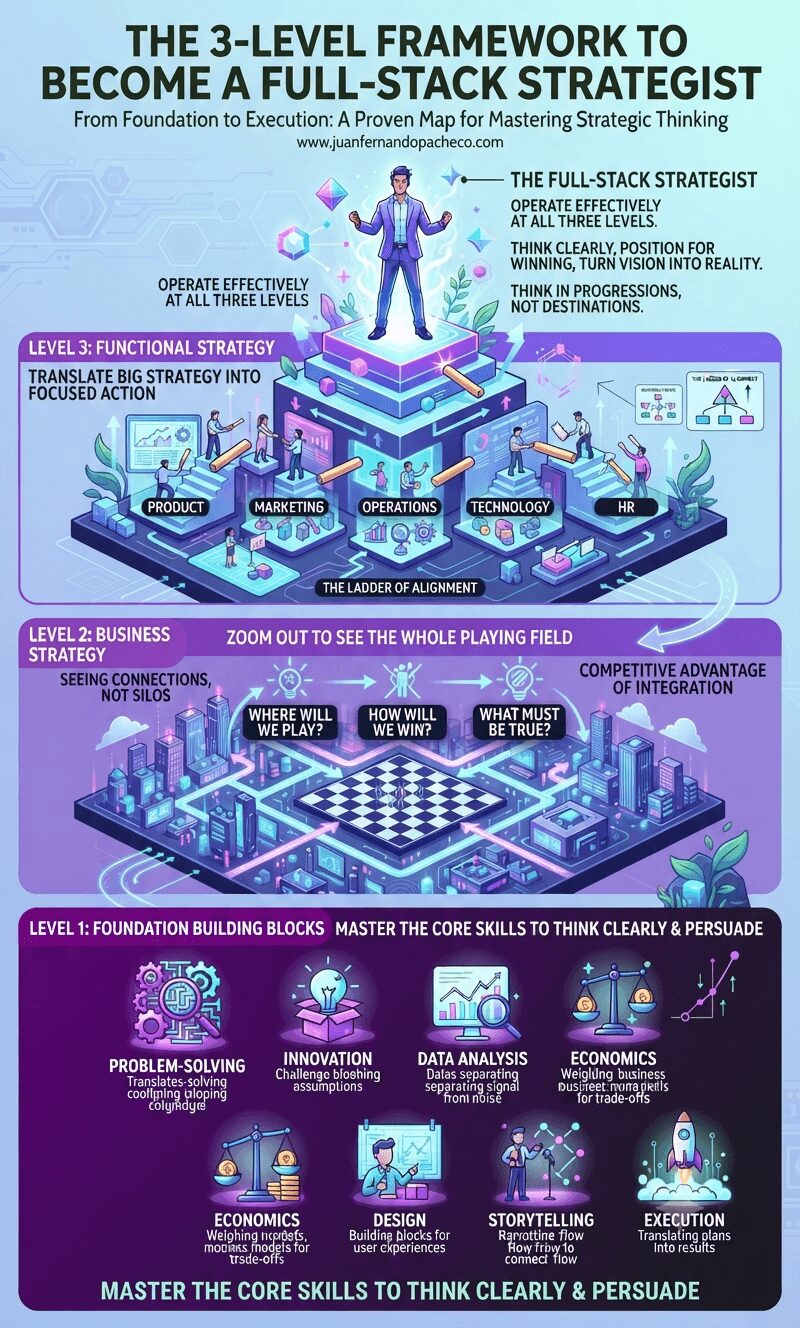
After years of working with organizations across industries and helping leaders develop strategic capabilities, I’ve found that the most effective approach to mastering strategy follows a simple 3-level map. This framework transforms strategy from an abstract concept into a concrete progression that builds from foundational thinking skills all the way to tactical execution.
Whether you’re an aspiring strategist, a leader looking to sharpen your strategic edge, or someone who just wants to understand how great strategies are built, this framework will serve as your guide.
Let’s decode the strategy together.
Why Most People Struggle with Strategy
Before we dive into the framework itself, let’s address the elephant in the room: why does strategy feel so intimidating?
The answer lies in how we typically approach it. Most people try to jump straight into crafting grand strategic visions without first developing the core skills needed to think strategically. It’s like trying to build the roof of a house before laying the foundation.
Strategy requires a specific set of mental models, analytical capabilities, and communication skills.
Without these building blocks, you’re left memorizing frameworks without truly understanding when or how to apply them. You end up with strategies that sound impressive in PowerPoint but fall apart in practice.
The 3-level framework solves this problem by providing a clear progression path. Each level builds on the previous one, ensuring you develop the right capabilities at the right time.
Level 1: Foundation Building Blocks – Master the Core Skills to Think Clearly and Craft Persuasive Stories
The foundation of strategic excellence isn’t a fancy framework or a proprietary methodology. It’s a set of seven core skills that enable you to think clearly, analyze situations rigorously, and communicate your ideas persuasively.
Think of these as your strategic toolkit. You’ll use them at every level of your strategic journey, and they compound in value over time.
1. Problem Solving: Break Down Complexity and Design Unique Solutions
Great strategists are exceptional problem solvers. But this isn’t about quick fixes or surface-level solutions. It’s about the ability to take a messy, ambiguous situation and break it down into its parts.
When you encounter a strategic challenge, your first instinct shouldn’t be to jump to solutions. Instead, ask:
- What’s the real problem here?
- What are the underlying dynamics?
- What assumptions are we making?
The best strategists resist the urge to rush. They sit with complexity, explore multiple angles, and only then design solutions that address root causes rather than symptoms.
2. Innovation: Spot Opportunities and Challenge Conventional Thinking
Strategy isn’t just about solving problems—it’s about seeing possibilities others miss. Innovation as a foundational skill means developing the ability to question conventional wisdom and spot opportunities hidden in plain sight.
This doesn’t mean being contrarian for the sake of contrarianism. It means asking:
- What if the opposite were true?
- What assumptions are everyone making that might be wrong?
- Where are the white spaces in the market?
The most powerful strategies often come from reframing the problem entirely, not from optimizing within existing constraints.
3. Data Analysis: Make Decisions Based on Evidence, Not Guesswork
In an age of information abundance, the ability to separate signal from noise is crucial. Data analysis as a strategic skill isn’t about becoming a data scientist—it’s about developing intellectual rigor.
You need to ask:
- What evidence supports this claim?
- Are we confusing correlation with causation?
- What data are we ignoring because it’s inconvenient?
Great strategists let evidence shape their thinking, not confirm their biases. They’re comfortable with ambiguity but refuse to be careless with facts.
4. Economics: Understand Trade-offs, Unit Economics, and Business Models
Strategy is fundamentally about choices, and every choice has an economic implication. You don’t need an MBA to think like an economist, but you do need to understand core concepts like trade-offs, opportunity costs, and unit economics.
When you evaluate a strategic option, ask:
- What are we giving up by choosing this path?
- What’s the economic logic?
- How does value get created and captured?
Strategies that ignore economic realities are just wishful thinking dressed up in strategic language.
5. Design: Shape Systems and Experiences That Work in the Real World
Strategy isn’t just about analysis—it’s about creating systems and experiences that actually work for real people. Design thinking brings empathy and iteration into the strategic process.
This means asking:
- Who are we serving?
- What do they actually need (versus what we think they need)?
- How might we prototype and test our ideas before going all-in?
The best strategies are designed with the end user in mind, not just the boardroom.
6. Storytelling: Craft Clear, Persuasive Narratives for Your Ideas
You can have the most brilliant strategy in the world, but if you can’t communicate it clearly and persuasively, it won’t matter. Storytelling is the bridge between strategic insight and organizational action.
This isn’t about manipulation or spin. It’s about structuring your ideas in a way that resonates emotionally and logically. It’s about making the complex simple without being simplistic.
Ask yourself:
- Can I explain this strategy in a way that a smart 12-year-old could understand?
- Does my narrative connect the dots between where we are, where we’re going, and why it matters?
7. Execution: Turn Plans into Results
Finally, a strategy without execution is just a hallucination. The ability to translate strategic intent into concrete action is itself a foundational skill.
This means thinking through:
- What specifically needs to happen?
- Who’s responsible?
- What resources are required?
- How will we measure progress?
Execution-oriented strategists don’t just design elegant strategies—they design strategies that can actually be implemented given real-world constraints.
Mastering these seven building blocks takes time, but it’s worth the investment.
They’re the foundation upon which everything else is built. Without them, you’re trying to do advanced strategy with beginner-level thinking tools.
Level 2: Business Strategy – Zoom Out to See the Whole Playing Field
Once you’ve developed your foundation, you’re ready to tackle business strategy. This is where you zoom out to see the whole playing field.
Business strategy is about winning. It’s the set of choices that positions you to win in the market.
But here’s the key insight: business strategy isn’t about optimizing individual parts—it’s about understanding how all the parts connect to create a coherent whole.
The Essence of Business Strategy
At its core, business strategy answers three fundamental questions:
- Where will we play? Which markets, segments, geographies, and channels will you compete in?
- How will we win? What unique value will you deliver, and what capabilities will enable you to deliver it better than anyone else?
- What must be true? What assumptions about the market, customers, competition, and your own capabilities must hold for this strategy to succeed?
These aren’t easy questions, and they require the foundational skills we discussed earlier. You need problem-solving to break down the competitive landscape, data analysis to understand market dynamics, economics to evaluate trade-offs, and storytelling to align the organization around your choices.
Seeing Connections, Not Just Components
One of the biggest mistakes leaders make is treating different aspects of their business as siloed initiatives. Marketing does its thing, product does its thing, operations does its thing—and somehow they expect the sum to be greater than the parts.
Business strategy is the discipline of seeing how everything connects.
- Your product decisions affect your marketing message.
- Your operational capabilities constrain or enable your value proposition.
- Your pricing strategy shapes your customer segments.
When you’re doing business strategy well, you’re constantly asking: How does this choice ripple through the rest of the system? Are we creating coherence, or are we creating contradictions?
The Competitive Advantage of Integration
The most powerful business strategies create self-reinforcing systems where each element strengthens the others.
Think about companies like Apple, Amazon, or Toyota. Their strategies aren’t just a collection of good tactics—they’re integrated systems where everything works together.
This integration is hard to replicate. Competitors might copy individual elements, but they can’t easily copy the entire system and the way the pieces fit together.
That’s the power of zooming out to see the whole playing field. You’re not just making isolated decisions—you’re designing a coherent system for winning.
Level 3: Functional Strategy – Translate Big Strategy into Focused Action
Now we arrive at the most specific level: functional strategy. This is where the rubber meets the road, where big strategic visions get translated into focused, actionable plans for each function of the business.
The Role of Functional Strategy
If business strategy is about seeing the whole playing field, functional strategy is about mastering your specific position on that field. Each function—brand, product, marketing, operations, technology, finance, HR—needs its own strategy that ladders up to the overall business strategy.
But here’s the critical point: functional strategies shouldn’t be created in isolation. They should be explicit translations of the business strategy into functional-specific choices and actions.
Making Strategy Specific
This is where strategy gets specific. You’re no longer talking in broad strokes about “where to play” and “how to win.” You’re answering questions like:
- Product Strategy: What features will we build? What’s our roadmap? How do we prioritize?
- Marketing Strategy: What messages will we communicate? Through which channels? To which audiences?
- Operations Strategy: How will we organize our workflows? What processes need optimization? Where do we invest in automation?
- Technology Strategy: What systems do we need? What’s our architecture approach? How do we balance innovation with stability?
Each of these functional strategies needs to be coherent on its own terms, but also aligned with the others and with the overarching business strategy.
The Ladder of Alignment
Think of it as a ladder. At the top, you have your business strategy—the overall game plan for winning. Below that, you have functional strategies that translate that game plan into functional-specific actions.
When the ladder is well-constructed, every rung supports the one above it.
- Your product decisions support your marketing message.
- Your operational capabilities enable your value proposition.
- Your technology investments fuel your innovation agenda.
But when the ladder is broken—when functional strategies are misaligned or working at cross-purposes—the whole structure becomes unstable. You get friction, waste, and strategies that fail to deliver results.
The Full-Stack Strategist
This brings us to the ultimate goal: becoming a full-stack strategist.
A full-stack strategist is someone who can operate effectively at all three levels.
- They have the foundational thinking skills to analyze situations rigorously and communicate persuasively.
- They can zoom out to see the whole playing field and design coherent business strategies. And
- They can zoom in to translate those strategies into functional-specific actions that actually get implemented.
Most people specialize in one level. They’re either great thinkers who struggle with execution, or they’re tactical doers who lose sight of the bigger picture. Full-stack strategists bridge this gap.
Putting the Framework into Practice
So how do you actually use this framework? Here’s my advice:
Start where you are.
If you’re early in your strategic journey, focus on Level 1. Develop those seven foundational skills. Read widely, practice relentlessly, and seek feedback. Don’t rush to craft grand strategies before you’ve built your thinking muscles.
Diagnose your gaps.
Where do you currently spend most of your time? Are you stuck in the tactical weeds without seeing the bigger picture? Or are you floating in strategic abstraction without translating ideas into action? The framework helps you see what you’re missing.
Build coherence across levels.
Whatever your role, ask yourself: How do my daily activities connect to the broader business strategy? What foundational skills do I need to strengthen to be more effective? Where are the misalignments between different levels?
Think in progressions, not destinations.
Becoming a full-stack strategist isn’t a one-time achievement. It’s a continuous journey of development. You’ll get better at some levels before others, and that’s okay. The key is intentional progression.
The Timeless Nature of Strategic Thinking
Here’s what I love about this framework: it’s evergreen. The specific tactics and tools will change—new technologies emerge, market dynamics shift, competitive landscapes evolve. But the fundamental levels of strategic thinking remain constant.
Five years from now, you’ll still need to think clearly and solve problems. You’ll still need to see the whole playing field and make coherent choices. You’ll still need to translate strategy into action.
That’s why investing in strategic capability is such a high-leverage activity. It’s not about learning the latest framework or memorizing case studies. It’s about developing enduring capabilities that compound in value throughout your career.
Your Strategic Journey Starts Now
Strategy doesn’t have to be a mystery. It’s not reserved for the anointed few in the corner office. It’s a learnable discipline that follows a logical progression.
Start with the foundation. Build your core thinking skills. Then learn to see the whole playing field and make coherent strategic choices. Finally, master the art of translating big strategy into focused functional action.
Do this consistently, and you’ll become what the world desperately needs: a full-stack strategist who can think clearly, position for winning, and turn vision into reality.
The framework is simple. The work is challenging. The payoff is worth it.
Now go decode your strategy.