How strategic perspective shifts unlock breakthrough solutions
In the late 1990s, Netflix faced an existential question:
Were they a DVD-by-mail company or something fundamentally different?
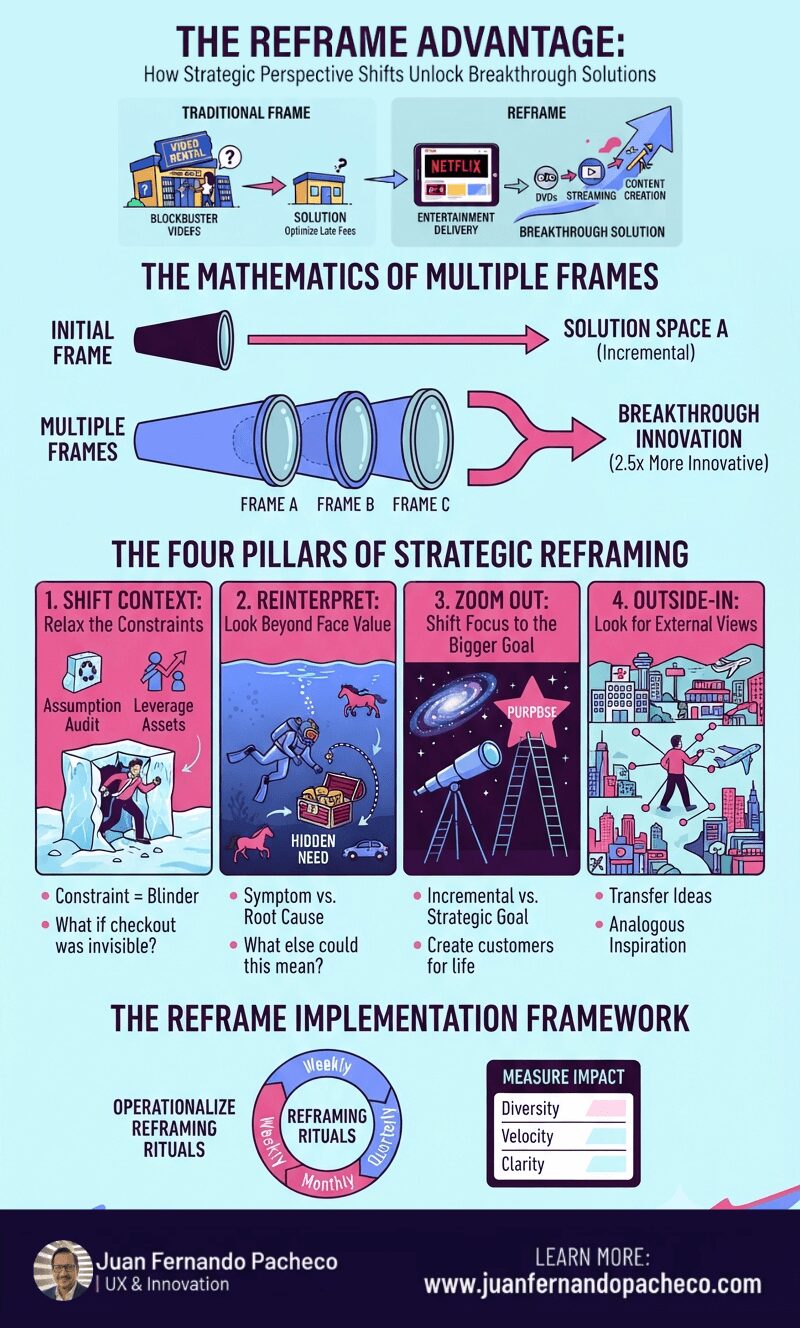
While Blockbuster saw itself as a video rental business competing on store locations and late fees, Netflix reframed the problem entirely. They weren’t in the “rental” business—they were in the “entertainment delivery” business. This single perspective shift eventually led them from DVDs to streaming to content creation, fundamentally disrupting an entire industry.
This is the power of reframing:
The deliberate practice of changing how you approach a problem so you can design creative solutions that deliver high value, even with limited resources.
As a strategist with many years of experience in UX design and product development, I’ve witnessed countless teams solve the wrong problems brilliantly. They optimize features nobody wants, build roadmaps based on faulty assumptions, and wonder why their “perfect” solutions fail in the market. The difference between incremental improvement and breakthrough innovation often isn’t better execution—it’s better framing.
The Mathematics of Multiple Frames
Consider this:
Every problem exists within a “frame”—a mental boundary that defines what’s possible.
When you approach a challenge through Frame 1, you generate Options A and B, which lead to Solution Space 1. But when you deliberately shift to Frame 2, you unlock Options C and D, opening an entirely different Solution Space 2.
The exponential impact becomes clear when you explore multiple frames systematically.
Research shows that teams that generate at least three distinct problem frames before solution-finding produce 2.5x more innovative outcomes than those who jump straight to solving the first formulation they encounter.
Yet most organizations remain trapped in their initial frame, optimizing within constraints that may not even exist. They’re solving for “How do we reduce customer service call volume by 10%?” when the real opportunity lies in “How do we eliminate the need for customers to call us at all?“
The Four Pillars of Strategic Reframing
After years of studying high-performing teams and analyzing strategic breakthroughs across industries, I’ve identified four core reframing techniques that consistently unlock breakthrough solutions. Each technique operates as a cognitive lever, allowing you to shift perspective systematically rather than hoping for random inspiration.
1. Shift Context: Relax the Constraints
The Core Principle: Every problem comes wrapped in implicit constraints—assumptions about resources, time, technology, or rules that may be entirely artificial. Shifting context means deliberately relaxing these constraints to see what becomes possible.
Why It Works: Constraints focus attention, but they also create blinders. When you’re told to “improve the checkout process by 15%,” you naturally focus on incremental tweaks. But when you ask, “What if checkout was completely invisible?” you enter a different solution space entirely. Amazon’s “Just Walk Out” technology didn’t come from optimizing cashier speed—it came from eliminating the checkout concept.
Practical Application:
Change the lens through which you view the problem.
If you’re designing a healthcare app, try viewing it through different lenses:
- Patient lens: What creates anxiety? Where do people feel vulnerable?
- Doctor lens: What information saves time? What reduces diagnostic errors?
- Insurance lens: What prevents fraud? What streamlines claims?
- Family lens: How does this affect caregivers? What creates peace of mind?
Each lens reveals different opportunity spaces. The breakthrough often comes from serving an underserved lens better than anyone else.
Look at the strengths you can leverage.
- Instead of starting with “What’s the problem?” ask “What unique assets do we have that others don’t?”
- Apple didn’t enter the phone market by asking, “How do we make a better phone?” They asked, “How do we leverage our design expertise, software capabilities, and ecosystem to reinvent mobile communication?“
Tool: Constraint Audit
- List every constraint you’re working within (budget, timeline, technology, regulations)
- For each constraint, ask: “Is this real or assumed?”
- Challenge the top three constraints: “What if this didn’t exist?”
- Explore solutions in the expanded space
Input: Current problem statement + perceived constraints
Output: Relaxed constraint framework + new opportunity areas
Reference: The Blue Ocean Strategy framework
2. Reinterpret: Look Beyond Face Value
The Core Principle: Problems are rarely what they first appear to be. The surface-level symptom often masks a deeper need, hidden opportunity, or completely different challenge. Reinterpretation means digging beneath the obvious to discover what’s really happening.
Why It Works: Henry Ford famously noted, “If I had asked people what they wanted, they would have said faster horses.” Customers don’t ask for radical innovation because they can’t imagine it—they ask for improvements to what they know. Your job as a strategist is to interpret the underlying need, not just the stated request.
Practical Application:
Ask “What else could this situation mean or imply?”
When Airbnb founders noticed their New York listings had poor photos, they didn’t just see a photography problem. They reinterpreted it: “People don’t trust strangers’ homes because the listings feel impersonal.” The solution wasn’t better cameras—it was professional photography that made spaces feel aspirational, transforming how people perceived “staying in a stranger’s home.”
Use the “What If” approach to flip assumptions. Try these powerful reframes:
- “What if this problem is actually a way to innovate?”
- “What if our biggest weakness is actually our secret advantage?”
- “What if the customer segment we’re ignoring is actually our future?”
- “What if the regulation constraining us actually protects our moat?”
When Southwest Airlines faced the constraint of only serving Texas initially, they didn’t see limitation—they saw the opportunity to perfect a low-cost, high-efficiency model before scaling. That “constraint” became their competitive advantage.
Tool: The Five Whys + Reframe Matrix
- State the problem clearly
- Ask “Why is this a problem?” five times to reach root cause
- At each level, ask “What else could this mean?”
- Map interpretations across a 2×2: Obvious vs. Hidden × Problem vs. Opportunity
Input: Surface-level problem statement
Output: Multiple interpretations + hidden opportunity areas
Framework: Toyota’s Five Whys adapted for strategic reframing
3. Zoom Out: Shift Focus to the Bigger Goal
The Core Principle: Most teams optimize for tactical metrics while losing sight of strategic purpose. Zooming out means regularly reconnecting to the fundamental “why” behind your work, then asking whether current efforts actually serve that higher goal.
Why It Works: Incremental goals produce incremental solutions. When you’re tasked with “improving quarterly retention by 3%,” you’ll tweak onboarding emails. When you’re tasked with “creating customers for life,” you rethink the entire value proposition.
The bigger goal demands bigger thinking.
Practical Application:
Remind yourself regularly why you’re doing this and what’s at stake.
Patagonia’s mission isn’t to sell jackets—it’s to “save our home planet.” This zoomed-out perspective led them to run ads saying “Don’t Buy This Jacket” on Black Friday, which paradoxically increased sales while building unprecedented brand loyalty among environmentally conscious consumers.
Ditch incremental goals for bigger strategic ones. Compare these goal frames:
- Incremental: “Reduce customer support tickets by 10%”
- Strategic: “Create a product so intuitive that support becomes unnecessary”
- Incremental: “Increase feature adoption by 15%”
- Strategic: “Become indispensable to our customers’ daily workflows”
- Incremental: “Improve NPS score from 40 to 50”
- Strategic: “Create such remarkable value that customers become evangelists”
The strategic frame doesn’t just inspire—it reveals entirely different solution paths. You don’t improve NPS by asking happier questions; you create evangelists by solving problems competitors ignore.
Tool: Goal Laddering
- Start with your current objective
- Ask “Why is this important?” (ladder up to purpose)
- Ask “How else could we achieve this purpose?” (ladder across to alternatives)
- Ask “What would make this 10x more impactful?” (ladder up to transformation)
Input: Current tactical goal
Output: Strategic purpose + alternative pathways + transformational opportunities
Case Study: Google’s evolution from “best search engine” to “organize the world’s information”
4. Outside-In: Look for External Views
The Core Principle: Internal perspectives create echo chambers. Teams immersed in their industry, company culture, and existing solutions develop tunnel vision. Outside-in thinking deliberately imports perspectives from external sources—other industries, disciplines, customer segments, or geographies.
Why It Works: Innovation is often just the transfer of ideas across boundaries. The restaurant reservation system came from airline booking systems. Surgical checklists came from aviation. Ride-sharing came from understanding that “taxi medallions” were an artificial constraint, not a business necessity.
Practical Application:
Seek external perspectives to avoid tunnel vision.
When the Cleveland Clinic wanted to improve patient experience, they didn’t just survey patients—they studied the Ritz-Carlton’s approach to hospitality and Apple’s approach to simplicity. This outside-in perspective led to radical changes in how they designed patient interactions, treating healthcare as hospitality rather than just medical treatment.
Gather input from other industries to learn fresh ideas and insights. Create a “cross-industry inspiration matrix”:
- Industry: What company delivers exceptional [speed/reliability/experience]?
- Discipline: How would a game designer/anthropologist/architect approach this?
- Segment: How do teenagers/elderly/international users solve this differently?
- Extremes: What do the most demanding users need that others don’t?
When designing financial services for millennials, don’t just study banks—study how Spotify creates personalized experiences, how Instagram builds community, and how Uber removes friction.
Tool: Analogous Inspiration Sessions
- Identify the core challenge (e.g., “improve onboarding”)
- Research how 5 different industries solve similar challenges (hotels check guests in, airlines board planes, restaurants seat diners)
- Extract principles from each (anticipation, efficiency, hospitality)
- Adapt principles to your context
Input: Internal challenge
Output: Cross-industry principles + adapted solutions + fresh perspectives
Reference: IDEO’s approach to analogous inspiration
The Reframe Implementation Framework
Understanding these four techniques is one thing; embedding them into your strategic practice is another. Here’s how to operationalize reframing:
Create Reframing Rituals
Weekly: Dedicate 30 minutes to reframe one active challenge using a different technique each week. Rotate through Shift Context, Reinterpret, Zoom Out, and Outside-In.
Monthly: Host a “Frame Storm” session where the team generates at least 5 different ways to frame the quarter’s biggest challenge before discussing any solutions.
Quarterly: Conduct a “Frame Audit” reviewing major initiatives. Ask: “Are we solving the right problem? What frame are we operating from? What frames are we ignoring?”
Build Reframing Muscle
Individual Practice:
- Keep a “Frame Journal” documenting how you initially frame problems and how those frames evolve
- Read outside your domain—one book quarterly from an unrelated field
- Practice “frame switching” on low-stakes problems to build the habit
Team Practice:
- Assign a “Frame Challenger” role in meetings—someone responsible for questioning problem definitions
- Create a “Frame Library” documenting different ways your team has successfully reframed challenges
- Reward reframing breakthroughs as much as solution breakthroughs
Measure Reframing Impact
Track these metrics to ensure reframing drives results:
- Frame Diversity: How many distinct problem frames do you explore before solution-finding?
- Solution Space Expansion: Do reframed problems lead to more innovative solutions?
- Resource Efficiency: Are you achieving better outcomes with the same resources through better framing?
- Strategic Clarity: Does reframing help teams align on what really matters?
The Compound Effect of Reframing
The most powerful aspect of strategic reframing isn’t the immediate solution it unlocks—it’s the compound effect on your strategic thinking over time. Teams that practice reframing consistently develop:
Pattern Recognition: You start seeing frames everywhere—recognizing when you’re trapped in limiting assumptions or when others are solving the wrong problems.
Cognitive Flexibility: You become comfortable holding multiple perspectives simultaneously, switching between frames fluidly as situations demand.
Strategic Confidence: You stop fearing “not knowing the answer” because you trust your ability to reframe challenges until solutions emerge.
Innovation Velocity: You generate breakthrough ideas faster because you’re not stuck optimizing within broken frames.
Your Reframe Challenge
Here’s your immediate next step: Take your most pressing strategic challenge and apply all four reframing techniques before your next team meeting.
- Shift Context: What constraints can you relax? What strengths can you leverage differently?
- Reinterpret: What else could this problem mean? What if it’s actually an opportunity?
- Zoom Out: What’s the bigger goal? Why does this really matter?
- Outside-In: How do other industries solve this? What external perspectives would help?
Document each frame and the solution spaces they reveal. You’ll likely discover that your initial frame was just one of many possible approaches—and that better frames lead to better solutions.
The Long-Term Advantage
In a world where competitors can copy features, replicate processes, and hire away talent, your ability to see problems differently remains a sustainable competitive advantage. Reframing isn’t just a technique—it’s a strategic capability that compounds over time.
The teams and leaders who master reframing don’t just solve problems better; they solve better problems. They escape the trap of incremental optimization and unlock breakthrough innovation. They achieve more with less because they’re working on the right challenges from the start.
As you develop this capability, remember: The quality of your solutions is determined by the quality of your frames. Invest in reframing, and you invest in your strategic future.
Further Reading:
- Reframing by J. Richard Hackman (Harvard Business Review)
- The Art of Looking Sideways by Alan Fletcher
- Think Like a Rocket Scientist by Ozan Varol
- Range by David Epstein
- Blue Ocean Strategy by W. Chan Kim and Renée Mauborgne