Mastering the Hierarchy of Understanding for Strategic Breakthroughs
We live in an age of information abundance but insight scarcity.
Every day, you’re bombarded with data points, metrics, user feedback, market research, analytics dashboards, and stakeholder opinions. Yet despite having more information than ever before, many strategists, designers, and leaders struggle to make decisions with confidence.
The problem isn’t a lack of data—it’s a failure to climb the hierarchy of understanding.
There’s a critical difference between having information and having understanding. Between collecting data points and generating insights that drive action. This distinction separates good strategists from great ones. And it’s the skill that will determine whether you merely participate in your field or truly shape its future.
The Three Levels of Strategic Thinking
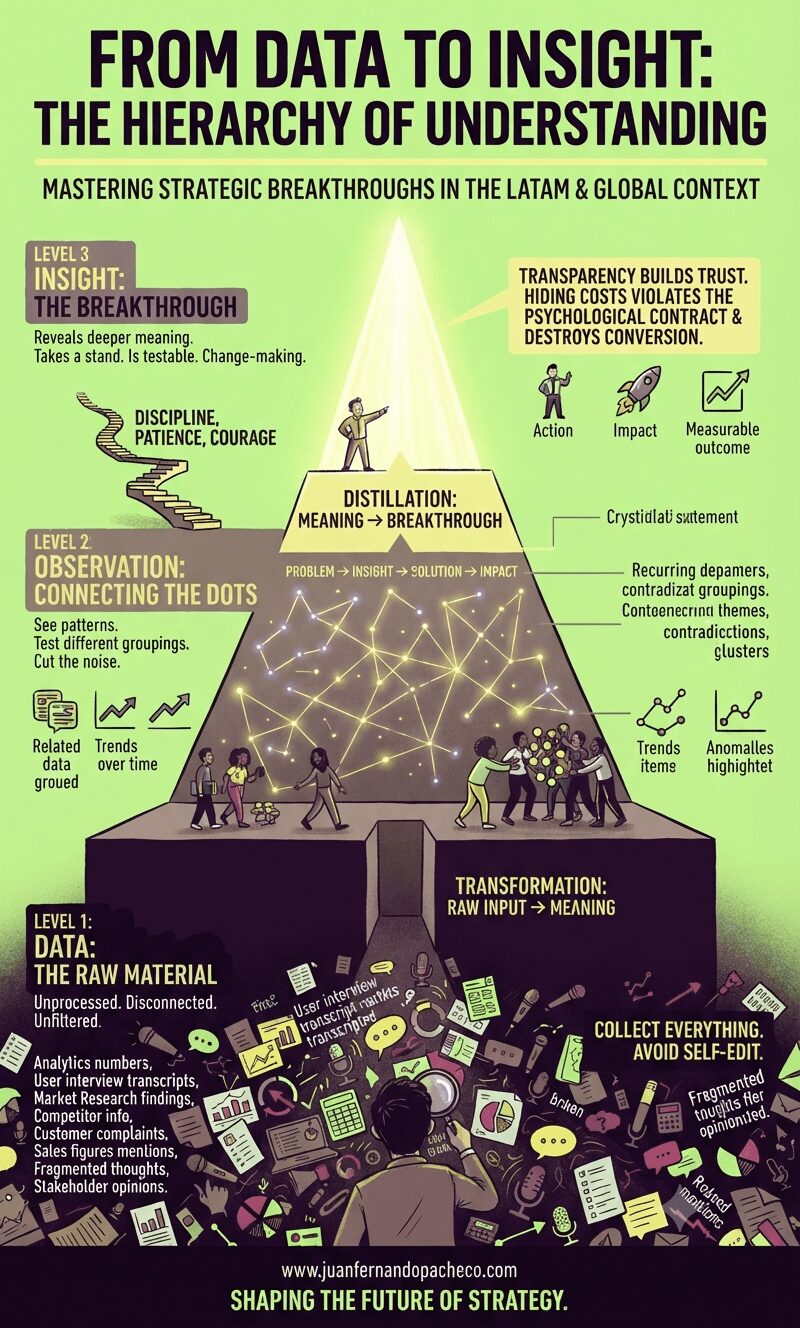
The hierarchy of understanding consists of three distinct levels: Data, Observation, and Insight. Each level represents a qualitative shift in how you process information and create meaning. Moving up this hierarchy is the essential work of strategy.
Think of it as a transformation process:
- Raw Input → Meaning → Breakthrough
Most people get stuck at the bottom. They confuse having data with having understanding. They present observations as if they were insights. And they wonder why their recommendations don’t move the needle.
Let’s explore each level in detail and learn how to master the ascent.
Level 1: Data — The Raw Material
At the base of the hierarchy sits Data—the raw, disconnected, and unfiltered thoughts, facts, and fragments you collect. This is your starting point, not your destination.
What Data Really Is
Data is everything you know before you’ve made sense of it:
- User interview transcripts
- Analytics numbers
- Market research findings
- Competitor information
- Customer complaints
- Sales figures
- Social media mentions
- Stakeholder opinions
- Your own scattered notes and observations
The critical characteristic of data at this stage is that it’s unprocessed. It hasn’t been organized, prioritized, or connected. It’s the raw material from which insights will eventually emerge.
The Data Collection Mindset
At this level, your job is simple but crucial: dump everything out.
Resist the temptation to self-edit. Don’t worry about whether something seems important or irrelevant. Don’t try to organize or categorize yet. Just get it all on the page.
This requires intellectual humility. You must acknowledge that you don’t yet know what matters. What seems trivial today might be the key to tomorrow’s breakthrough. What appears important might prove irrelevant once patterns emerge.
Essential Questions for the Data Stage
Ask yourself:
- What am I trying to say? This forces you to articulate your purpose, even if the answer isn’t clear yet.
- What matters most? This begins the process of prioritization, though you’ll refine your answer as you ascend the hierarchy.
The mistake most people make here is rushing through data collection. They want to jump straight to conclusions. They filter too early, discarding information that doesn’t fit their preconceptions. This is premature optimization, and it kills insight before it can be born.
The Data Trap
Beware: many professionals spend their entire careers at the data level. They present facts without meaning. They share metrics without interpretation. They confuse volume with value.
A report full of charts and numbers is not insight. It’s just data dressed up in expensive clothing.
Level 2: Observation — Connecting the Dots
Once you’ve gathered your raw material, you begin the work of transformation. This is where you move from Data to Observation—where ideas are given shape and you start connecting the dots to spot patterns.
The Art of Pattern Recognition
Observation is where meaning begins to emerge. You’re no longer looking at individual data points in isolation. Instead, you’re stepping back to see the constellation they form.
This requires a shift in perspective:
- From the specific to the general
- From the individual to the collective
- From the isolated to the interconnected
You’re looking for:
- Recurring themes
- Contradictions and tensions
- Clusters of related information
- Gaps and absences
- Relationships between seemingly unrelated elements
- Trends over time
- Anomalies that don’t fit the pattern
Creating Your Skeleton
At the observation stage, you need structure. Create a skeleton that organizes your thinking:
Problem → Insight → Solution → Impact
This framework forces you to move beyond description toward causation. You’re not just noting what’s happening; you’re beginning to understand why it matters and what might be done about it.
The Iterative Nature of Observation
Here’s where many people fail: they get attached to their first version. They spot one pattern and stop looking. They find one explanation and defend it fiercely.
But observation is inherently iterative. You must:
- Move ideas around — Don’t be precious about your initial organization
- Test different patterns — What if you grouped these differently?
- Challenge your assumptions — What are you taking for granted?
- Seek disconfirming evidence — What would prove you wrong?
Cutting the Noise
Observation also requires subtraction. You must:
- Cut jargon — Replace buzzwords with clear language
- Combine overlaps — If two observations say the same thing, merge them
- Eliminate the trivial — Not everything you collected matters
This is difficult work because it requires judgment. You’re making choices about what to keep and what to discard. You’re imposing order on chaos.
The Observation Plateau
Many strategists get stuck at the observation level. They’re excellent at identifying patterns and organizing information. They create beautiful frameworks and comprehensive analyses.
But they never quite reach the breakthrough. They describe what’s happening without revealing why it matters. They present patterns without extracting the deeper truth.
Observation is necessary but insufficient. It’s the middle step, not the final destination.
Level 3: Insight — The Breakthrough
At the top of the hierarchy sits Insight—where your message becomes distilled, precise, and persuasive. This is where understanding crystallizes into something actionable and transformative.
What Makes an Insight
An insight is not just another observation. It has specific characteristics:
- It reveals deeper meaning — An insight goes beneath the surface to expose the underlying truth. It answers the “why” behind the “what.”
- It has a distinct point-of-view (POV) — An insight takes a stand. It’s not neutral or balanced. It’s a specific interpretation that not everyone will agree with—and that’s exactly what makes it valuable.
- It’s testable — You should be able to validate your insight. Can someone unfamiliar with your work understand it and explain it back? Does it hold up when challenged?
The Distillation Process
Reaching insight requires ruthless distillation. You must compress everything you’ve learned into its essence. This is where you:
- Strip away everything non-essential
- Find the one thing that matters most
- Articulate the core truth that changes everything
Think of it like compressing a gas into a liquid. The substance is the same, but the density has increased dramatically. An insight contains immense power in a small package.
The Test of Insight
How do you know if you’ve truly reached insight? Ask yourself:
Can I explain this to someone unfamiliar with the work, and can they explain it back to me?
If the answer is no, you haven’t distilled enough. You’re still at observation, not insight.
Another test: Does this insight change how we act? If your insight doesn’t lead to different decisions or behaviors, it’s merely an interesting observation.
The Courage to Commit
Insight requires courage because it demands commitment. At the data level, you can hide behind facts. At the observation level, you can present multiple interpretations. But insight forces you to choose. You must say:
“This is what I believe is true, and here’s why it matters.”
This makes you vulnerable. You could be wrong. People might disagree. But without this commitment, you’ll never generate the breakthroughs that separate good strategy from great strategy.
Moving Up the Hierarchy: Practical Strategies
Understanding the hierarchy is one thing. Actually climbing it is another. Here are proven strategies to help you ascend:
1. Give Each Level Its Due
Don’t rush through data collection. Don’t skip the messy work of pattern recognition. And don’t stop short of true insight.
Each level requires different thinking:
- Data: Divergent, expansive, non-judgmental
- Observation: Analytical, organizational, iterative
- Insight: Convergent, decisive, bold
2. Create Physical Distance
Your environment shapes your thinking. Try this:
- Spread your data across a large wall or table
- Step back physically to see patterns
- Move closer to examine details
- Change your location entirely when you’re stuck
The hierarchy of understanding is also spatial. You need room to move.
3. Use Time as a Tool
Don’t try to climb the hierarchy in one sitting. Let your thinking marinate:
- Collect data in one session
- Sleep on it before looking for patterns
- Step away before forcing insight
- Return with fresh eyes
Your subconscious mind continues working even when you’re not actively thinking about the problem. Trust this process.
4. Seek External Perspective
You can’t see your own blind spots. Regularly test your thinking:
- Share your data with someone else and ask what patterns they see
- Present your observations to a colleague and ask what insight they’d draw
- Explain your insight to someone unfamiliar with the work
If they can’t follow your logic, you haven’t climbed the hierarchy effectively.
5. Practice the Ladder Exercise
Take any piece of information and consciously move it up the hierarchy:
Data: “Users are abandoning their shopping cart at a 70% rate”
Observation: “Users abandon carts when they encounter unexpected shipping costs at checkout”
Insight: “Transparency builds trust—hiding costs until the end of the journey violates the psychological contract and destroys conversion”
See how each level adds meaning and specificity?
¿Why does the hierarchy matter now more than ever?
In 2026 and beyond, the ability to climb the hierarchy of understanding is not just valuable—it’s essential. Here’s why:
Information Overload
We have more data than ever before. AI tools can process millions of data points in seconds. Analytics platforms track every click, scroll, and hesitation.
But more data doesn’t automatically create more understanding. In fact, without the discipline to climb the hierarchy, more data creates more confusion.
The Commoditization of Analysis
Basic analysis is becoming automated. AI can identify patterns, generate reports, and even suggest correlations. What AI cannot do—and what will become increasingly valuable—is generate true insight.
Insight requires human judgment, context, and the courage to take a position. This is your competitive advantage.
The Cost of Shallow Thinking
When you present data instead of insight, you waste everyone’s time. Decision-makers are drowning in information and starving for wisdom. They don’t need more facts; they need clarity.
Every time you fail to climb the hierarchy, you contribute to decision paralysis. You add to the noise instead of creating signal.
The Evergreen Principle
Here’s what makes the hierarchy of understanding evergreen: The fundamental challenge of transforming information into insight will never change.
Technology will evolve. Tools will improve. Data sources will multiply. But the cognitive work of moving from raw input to breakthrough understanding will always require:
- Discipline to collect without filtering too early
- Patience to sit with complexity while patterns emerge
- Courage to distill and commit to a point-of-view
These are human capabilities that no tool can replace.
Your Call to Action
Stop confusing data with insight. Stop presenting observations as if they were breakthroughs. Start doing the hard work of climbing the hierarchy of understanding.
Your next project, your next strategy, your next breakthrough depends on it.
Begin today:
- Take a current challenge you’re working on
- Audit where you are in the hierarchy
- Identify what’s keeping you stuck at your current level
- Take one concrete step to move up
The difference between a good strategy and a great strategy isn’t more information. It’s a better understanding.
Master the hierarchy. Generate insights that matter. Create breakthroughs that last.