The ultimate guide to writing that drives action
After many years of working with product teams, conducting user research, and translating complex business requirements into user-centered solutions, I’ve discovered one universal truth
The quality of your thinking is only as good as your ability to communicate it.
I’ve witnessed brilliant designers lose stakeholder buy-in because their proposals were buried under layers of jargon. I’ve seen innovative products fail to gain traction because their value propositions were scattered across endless slides. And I’ve watched talented professionals exhaust themselves trying to explain ideas that should have been obvious from the start.
The difference between success and failure often isn’t the idea itself—it’s the writing.
The Hidden Cost of Clunky Writing
In our field, we obsess over user experience, information architecture, and interaction design. Yet we often neglect the foundational skill that determines whether our work gets adopted, funded, or implemented: clear writing.
Clunky writing isn’t just an aesthetic problem. It’s a strategic failure that creates real business costs:
- Stakeholders tune out when they can’t quickly grasp your main point
- Teams misalign when priorities are buried in ambiguous language
- Users abandon products when instructions are scattered and confusing
- Ideas die when they’re forgettable and fail to create impact
When I review product documentation, design rationales, or strategy decks, I see the same four patterns that separate clunky writing from clear writing. Understanding these patterns—and how to transform them—will fundamentally change how your work is received.
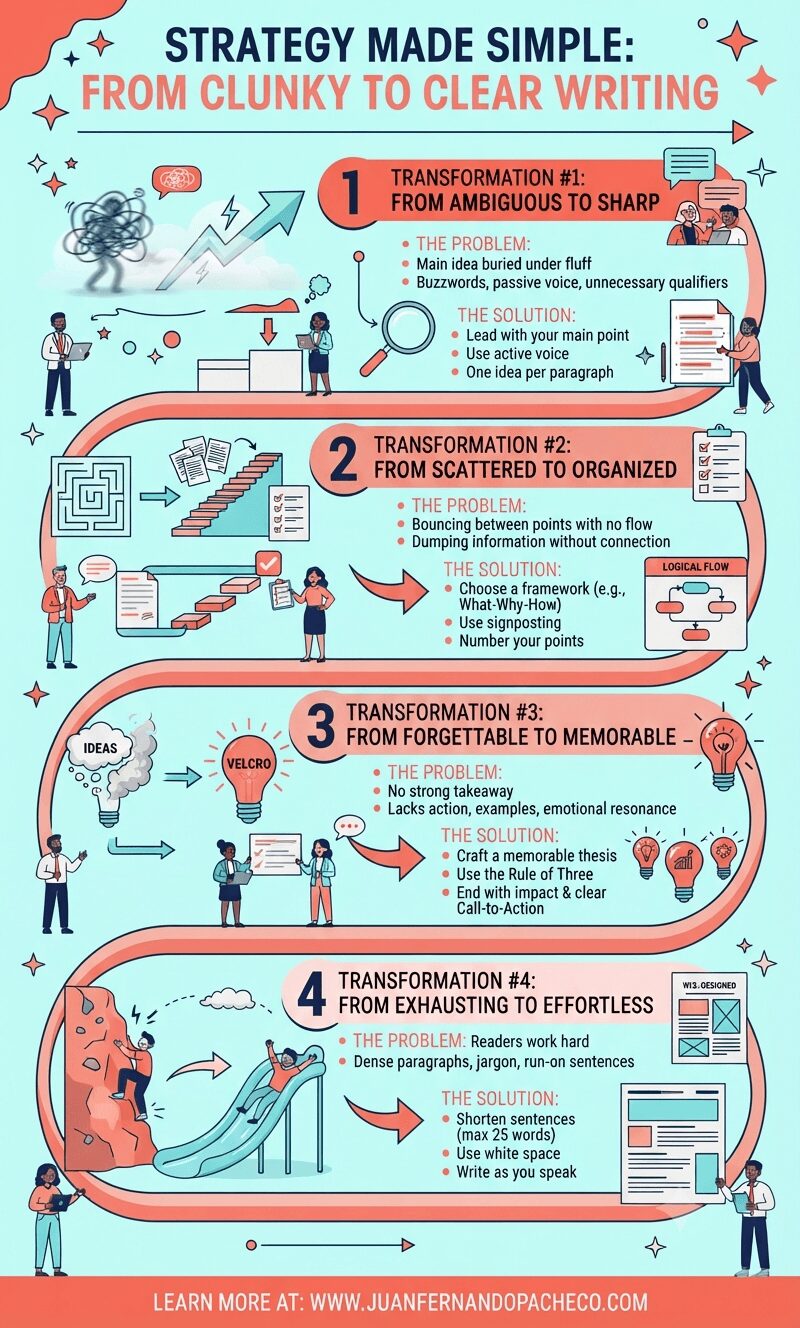
The four transformations of clear writing
#1: From Ambiguous to Sharp
The Problem: Your main idea is buried under layers of fluff.
I recently reviewed a 40-page product requirements document in which the core feature was mentioned on page 23, buried among paragraphs about “leveraging synergies” and “optimizing touchpoints.” The team had spent six months building something nobody understood.
This is ambiguous writing. It hides behind:
- Vague corporate buzzwords
- Unnecessary qualifiers (“potentially,” “possibly,” “in some cases”)
- Passive voice that obscures who does what
- Multiple ideas competing for attention in the same sentence
The Solution: Make your core message obvious and easy to grasp.
Sharp writing cuts through the noise. Here’s how to achieve it:
Lead with your main point. Don’t build up to it—start with it. If you’re writing a design rationale, begin with:
We’re changing the checkout flow because 67% of users abandon at the shipping calculation step.
Not:
In considering various optimization opportunities across the user journey…
- Use active voice. “The team will launch the feature in Q3” is stronger than “The feature will be launched in Q3 by the team.“
- Eliminate weasel words. If you write “significantly improve,” specify how much. If you say “users prefer it,” show the data.
- One idea per paragraph. Give each concept room to breathe. When you cram multiple ideas together, readers can’t tell what matters most.
I apply this principle to every UX case study I write. The first sentence tells you exactly what problem we solved and for whom. Everything else supports that statement.
#2: From Scattered to Organized
The Problem: You bounce between points with no clear flow.
Scattered writing feels like a conversation with someone who keeps changing the subject.
You’re reading about user research findings, then suddenly you’re looking at technical architecture, then back to competitor analysis, then to budget concerns—with no transitions or logical connections.
This happens when writers haven’t structured their thinking before they start typing. They dump everything they know onto the page, hoping readers will connect the dots.
The Solution: Build every point on the last in a logical flow.
Organized writing follows a deliberate structure. Readers should feel like they’re climbing a staircase, not wandering through a maze.
Choose a framework and stick to it. Common structures include:
- Problem → Solution → Impact (for proposals)
- Context → Insight → Recommendation (for research)
- Situation → Complication → Resolution (for case studies)
- What → Why → How (for explanations)
Use signposting. Tell readers where you’re going:
First, we’ll examine the user research. Then, we’ll explore three design options. Finally, we’ll recommend the optimal solution.
Create bridges between sections. End each section with a sentence that leads to the next. “Understanding the problem is only half the battle. Now let’s explore how we solved it.”
Number your points. When you have multiple arguments or findings, number them. It creates visual structure and helps readers track progress.
In my product strategy documents, I use a consistent hierarchy:
- Executive Summary
- Market Context
- User Needs
- Solution Approach
- Implementation Plan
- Success Metrics.
Every stakeholder knows exactly where to find what they need.
#3: From Forgettable to Memorable
The Problem: No strong takeaway the reader can hold on to.
I’ve read countless design portfolios, strategy memos, and product briefs that were technically competent but completely forgettable. A week later, I couldn’t recall a single key point.
Forgettable writing lacks:
- A clear call-to-action
- Concrete examples that stick
- Emotional resonance
- A memorable framework or phrase
The Solution: Deliver your message with impact that lingers.
Memorable writing creates mental Velcro—ideas that stick to your reader’s brain.
Craft a memorable headline or thesis. “Clear writing brings structure to your thoughts” is more memorable than “The importance of effective communication in business contexts.”
Use the rule of three. People remember things in threes (benefits, examples, steps).
The brain loves this pattern.
Include specific, vivid examples. Instead of “improved user engagement,” write “reduced checkout time from 8 minutes to 90 seconds, increasing conversion by 34%.”
Create a sticky phrase or framework. “The Four Transformations” is easier to remember than “several improvements to consider.”
End with impact. Your conclusion shouldn’t just summarize—it should inspire action. Tell readers exactly what to do next and why it matters.
When I lead design thinking workshops, I don’t just explain empathy mapping. I give participants a phrase they’ll remember: “You are not your user.” Three years later, they still quote it.
#4: From Exhausting to Effortless
The Problem: Readers work hard to understand it.
Exhausting writing makes readers feel like they’re doing heavy lifting. They encounter:
- Dense paragraphs with no white space
- Jargon they have to decode
- Sentences that run on for three lines
- Acronyms they don’t know
- Concepts explained in abstract terms
When reading feels like work, people stop reading.
The Solution: Make reading feel smooth and intuitive.
Effortless writing respects the reader’s cognitive load. It feels like sliding down a water slide, not climbing a rock wall.
Shorten your sentences. If a sentence runs over 25 words, break it in two. Vary sentence length for rhythm, but favor brevity.
Use white space strategically. Large blocks of text intimidate readers. Break content into digestible chunks with headers, bullet points, and paragraph breaks.
Define your terms. If you must use technical language, explain it on first use. Better yet, use plain language from the start.
Write as you speak. Read your writing aloud. If it sounds unnatural or stiff, rewrite it. Clear writing converses; it doesn’t lecture.
Use formatting as a guide. Bold key terms. Use italics for emphasis. Create lists for sequences. Visual hierarchy helps readers scan and comprehend faster.
I apply this principle to every UX deliverable I create. My research reports use clear headers, pull quotes for key findings, and visual callouts for data. Stakeholders can skim the document in five minutes or dive deep for details—both experiences are effortless.
Why This Matters for Designers and Strategists
You might be thinking, “I’m a designer, not a writer.” But in 2026, that distinction is meaningless.
Every design decision requires justification. Every strategy needs articulation. Every user research finding demands synthesis. Every product concept needs a narrative.
Your design is only as strong as your ability to communicate it.
- When you present a UX case study, you’re writing.
- When you document a design system, you’re writing.
- When you craft a product vision, you’re writing.
- When you write user stories or acceptance criteria, you’re writing.
The professionals who advance fastest aren’t always the most talented designers—they’re the ones who can clearly articulate their thinking, persuade stakeholders, and rally teams around a shared vision.
Your Action Plan: Start Today
Don’t wait for a big project to practice clear writing. Start now:
Weekly: Take one document you’re working on—a design brief, a strategy memo, a case study. Apply one transformation. Make the main point sharper. Reorganize the flow. Add a memorable takeaway. Break up dense paragraphs.
Monthly: Audit your last three written deliverables. Where are they clunky? Where are they clear? Ask a colleague to read one and tell you the main point in one sentence. If they can’t, you’ve found your improvement area.
Quarterly: Build a writing checklist based on the four transformations. Before sending any important document, run it through:
- ✓ Is the main point obvious in the first paragraph?
- ✓ Does the structure follow a logical flow?
- ✓ Is there one memorable takeaway?
- ✓ Can someone skim this in 2 minutes and get it?
Yearly: Make clear writing a core competency. Read one book on writing. Take one course. Practice daily. Your career will thank you.
The Compound Effect of Clear Writing
Here’s what happens when you commit to clear writing:
Your designs get approved faster. Your strategies get funded. Your research gets acted upon. Your ideas spread. Your influence grows.
But more importantly, clear writing forces clear thinking. When you struggle to explain something simply, it reveals gaps in your own understanding. The act of writing clearly makes you a better designer, strategist, and problem-solver.
In a world drowning in information, clarity is a superpower. Most people write to impress. Write to express. Most people hide behind complexity. Choose simplicity. Most people accept clunky communication. Commit to clarity.
Your ideas matter. Make them impossible to ignore.
Ready to transform your communication? Start with one document today. Apply one transformation. Share your progress in the comments below.