The Why-What-How Framework for Winning Strategies
Let me ask you something:
How many times have you sat through a strategy meeting that left you more confused than when you started? You’re not alone.
Most organizations struggle with strategy, not because they lack smart people or good ideas, but because they lack clarity.
After years of working with leaders across industries, I’ve discovered that every winning strategy shares one fundamental characteristic: it starts with crystal-clear thinking. And the simplest way to achieve that clarity is through a three-part framework that I call the Why-What-How formula.
This isn’t just another strategic planning model. It’s a practical approach that cuts through complexity and helps you build sharper, smarter strategies that actually work. Whether you’re leading a startup, managing a department, or steering an enterprise transformation, this framework will help you move from where you are to where you want to be with purpose and precision.
The Foundation: Why Strategy Needs Simplicity
Before we dive into the framework itself, let’s address a critical issue.
Too many organizations treat strategy as a complex, mysterious discipline reserved for C-suite executives and expensive consultants.
They create hundred-page documents filled with jargon, matrix diagrams, and buzzwords that nobody understands.
The result? Strategy becomes disconnected from execution. People don’t understand what they’re supposed to do differently, so they keep doing what they’ve always done. The strategy sits on a shelf, gathering dust while the organization drifts aimlessly.
A great strategy isn’t complicated. It’s clear. It’s compelling. It’s actionable. And it all starts with answering three fundamental questions in the right order.
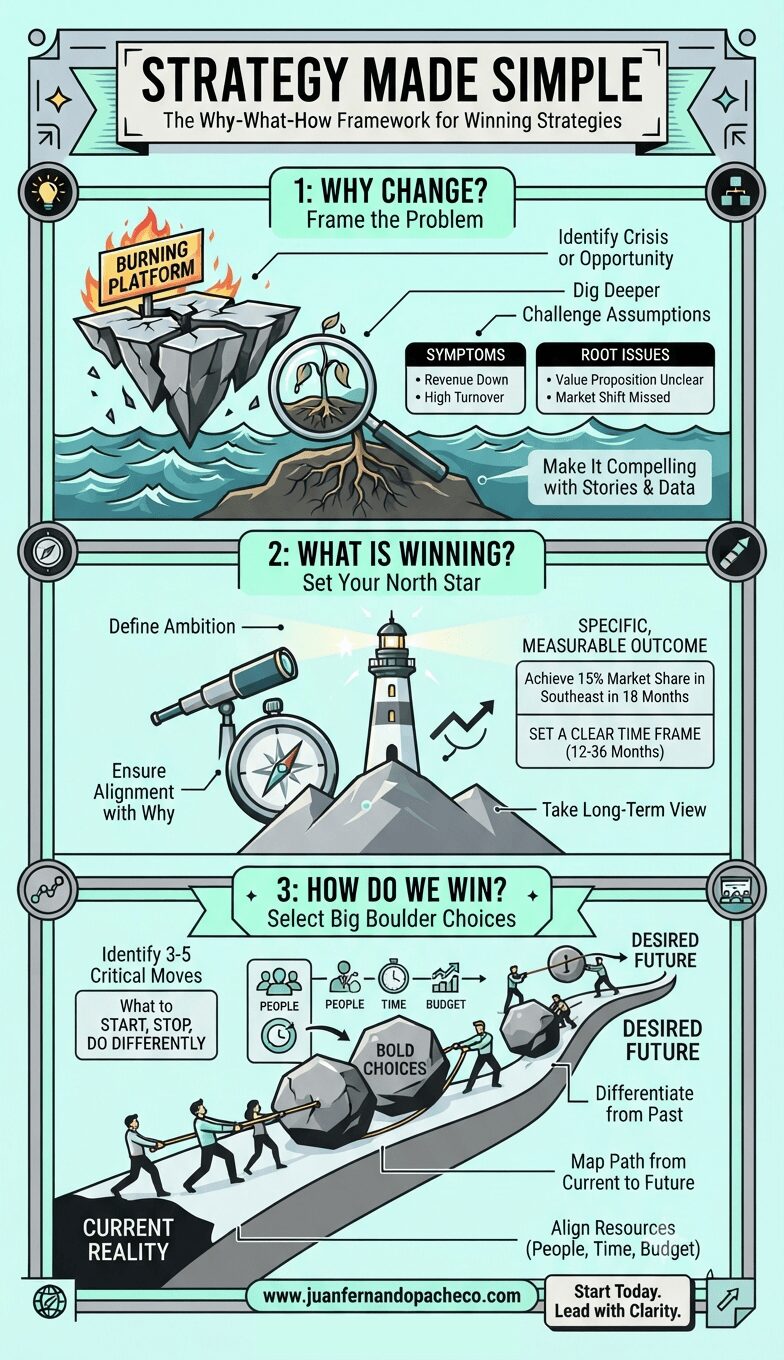
Step 1: WHY Change? Frame the Problem and Its Urgency
Every great strategy begins with a simple but powerful question: Why change?
This isn’t about justifying change for change’s sake. It’s about identifying the burning platform or the unmissable opportunity that makes action imperative. Without a compelling why, even the best strategies will fail because people won’t have the motivation to push through the inevitable challenges.
Understanding the Burning Platform
The concept of a “burning platform” comes from a famous story about an oil rig worker who jumped into the freezing North Sea rather than stay on a burning platform. Sometimes, the pain of staying the same becomes greater than the fear of change. That’s when real transformation happens.
But your burning platform doesn’t have to be a crisis. It can also be an opportunity you simply can’t afford to miss.
- Maybe it’s a new technology that could revolutionize your industry.
- Maybe it’s a shifting customer expectation that creates a window for differentiation.
- Maybe it’s a competitive threat that demands a response.
Whatever it is, you need to articulate it with absolute clarity.
Zeroing In on the Real Issue
Here’s where many leaders go wrong: they focus on symptoms instead of root causes.
- Revenue is down, so they launch a cost-cutting initiative.
- Customer satisfaction scores are slipping, so they implement a new CRM system.
- Employee turnover is high, so they increase salaries.
These responses might provide temporary relief, but they don’t address the underlying problem. To frame the problem correctly, you need to dig deeper. Ask “why” five times. Challenge assumptions. Look at the data. Talk to customers. Listen to employees.
For example, if revenue is down, the real issue might be that your value proposition no longer resonates with your target market. Or that a competitor has fundamentally changed the rules of the game. Or that customer needs have evolved, and you haven’t kept pace.
The difference between addressing symptoms and solving root problems is the difference between temporary fixes and lasting transformation.
Making It Compelling
Once you’ve identified the real issue, you need to make it compelling. This is where storytelling meets data. You need to show what’s at stake if nothing changes. Paint a vivid picture of the future if you stay on your current path versus the future if you take action.
- Use concrete numbers, but don’t rely on numbers alone.
- Share customer stories.
- Highlight competitive moves.
- Show market trends.
- Make it real and make it urgent.
Remember, urgency doesn’t mean panic. It means creating a sense of purposeful momentum that motivates people to act now rather than later.
Step 2: WHAT Is Winning? Set Your North Star
Once you’ve established why change is necessary, the next question is: What is winning?
This is where you set your ambition—your north star. It’s the clear outcome that people can rally around, the destination that gives direction to all your efforts. Without a well-defined what, even the most motivated team will scatter their energy in different directions.
Choosing a Specific, Measurable Outcome
Vague aspirations like “be the best” or “increase growth” don’t work. They’re too ambiguous to guide decision-making or measure progress.
Your definition of winning needs to be specific and measurable.
Instead of “improve customer satisfaction,” try “achieve a Net Promoter Score of 70+ by Q4 2029.” Instead of “expand market presence,” try “capture 15% market share in the Southeast region within 18 months.“
Specificity creates clarity. Clarity enables focus. Focus drives results.
Setting a Clear Time Frame
Ambition without a deadline is just a dream.
You need to set a clear time frame that creates urgency without being unrealistic.
This timeframe should be long enough to allow for meaningful transformation but short enough to maintain momentum and accountability.
For most strategic initiatives, a 12-36 month horizon works well. It’s far enough out to require significant change but close enough to feel achievable.
Ensuring Alignment with Your Why
Here’s a critical test: Does your definition of winning directly address the problem or opportunity you identified in your why? If there’s a disconnect, you’ll struggle to maintain commitment when things get difficult.
If your why is about responding to a competitive threat, your what should clearly position you to win against that competitor. If your why is about capturing a new market opportunity, your what should define what success looks like in that market.
The alignment between why and what creates coherence. It ensures that every element of your strategy reinforces the others.
Taking a Long-Term View
While you need specific near-term outcomes, don’t lose sight of the bigger picture. Your north star should point toward sustainable success, not just short-term gains. Ask yourself: Will achieving this outcome position us well for the next five to ten years? Or are we optimizing for today at the expense of tomorrow?
The best strategies balance immediate needs with long-term vision.
Step 3: HOW Do We Win? Select Your Big Boulder Choices
Now comes the hardest part: How do we win?
This is where strategy becomes concrete. It’s where you make the bold, focused choices that will move you from your current reality to your desired future. These are your “big boulder choices”—the critical few moves that will create disproportionate impact.
Identifying 3-5 Winning Choices
One of the biggest mistakes organizations make is trying to do everything. They create long lists of initiatives, projects, and action items. The result is diffusion of effort. Nothing gets the attention and resources it needs to succeed.
Great strategy is about choice—and more importantly, about what you choose NOT to do. Identify the 3-5 big moves that will position you to win. These should be bold enough to make a real difference but focused enough to be achievable.
Think of these choices as boulders, not pebbles. Pebbles are easy to move but don’t create much impact. Boulders are hard to move, but once they start rolling, they create unstoppable momentum.
Differentiating from the Past
Your how should represent a clear departure from business as usual. If your strategy is just a continuation of what you’ve done before, it’s not a strategy—it’s a plan.
Ask yourself: How is this different from what we’ve done before? What are we going to start doing that we’ve never done? What are we going to stop doing that we’ve always done? What are we going to do differently?
If you can’t answer these questions clearly, you haven’t made real strategic choices.
Aligning People, Time, and Budget
Choices without commitment are just wishes. Once you’ve identified your big boulder choices, you need to align your resources behind them. This means:
- People: Assign your best talent to your most important priorities. Don’t spread your A-players thin across too many initiatives.
- Time: Protect time for strategic work. If everyone is 100% utilized on day-to-day operations, nothing will change.
- Budget: Fund your priorities adequately. Underfunding strategic initiatives is a slow way to kill them.
Alignment is where strategy meets execution. It’s where good ideas become real results.
Mapping Your Path from Current to Future
Visualize your strategy as a journey from your current state to your future state. Your big boulder choices are the critical waypoints along that journey—points A, B, and C that you must pass through to reach your destination.
Each choice should build on the previous one and set up the next. They should create a coherent path, not a random collection of initiatives. When you can clearly articulate how each choice moves you closer to your north star, you know you have a winning strategy.
Putting It All Together: The Power of Clarity
The beauty of the Why-What-How framework is its simplicity. But don’t mistake simplicity for easy. Making clear strategic choices is hard work. It requires discipline, courage, and often, difficult conversations.
But the alternative is worse. Without clarity, you’ll drift. You’ll react to every competitive move, chase every new trend, and exhaust your resources on too many priorities. You’ll have activity without progress, effort without impact.
A great strategy gives you focus. It helps you say no to good ideas so you can say yes to great ones. It aligns your organization around a common purpose and a clear path forward. It turns complexity into clarity.
Making It Stick
Creating a strategy is one thing. Making it stick is another. Here are a few final thoughts:
Communicate relentlessly. You can’t over-communicate your strategy. Repeat it in different ways, in different forums, to different audiences. Make it impossible to misunderstand.
Connect it to daily work. Help people see how their individual roles contribute to the bigger picture. Strategy shouldn’t be something that happens “up there.” It should inform decisions at every level.
Review and adapt. Strategy isn’t set in stone. Review progress regularly. Celebrate wins. Learn from setbacks. Adjust course when needed. But don’t confuse adaptation with abandonment. Stay committed to your north star while being flexible about your path.
Lead by example. As a leader, your actions speak louder than your words. Make decisions consistent with your strategy. Allocate resources according to your priorities. Hold yourself and others accountable for results.
Your Turn
Strategy doesn’t have to be complicated. Start with why. Define what winning looks like. Make bold choices about how you’ll get there. Communicate with clarity. Execute with discipline.
That’s it. That’s the formula.
The question isn’t whether this framework works—it does. The question is whether you’ll have the courage to use it. To make the hard choices. To say no to the good so you can say yes to the great. To lead your organization from where it is to where it needs to be.
The world doesn’t need more complex strategies. It needs clearer ones. It needs leaders willing to do the hard work of making simple, powerful choices and sticking with them.
That leader can be you. Start today.