Beyond the process
If you’ve spent any time in product design, you’ve likely encountered countless diagrams, frameworks, and methodologies promising to be the “ultimate design process.” You’ve seen the Double Diamond, the Triple Diamond, Continuous Discovery, Build-Measure-Learn loops, and various other visual representations of how design “should” work.
But here’s a truth that might liberate you:
There is no such thing as a single, universal design process.
What exists instead is a rich ecosystem of tools, frameworks, and approaches—each suited to solving different problems at different times. The real mastery isn’t in rigidly following a prescribed process, but in developing the wisdom to know which tool to use, when to use it, and how to adapt as circumstances change.
Reframing how we think about design
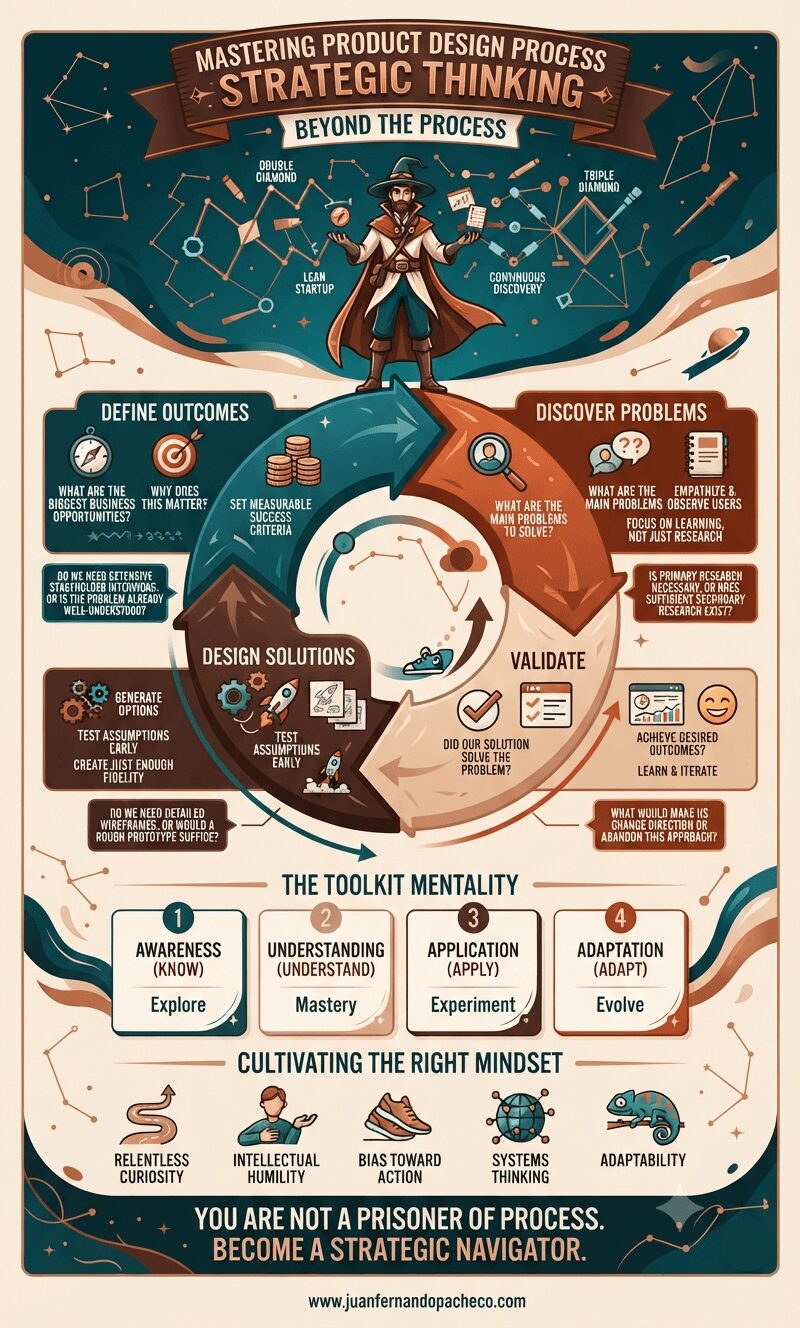
Let’s start by examining the image above. It presents a clean, four-stage journey:
- Define outcomes – What are the biggest business opportunities and why?
- Discover problems – What are the main problems to solve across the experience?
- Design solutions – What are the best ways to solve these problems?
- Validate – Did our solution solve the problem and achieve the desired outcome?
This framework is elegant and logical. But here’s what the diagram doesn’t show:
- The messy reality of actual product work,
- The stakeholder politics, the technical constraints,
- The shifting priorities, and
- The countless moments where you’ll need to loop back, skip ahead, or abandon an approach entirely.
This is a map, but you’re the navigator. And like any skilled navigator, you need more than one map—you need to understand the terrain, read the conditions, and choose the right tools for the journey ahead.
The toolkit mentality
When we talk about “the design process,” we often fall into the trap of treating it as a rigid sequence of steps to be followed religiously. But this misses the point entirely. What we’re really discussing is design thinking—a mindset and approach to problem-solving that prioritizes understanding, experimentation, and learning.
Consider the various frameworks you’ve encountered:
- The Double Diamond (Design Council) emphasizes divergent and convergent thinking
- Continuous Discovery (Teresa Torres) focuses on ongoing customer engagement
- The Triple Diamond adds implementation and scaling considerations
- Build-Measure-Learn (Lean Startup) prioritizes rapid iteration and validated learning
Each of these frameworks has merit. Each offers a slightly different lens through which to view product design. But fundamentally, they all serve the same two critical purposes:
- Determine a solution to the problem as quickly as possible (focus on speed)
- Ensure you’re solving the right problem in the first place (focus on risk)
Everything else is tactical.
Speed vs. Risk: The eternal tension
Every design decision you make exists on a spectrum between speed and risk. Move too fast without adequate validation, and you risk building the wrong thing. Move too slowly in pursuit of perfect understanding, and you risk missing your window of opportunity or wasting resources on over-analysis.
A mature design practice isn’t about eliminating this tension—it’s about managing it intelligently. This requires asking yourself difficult questions at every stage:
- How long should we spend on each stage?
- How much effort is enough?
- Who else needs to be involved?
- How much research is sufficient?
- What’s the most effective way to test this idea?
- How do we learn as quickly as possible?
These aren’t questions with universal answers. They’re contextual decisions that depend on your specific situation, constraints, and goals.
The Danger of Blind Process Adherence
One of the most common mistakes I see designers make is following a process simply because it’s “the process.” They conduct stakeholder interviews because the framework says to do so, not because they’ve thought critically about whether those interviews will actually move the project forward.
They create detailed wireframes when a quick prototype built with an engineer might yield better insights in the same timeframe. They embark on lengthy research cycles when a simple desirability test via social media could validate customer appetite in days.
This is process theater—going through the motions without understanding the purpose behind each action.
Instead, every activity should be intentional. Before you begin any research, workshop, or design exercise, ask yourself:
- What is the specific outcome I need from this stage?
- What do I need to learn to confidently move to the next step?
- How can I conclude as quickly as possible without sacrificing quality?
- What do I need to learn to de-risk this project or idea?
- How will this specific tool or framework help me determine the right solution?
If you can’t answer these questions clearly, you’re probably not ready to begin.
Building your personal design toolkit
The path to becoming a product design maestro isn’t about mastering one perfect process. It’s about curating a diverse toolkit and developing the judgment to know when to use each tool.
1: Awareness
Start by understanding what you don’t know. Even if you haven’t used a particular tool or framework, simply being aware of its existence is the first stage of learning. Create a living document—a personal knowledge base—where you track:
- Tools you’ve used successfully
- Tools you’ve tried that didn’t work for your context
- Tools you’ve heard about but haven’t tried yet
- The specific problems each tool is best suited to solve
This isn’t about hoarding knowledge; it’s about building a reference library you can draw from when facing new challenges.
2: Understanding
Once you’re aware of a tool, dive deeper. Understand not just how it works, but:
- When it’s most effective
- Why it works (the underlying principles)
- What its limitations are
- Who it works best for (team size, organizational culture, project type)
This is the “Shu” stage of Shuhari—a Japanese concept describing the stages of learning to mastery. In the Shu stage, you follow the rules and forms precisely, learning the fundamentals before you can adapt or innovate.
3: Application
Knowledge without application is theoretical. Actively seek opportunities to test new tools in your work. Treat each design challenge as a laboratory where you can:
- Experiment with unfamiliar approaches
- Compare the effectiveness of different tools
- Measure outcomes and learn from both successes and failures
- Refine your judgment about when to use what
Document your results. What worked? What didn’t? Why? This reflection is where real learning happens.
4: Adaptation
As you gain experience, you’ll move into the “Ha” and “Ri” stages of Shuhari—where you begin to adapt the rules and eventually transcend them entirely. You’ll start combining tools in novel ways, modifying frameworks to fit your context, and perhaps even creating your own approaches.
This is where true mastery emerges: not in rigid adherence to someone else’s process, but in the confident, flexible application of principles to unique situations.
Practical application: Thinking critically about each phase
Let’s return to our four-phase framework and examine how to think critically about each stage.
1st phase: Define Outcomes
Before you begin any design work, you must understand what success looks like. But “define outcomes” doesn’t mean writing vague mission statements or aspirational goals. It means getting specific about:
- What business problem are we solving?
- Why does this matter now?
- What would success look like in measurable terms?
- What are the constraints (time, budget, technical, organizational)?
Critical questions to ask:
- Do we really need extensive stakeholder interviews, or is the problem space already well understood?
- Can we align on outcomes through a focused workshop rather than weeks of meetings?
- What’s the minimum alignment we need to move forward confidently?
2nd phase: Discover Problems
Once you understand the desired outcome, you need to identify the obstacles preventing you from achieving it. This is where research, observation, and empathy come into play. But research isn’t an end in itself—it’s a means to an end.
Critical questions to ask:
- What do we already know, and what do we genuinely need to learn?
- Is primary research necessary, or does sufficient secondary research exist?
- What’s the fastest way to validate our assumptions about user needs?
- Are we discovering problems or just confirming what we want to hear?
Remember:
The goal isn’t to conduct the most comprehensive research possible. The goal is to learn enough to confidently identify the most important problems to solve.
3rd phase: Design Solutions
With a clear understanding of the problems, you can now explore potential solutions. This is where creativity meets constraint. But solution design isn’t about creating perfect, polished designs—it’s about generating options, testing assumptions, and converging on the most promising direction.
Critical questions to ask:
- Do we need detailed wireframes, or would a rough prototype suffice?
- Could we pair with an engineer to test something with users faster?
- Are we exploring enough options, or converging too quickly on the first idea?
- How might we test the riskiest assumptions before investing in full implementation?
The best solution isn’t always the most elegant one—it’s the one that solves the right problem, can be implemented within constraints, and can be validated with real users.
4th phase: Validate
Validation is where many design processes break down. It’s tempting to treat validation as a checkbox—”we tested with users, so we’re done.” But validation isn’t a one-time event; it’s an ongoing conversation with reality.
Critical questions to ask:
- Did our solution actually solve the problem we identified?
- Did we achieve the desired outcome we defined in phase one?
- What did we learn that should inform our next iteration?
- Are we measuring the right things, or just the easy things?
- What would make us change direction or abandon this approach?
Validation should be rigorous, honest, and humble. It requires being willing to admit when you’re wrong and having the courage to pivot based on evidence rather than ego.
The continuous loop
Notice that our framework isn’t linear—it’s cyclical. The arrows in the diagram aren’t decorative; they’re essential. Product design is iterative by nature. You’ll loop back to redefine outcomes as you learn more. You’ll discover new problems while testing solutions. You’ll need to redesign based on validation results.
This isn’t failure—it’s the process working as intended.
The teams that excel aren’t the ones that get it right the first time. They’re the ones that learn fastest, adapt quickly, and maintain momentum through uncertainty.
Cultivating the right mindset
Tools and frameworks are important, but they’re secondary to mindset. The most successful product designers I know share certain characteristics:
- Relentless curiosity: They’re never satisfied with surface-level understanding. They dig deeper, ask “why” repeatedly, and remain open to having their assumptions challenged.
- Intellectual humility: They recognize that they don’t have all the answers. They’re comfortable saying “I don’t know” and view every project as a learning opportunity.
- Bias toward action: They understand that perfect is the enemy of good. They’d rather test a rough idea and learn than spend months perfecting a solution in isolation.
- Systems thinking: They see beyond individual features or screens to understand how everything connects. They consider the broader ecosystem, not just their piece of it.
- Adaptability: They don’t fall in love with their tools or processes. They’re willing to abandon what’s not working and try something new.
Your journey forward
If you take away only one thing from this article, let it be this: You are not a prisoner of process.
The frameworks you’ve learned, the methodologies you’ve studied, the best practices you’ve internalized—these are all tools in your toolkit, not commandments carved in stone. Use them wisely, adapt them freely, and never stop expanding your repertoire.
Start today by:
- Auditing your toolkit: What tools and frameworks do you currently use? Which ones serve you well, and which ones are you using out of habit rather than intention?
- Identifying gaps: What tools or approaches are you unfamiliar with that might serve you well? Make a list and commit to learning one new approach this quarter.
- Questioning your process: For your current project, ask yourself: “Am I doing this because it’s the most effective way to learn and de-risk, or because it’s what we always do?”
- Embracing experimentation: Treat your next design challenge as an opportunity to try something new. Document what you learn, share it with your team, and refine your approach.
- Maintaining curiosity: Stay hungry for knowledge. Read widely, talk to designers in different industries, attend conferences, take courses, and never assume you’ve arrived.
The field of product design will continue to evolve. New tools will emerge, old frameworks will be refined, and the challenges we face will grow more complex. But if you build your practice on a foundation of strategic thinking, adaptive tool use, and continuous learning, you’ll not only survive these changes—you’ll thrive.
Remember:
There is no perfect process. There’s only the process that helps you solve the right problems, learn as quickly as possible, and create meaningful value for users and businesses alike.
Now go forth and design—not by the book, but by your own informed, adaptable, ever-evolving judgment. That’s where true mastery lies.