Your strategic blueprint for market leadership
In today’s hyper-competitive business landscape, companies face an impossible-sounding challenge: be everything to everyone. Deliver the lowest prices while offering cutting-edge innovation and providing white-glove personalized service. It’s a seductive but dangerous trap that has claimed countless businesses.
What if I told you that trying to excel at everything is actually the fastest path to mediocrity?
Over two decades ago, strategic thinkers Michael Treacy and Fred Wiersema cracked the code on sustainable competitive advantage. In their groundbreaking book “The Discipline of Market Leaders,” they introduced a framework that remains remarkably relevant today: the Value Discipline Model.
This isn’t just another business theory gathering dust on a shelf. It’s a practical, battle-tested framework that explains why companies like Apple, Walmart, and McKinsey dominate their respective industries—and why so many others struggle to gain traction.
Let me walk you through this powerful model and show you how to apply it to your organization.
Understanding the Value Discipline Model
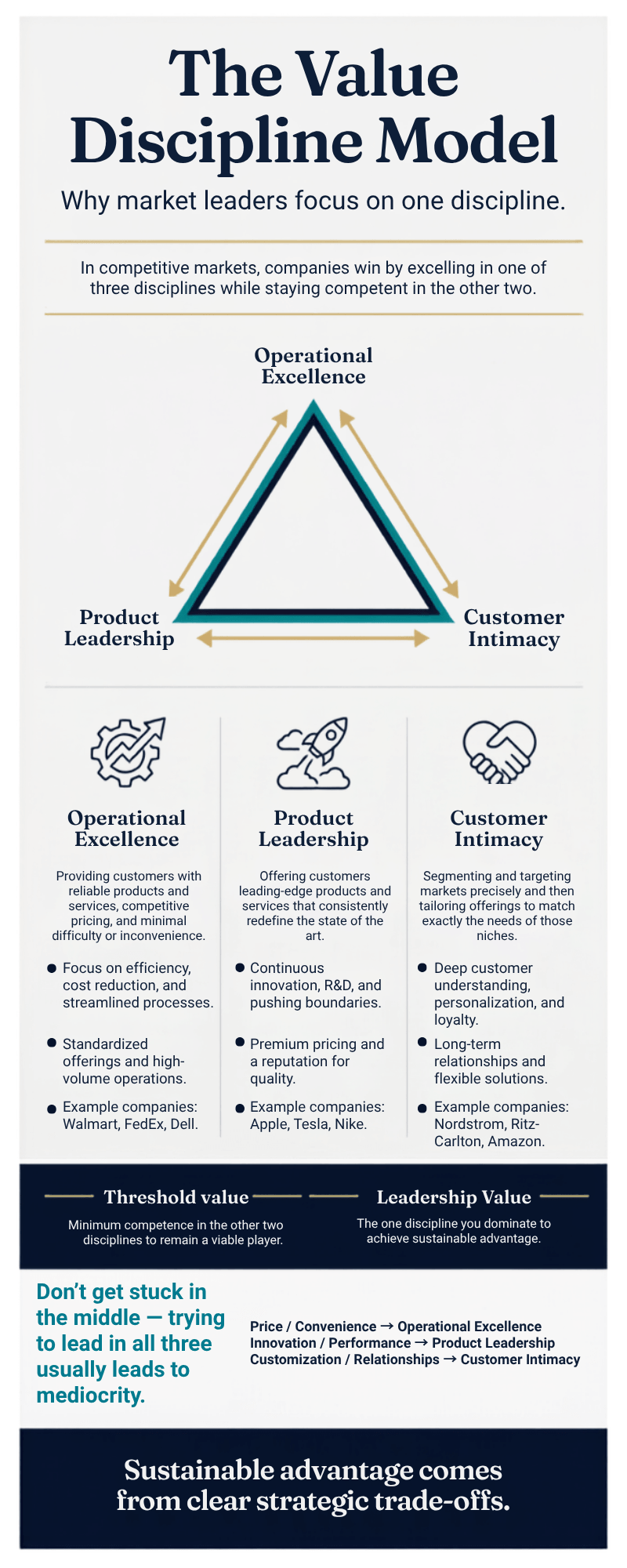
At its core, the Value Discipline Model presents a simple but profound truth: market-leading companies excel in one of three value disciplines while maintaining acceptable standards in the other two.
Think of it as a strategic triangle. Each corner represents a different path to dominance:
- Operational Excellence – Being the best at efficient, reliable delivery
- Product Leadership – Offering the most innovative, cutting-edge solutions
- Customer Intimacy – Building deep, personalized relationships
Here’s what makes this model so powerful: it acknowledges that you can’t be the best at all three simultaneously. Resources are finite. Focus is essential. And attempting to lead in multiple disciplines simultaneously typically results in leading in none.
But before we dive deeper, let’s clarify what each discipline really means and how you can recognize it in action.
Operational Excellence: The Art of Efficient Delivery
Operational Excellence (often abbreviated as OpEx) isn’t about being cheap—it’s about being efficient. Companies that master this discipline deliver reliable products and services at competitive prices with minimal friction for customers.
The Operational Excellence Mindset
When you choose Operational Excellence as your primary discipline, you’re committing to:
- Streamlining processes to eliminate waste and reduce costs
- Standardizing operations to ensure consistency and reliability
- Investing in technology that improves efficiency and reduces errors
- Optimizing supply chains to deliver products faster and cheaper
- Creating hassle-free experiences that make doing business with you effortless
The goal isn’t to offer the flashiest product or the most personalized service. It’s to make the customer’s life easier by removing obstacles, reducing costs, and delivering predictable quality every single time.
Real-World Masters of Operational Excellence
McDonald’s didn’t become a global powerhouse by serving gourmet burgers. They became dominant by perfecting the art of consistent, fast, affordable food delivery. Whether you’re in Tokyo, New York, or Paris, you know exactly what you’re getting, how long it will take, and how much it will cost.
IKEA revolutionized furniture retail not through superior design alone, but by creating an incredibly efficient flat-pack system that reduced shipping costs, minimized damage, and passed savings to customers. Their entire business model—from the warehouse layout to the self-service showroom—is engineered for operational efficiency.
Walmart built an empire on the promise of “Everyday Low Prices,” backed by a supply chain and logistics system that competitors struggle to match. Their operational excellence allows them to offer lower prices while maintaining profitability.
Is Operational Excellence Right for You?
Choose this discipline if:
- Your market is price-sensitive
- Customers value convenience and reliability over customization
- You can achieve economies of scale
- Your competitive advantage comes from process innovation rather than product innovation
Product Leadership: Pushing the Boundaries of Innovation
If Operational Excellence is about doing things efficiently, Product Leadership is about doing things that have never been done before.
The Product Leadership Philosophy
Companies pursuing Product Leadership commit to:
- Continuous innovation and rapid product development
- Investing heavily in R&D to stay ahead of the curve
- Cannibalizing their own products before competitors do
- Attracting top creative talent who thrive on pushing boundaries
- Accepting higher risks in pursuit of breakthrough solutions
Product leaders don’t just respond to market needs—they anticipate them, often creating demand for products customers didn’t even know they wanted.
The Product Leadership Playbook
Apple is the textbook example of Product Leadership. They don’t compete on price. They don’t offer the most customized solutions. What they do is consistently deliver products that redefine categories. The iPhone didn’t just improve mobile phones—it reinvented them. Apple’s willingness to kill successful products (like the iPod) in favor of newer innovations demonstrates their commitment to staying at the cutting edge.
Nike dominates athletic footwear not by being the cheapest or the most personalized, but by consistently pushing the boundaries of performance technology and design. Their investment in innovation—from Air technology to sustainable materials—keeps them ahead of competitors.
Rolex doesn’t make the most affordable watches, nor do they customize each piece for individual clients. What they offer is uncompromising quality, precision, and prestige that comes from decades of product excellence.
Is Product Leadership Your Path?
Consider this discipline if:
- Your industry rewards innovation and first-mover advantage
- You have access to significant R&D resources
- Your customers value cutting-edge features and performance
- You can tolerate higher failure rates in pursuit of breakthroughs
- Your brand can command premium prices
Customer Intimacy: The Power of Deep Relationships
While Product Leaders focus on what they sell and Operational Excellence champions focus on how efficiently they sell it, companies pursuing Customer Intimacy focus on who they’re selling to.
The Customer Intimacy Approach
Organizations that excel in Customer Intimacy:
- Deeply understand individual customer needs and preferences
- Customize solutions rather than offering one-size-fits-all products
- Build long-term relationships rather than transactional interactions
- Empower employees to make decisions that benefit specific customers
- Charge premium prices justified by exceptional value and service
Customer intimacy isn’t about being nice—it’s about being indispensable. These companies embed themselves so deeply in their clients’ operations that switching becomes painful, expensive, or risky.
Masters of Customer Intimacy
McKinsey & Company doesn’t sell generic consulting templates. They embed themselves in their clients’ organizations, developing deep understanding of unique challenges and crafting tailored strategies. Their value comes not from a standardized product but from intimate knowledge of each client’s situation.
Goldman Sachs builds relationships that span decades, understanding their clients’ financial goals, risk tolerance, and strategic objectives at a level that enables highly personalized advisory services.
Salesforce built a $200+ billion company not just by selling CRM software, but by positioning themselves as partners in their clients’ digital transformation journeys, offering extensive customization and ongoing support.
Is Customer Intimacy Your Competitive Edge?
This discipline fits if:
- Your customers have complex, unique needs
- Relationship longevity is more valuable than transaction volume
- You can invest time in understanding individual clients
- Your team has the expertise to deliver customized solutions
- Your market rewards deep expertise over breadth
The Critical Choice: Why You Can’t Do It All
Here’s where most companies go wrong: they try to excel at all three disciplines simultaneously.
Let me be clear: this is a recipe for strategic mediocrity.
The Value Discipline Model doesn’t suggest you should ignore the other two disciplines. You must maintain threshold competence in all three. But you must excel in only one.
The Threshold vs. Leadership Distinction
Think of it this way:
- Threshold Value (inner circle): The minimum standard you must meet to stay in the game
- Leadership Value (outer circle): The area where you dominate and differentiate
If you’re pursuing Operational Excellence, you still need decent products and acceptable customer service. But you won’t have the most innovative products or the most personalized relationships—and that’s okay.
If you’re a Product Leader, you still need efficient operations and reasonable customer service. But you won’t have the lowest prices or the deepest individual relationships—and that’s acceptable.
If you excel at Customer Intimacy, you still need reliable operations and good products. But you won’t be the cheapest or the most innovative—and that’s fine.
The Danger of Being Stuck in the Middle
Companies that try to be everything to everyone typically end up being nothing special to anyone. They’re not cheap enough to win on price, not innovative enough to command premium prices, and not personalized enough to build deep loyalty.
This “stuck in the middle” position is strategically fatal in the long run.
How to Choose Your Value Discipline
So how do you decide which discipline to pursue? Here’s a framework:
1. Assess Your Market
What does your market value most?
- Price and convenience? → Operational Excellence
- Innovation and performance? → Product Leadership
- Customization and relationships? → Customer Intimacy
2. Evaluate Your Strengths
What are you naturally good at?
- Process optimization and efficiency? → Operational Excellence
- Innovation and creative problem-solving? → Product Leadership
- Relationship building and customization? → Customer Intimacy
3. Analyze Your Competition
Where are the gaps?
- If everyone competes on price, can you differentiate through innovation or relationships?
- If the market is saturated with similar products, can you win through efficiency or intimacy?
4. Consider Your Resources
What can you sustain?
- Operational Excellence requires investment in technology and process
- Product Leadership demands R&D budgets and tolerance for failure
- Customer Intimacy needs skilled people and time-intensive engagement
5. Align With Your Culture
What energizes your team?
- Some cultures thrive on efficiency and standardization
- Others flourish with innovation and experimentation
- Still others excel at relationship-building and customization
Implementing Your Chosen Discipline
Once you’ve chosen your discipline, the real work begins. Here’s how to execute:
For Operational Excellence:
- Map and optimize every process
- Invest in automation and technology
- Standardize wherever possible
- Measure efficiency relentlessly
- Train employees on consistency and reliability
For Product Leadership:
- Allocate significant resources to R&D
- Create a culture that rewards experimentation
- Accept that some failures are necessary for breakthroughs
- Stay close to emerging trends and technologies
- Be willing to cannibalize your own successful products
For Customer Intimacy:
- Invest in deep customer research and insights
- Empower frontline employees to make decisions
- Customize solutions rather than forcing standardization
- Measure relationship depth, not just transaction volume
- Build systems that capture and share customer knowledge
Common Pitfalls to Avoid
1. Discipline Drift
Don’t abandon your chosen discipline when competitors attack from a different angle. Stay focused.
2. Neglecting Threshold Requirements
Excelling in one area doesn’t excuse failure in the others. Maintain minimum standards across all three.
3. Confusing Tactics with Strategy
Discounts, new features, or loyalty programs are tactics. Your value discipline is your strategic foundation.
4. Trying to Serve Everyone
Your discipline choice means saying “no” to customers who value what you don’t prioritize.
5. Failing to Communicate Your Discipline
Your entire organization—from hiring to performance metrics—must align with your chosen discipline.
The Timeless Nature of the Value Discipline Model
What makes the Value Discipline Model evergreen is its foundation in fundamental strategic trade-offs. Technology changes. Markets evolve. Customer preferences shift. But the reality that resources are finite and focus is essential remains constant.
Whether you’re reading this in 2026 or 2029, the core insight holds: sustainable competitive advantage comes from making clear strategic choices about where to excel and where to be merely competent.
Your Next Steps
As you reflect on the Value Discipline Model, ask yourself:
- Which discipline does your organization currently pursue? (Be honest—it might not be the one you think you’re pursuing)
- Are you trying to excel at all three? If so, where is this creating confusion or mediocrity?
- What would change if you made a clear choice? What would you stop doing? What would you double down on?
- Does your entire organization understand and align with your chosen discipline? Or is there strategic drift?
Remember William Butler Yeats’ wisdom:
“Do not wait to strike till the iron is hot, but make it hot by striking.”
Don’t wait for the perfect moment to clarify your strategic discipline. Make the choice. Commit to it. Execute relentlessly.
Market leadership isn’t about being good at everything. It’s about being exceptional at one thing and competent at the rest.
What is your company’s competitive advantage? Which value discipline will you master?
The choice is yours. Make it count.