Over a decade ago, in 2014, the User Experience industry was fighting a pivotal battle for identity.
As the digital landscape matured, UX practitioners were desperately trying to escape the pigeonhole of being viewed as tactical “wireframers” or “pixel-pushers”. To elevate their role and secure a seat at the product strategy table, many turned to Clayton Christensen’s “Jobs-to-be-Done” (JTBD) theory.
The argument was revolutionary at the time:
People do not buy products based on their demographic attributes, nor do they buy them simply because they possess a certain technology. People “hire” products to get a specific “Job” done in their lives.
The core premise was that if a company defines itself by its technology or its target demographic, it will eventually be disrupted. But if it defines itself by the stable, enduring Job it helps the customer accomplish, it can weather any technological shift.
That advice was foundational. It successfully shifted the industry’s focus from features to outcomes.
But we are now in 2026.
The landscape of User Experience has been fundamentally rewritten by Generative AI, agentic workflows, and hyper-connected ecosystems. The tactical execution layer of our profession—wireframing, basic user flows, interface generation, and even preliminary usability synthesis—has been entirely commoditized by machines. The “tactical table” no longer exists.
Therefore, applying JTBD in 2026 is not just about improving our design process; it is about survival. It is about recognizing that while the functional “Job” remains stable, the ecosystem required to execute it has exploded in complexity.
If you are a UX leader, a Product Strategist, or a Business Development Manager, you must evolve your understanding of the “Job.” You must move beyond user-centric task completion and embrace Strategic UX and Jobs to be Done as the ultimate framework for orchestrating business value in an AI-driven world.
Here is how the timeless principles of JTBD have evolved for the modern era, and how you can use them to architect genuine customer progress.
1. The Stability of the Job vs. The Chaos of the Ecosystem
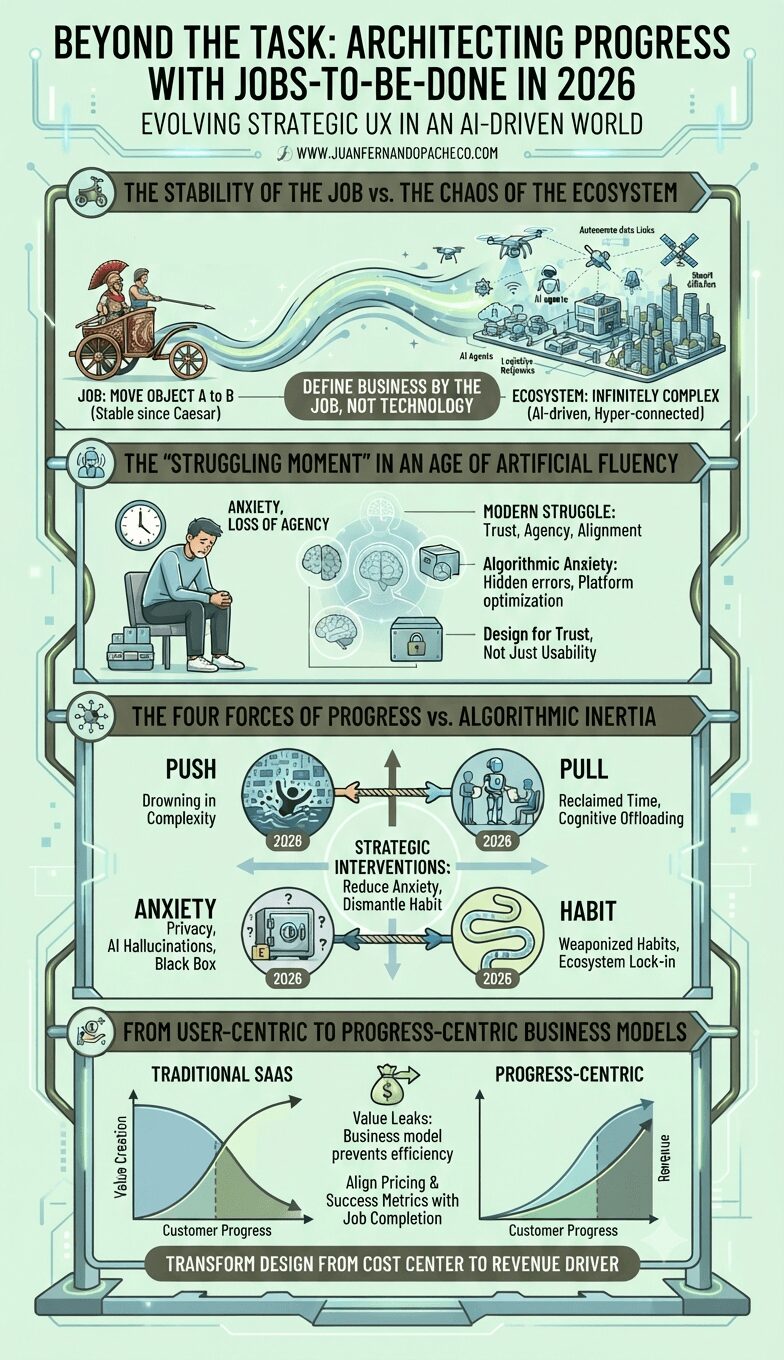
Let us revisit Christensen’s classic analogy, which remains as true today as it was in 1997: the job of moving an object from point A to point B with perfect certainty is incredibly stable. Julius Caesar hired a chariot to get this job done; in the 20th century, we hired FedEx. The job itself did not change; only the technology used to solve it evolved.
However, in 2026, the evolution is no longer a simple linear upgrade from a chariot to a truck. It is a dimensional shift.
Today, you do not just “hire” a logistics company. You hire an autonomous supply chain network, managed by predictive AI agents, integrated into your smart home infrastructure, and optimized by real-time global data feeds, all to fulfill the same job Caesar had.
The Job is stable, but the ecosystem required to execute it is infinitely complex.
This is where most modern companies fail. They fall into the trap of defining themselves by their current technological implementation. “We are an AI-driven logistics platform,” they say. But as Christensen warned, if you define your business by technology, you will eventually be blown out of the water by the next technological shift.
To survive, you must define your business by the Job.
But as a strategic designer, you must also recognize that a single product or interface rarely solves the modern Job. A dynamic, winning system of interconnected services solves it.
Your role is not to design the screen for one app; it is to map the entire operational loop. You must ensure that every touchpoint—whether it is a human customer service agent, an API handshake, or an autonomous drone—aligns seamlessly to get the Job done. This is the essence of systems thinking in UX.
2. The “Struggling Moment” in an Age of Artificial Fluency
To truly master Strategic UX and Jobs to be Done, we must look beyond the functional task and dive into the deep psychology of the user. This brings us to the profound insights of Bob Moesta, the renowned co-architect of the JTBD framework and a leading expert on the psychology of consumer behavior.
Moesta shifted the industry’s focus from the functional job to the emotional catalyst for change. He famously posited that:
“The struggling moment is the seed for all innovation.”
It is the exact point in time when a person finds themselves in a specific circumstance and realizes they cannot go any further with their current solution. Without the struggling moment, there is no story, no emotional energy, and no reason to switch to a new product.
Many years ago, the “struggling moment” was often about tangible friction. The form was too long. The navigation menu was confusing. Information was hidden behind three clicks.
In 2026, AI has largely solved the friction of information and basic interaction. Interfaces are conversational, predictive, and fluid. The UI is practically invisible. So, where is the struggle now?
The modern struggle is rooted in Trust, Agency, and Alignment.
When an AI agent automatically books your flight, rewrites your email, and manages your calendar, the functional job is done flawlessly.
But the emotional struggle has shifted.
The user feels a profound loss of agency. They experience “algorithmic anxiety”—the lingering fear that the machine is making a subtle, unexplainable error that will have real-world consequences, or that it is optimizing for the platform’s revenue rather than their actual progress.
If you are not mapping these new, invisible struggles, you are not doing UX. You are just decorating a black box.
Deep human-centered research in 2026 is about uncovering the emotional friction that persists even when the interface is perfectly frictionless. You must craft insight that turns this raw, emotional data into a strategic direction. You must design for trust, not just for usability.
3. The Four Forces of Progress vs. Algorithmic Inertia
To navigate these modern struggles and facilitate real change, we must apply Moesta’s “Four Forces of Progress.” He explains that any purchase or behavior change is governed by a tug-of-war between four distinct forces:
- The Push of the current situation,
- The Pull of the new solution,
- The Anxiety of the new, and
- The Habit of the present
Let us analyze how these forces have mutated in the 2026 landscape, and how strategic UX must respond to them:
- The Push (of the situation): In the past, the push was a broken workflow or a missing feature. Today, the push is often existential. Users are pushed by the sheer volume of digital noise and the dawning realization that their current, non-AI workflows are making them uncompetitive in their personal and professional lives. They are drowning in complexity, and the pain of the status quo has become unbearable.
- The Pull (of the new idea): The pull is no longer just “a better feature.” It is the promise of reclaimed time and cognitive offloading. The pull is the seductive idea of having a digital twin that handles the mundane so the user can focus on high-level strategy and human connection.
- The Anxiety (of the new): This is the critical force in 2026. As Moesta noted, anxiety is the force that holds people back from switching. Today, anxiety is at an all-time high. Users are anxious about data privacy, about AI hallucinations, about the depersonalization of service, and about the “black box” nature of algorithmic decision-making. If your product strategy does not actively engineer transparency and trust to reduce this anxiety, the user will not switch, no matter how powerful your AI is.
- The Habit (of the present): Habits are no longer just muscle memory; they are deeply entrenched algorithmic loops. Tech companies have weaponized habit through variable rewards, infinite feeds, and seamless ecosystem lock-in. Breaking a user’s habit to adopt a new solution requires overcoming immense, engineered inertia.
As a strategic designer, you cannot just optimize for the Pull. You must design systemic interventions that reduce Anxiety and dismantle the old Habit. This requires multidisciplinary integration.
You must work with legal teams to build transparent data policies (reducing anxiety), with marketing to reframe the narrative, and with engineering to build seamless, zero-friction migration paths (breaking habit). This is how you use design as a force multiplier for business success.
4. From User-Centric to Progress-Centric Business Models
Ultimately, the evolution of JTBD in 2026 demands a radical shift in how we view business models and value creation.
For the last decade, the SaaS (Software-as-a-Service) model dominated the tech landscape. We sold access to tools. We charged based on seats, usage, or arbitrary engagement metrics like Daily Active Users (DAU). But if we truly believe in Christensen’s theory—that the customer just wants to get a job done—then charging for “access” is a fundamentally flawed model. It misaligns the vendor’s incentives with the customer’s progress.
Consider this: If my job is to “manage my company’s regulatory compliance,” and your AI-driven software helps me do it in 5 minutes instead of 50 hours, you have provided massive, transformative value. But under a traditional SaaS model, you just lost 99% of your computing and usage revenue because I finished the job so quickly.
In 2026, the most innovative companies are shifting from user-centric model to progress-centric business model. They are aligning their pricing, operations, and success metrics with the successful completion of the Job.
This is where the rubber meets the road for UX and Business Development. You cannot design a progress-centric product if your business model is tethered to keeping the user trapped in your app. You must use JTBD to redefine your value proposition.
When you map the Customer Journey in this new era, you are not just looking for UI drop-offs. You are looking for “Value Leaks“—places where the business model actively prevents the user from completing the Job efficiently.
By aligning the UX strategy with a progress-based business model, you transform design from a tactical cost center into a primary driver of revenue, retention, and market differentiation. You move away from static plans and build dynamic, winning systems that scale with the user’s success.
The Architect of Progress
The tactical realities of our profession have been rewritten by machines.
The tools we use, the speed at which we iterate, and the very nature of the interfaces we build are unrecognizable compared to a decade ago. The days of fighting just to get a seat at the strategy table are over; the table has been replaced by the boardroom, and the stakes have never been higher.
But the fundamental truth of human behavior remains untouched:
People do not wake up wanting to use your software, your AI agent, or your platform. They wake up with a set of circumstances, a struggling moment, and a deep, inherent desire to make progress in their lives.
As UX professionals, Product Leaders, and Strategists in 2026, we are no longer just designers of interfaces. We are the Architects of Progress.
By mastering Strategic UX and Jobs to be Done, by understanding the deep emotional struggles of our users, and by aligning our business models with their success, we ensure that our work remains profoundly human, deeply strategic, and absolutely indispensable.
The job is the same as it was in Caesar’s time. But the way we architect the solution must be worthy of the future.