Over a decade ago, in 2015, a brilliant and pragmatic piece was written about “Getting Hired in UX.” It offered timeless advice for a rapidly maturing industry:
Beware of recruiter flattery, tell compelling “detective stories” about your process, avoid the red flags of superficial thinking, and prepare for rigorous whiteboard exercises. That advice was foundational. But we are now in 2026.
The landscape of User Experience has been fundamentally rewritten. Generative AI has commoditized the “how” of our industry. Creating user flows, generating UI variations, and even synthesizing basic usability reports can be done in seconds by machines. The baseline for tactical execution has been raised to the floor.
Therefore, getting hired today is no longer about proving you can follow a design process; it is about proving you can navigate complex business ecosystems, leverage technology as a strategic lever, and act as a vital partner in business development.
As I often discuss when exploring the intersection of UX and business strategy, design is not merely an aesthetic discipline or a user-advocacy function—it is a force multiplier for business success. If you are looking to step into a strategic UX, CX, or Product Design role in 2026, you must evolve your approach. Here is how the classic rules for getting hired have evolved in the modern era.
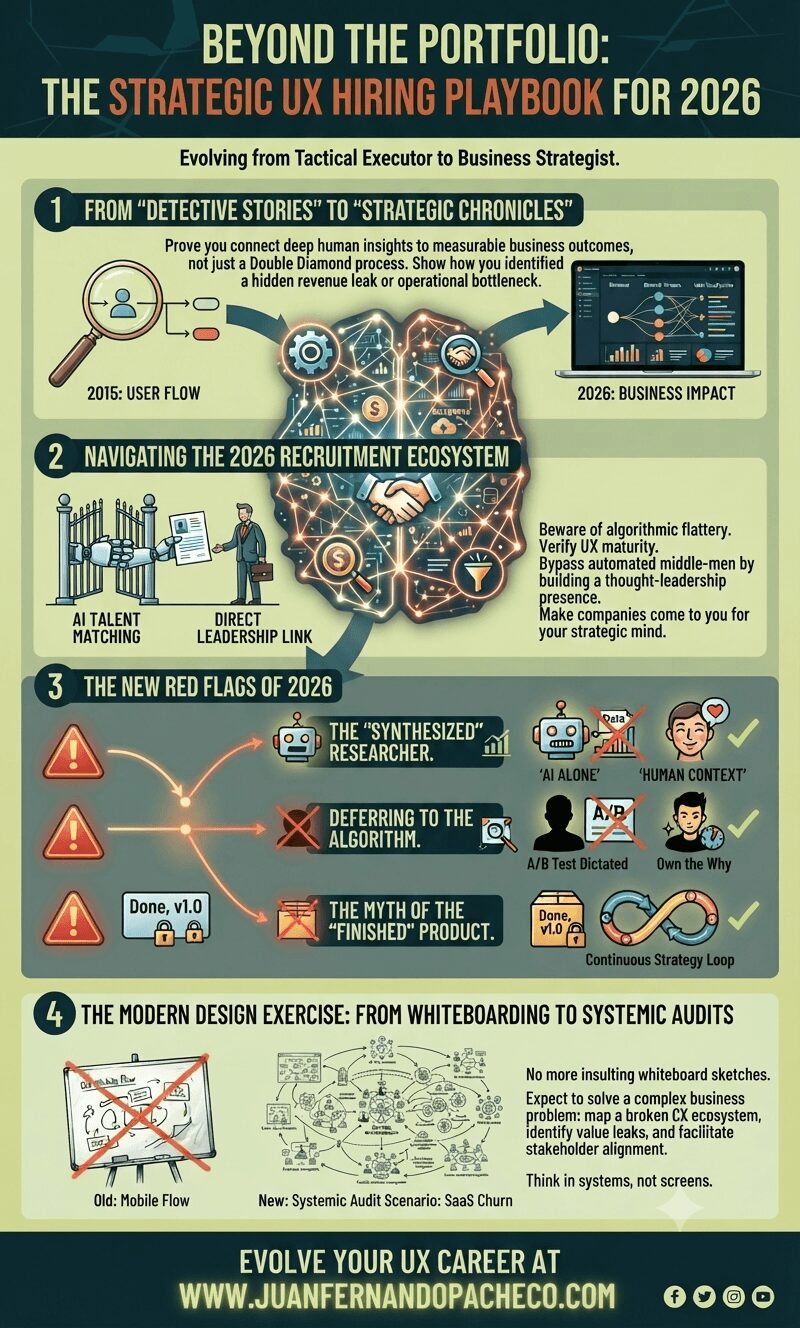
1. From “Detective Stories” to “Strategic Chronicles”
In 2015, the advice was to frame your projects as “detective stories”—tales of overcoming usability hurdles, finding unexpected user research insights, and navigating wrong turns. The goal was to prove you weren’t just a passenger following a Double Diamond process.
In 2026, AI can generate a flawless, step-by-step Double Diamond case study in seconds.
If your portfolio only shows how you moved from “Empathize” to “Define” to “Ideate,” you are demonstrating a process that a machine can replicate.
The new “detective work” is about business and systemic discovery. Your challenge is to communicate how you connect deep human insights to measurable business outcomes. I call this applying the Strategy Formula: winning with the Why, the What, and the How.
When you interview, do not just tell me about how you simplified a navigation menu. Tell me about how you discovered that a fractured backend operational loop was causing customer service delays, which in turn was destroying trust at the checkout phase.
Tell me how you mapped the customer journey not just to find friction, but to identify a hidden revenue leak in the business model.
Your narrative must show how you move beyond static plans to create dynamic, winning systems. Writing and public speaking remain crucial skills, not just for communication, but because they force you to articulate the business impact of your design decisions. In 2026, how you think about systemic value is far more important than how pretty your portfolio looks.
2. Navigating the 2026 Recruitment Ecosystem
The 2015 warning about recruiters flattering both sides to secure a placement fee is still relevant, but the mechanism has changed. Today, we operate in an era of AI-driven talent matching and hyper-personalized, automated outreach.
When you receive a message saying,
“Our AI has identified you as a 98% perfect match for this role”
Be cautious. The “flattery” is now algorithmic. Recruiters and matching algorithms optimize for keyword density and immediate placement, not for long-term strategic fit or cultural alignment.
If you are headhunted, your job is to verify the company’s actual maturity in UX. Are they looking for a strategic partner who can align product vision with business goals, or are they simply looking for someone to prompt AI tools to generate screens faster?
To cut through the noise of automated recruitment, you must:
- Build a direct, thought-leadership presence.
- Share your frameworks on Crafting Insight.
- Write about how you integrate Design Thinking with IT solutions.
- Make the companies come to you for your strategic mind.
If a recruiter reaches out, ensure the alignment is strategic. And if you have a direct link to the hiring company’s leadership, bypass the middleman. In 2026, building a direct relationship with business leaders who understand UX as a strategic lever is the ultimate career hack.
3. The New Red Flags of 2026
In any interview, I am looking for signals that separate strategic leaders from tactical executors. The red flags have evolved significantly over the last decade.
1: The “Synthesized” Researcher
In 2015, the red flag was a candidate who talked about user preferences (what they said) rather than behaviors (what they did). In 2026, AI can analyze millions of behavioral data points, synthesize thousands of support tickets, and summarize user interviews instantly.
The new red flag is a candidate who relies solely on the AI synthesis.
If you tell me, “The AI analysis of our user feedback showed a 15% drop-off due to UI friction,” I will assume you are a passenger. The green flag is the candidate who says:
“The algorithm identified a drop-off, but when I conducted deep, empathetic ethnographic interviews, I realized the friction wasn’t in the interface. It was a lack of emotional trust in our brand messaging at that specific touchpoint.”
You must show that you can feel the pain that quantitative data cannot capture. Deep human-centered research is no longer about gathering data; it is about finding the profound, unquantifiable human context that AI misses.
2: Deferring to the Algorithm
In 2015, designers often deferred to authority, saying, “The client wanted it like that,” or blaming legacy systems. In 2026, designers defer to the machine. They say, “The A/B test dictated this,” or “The AI optimization metric required this layout.”
All design involves considering alternative approaches and weighing their trade-offs. If you cannot answer probing questions about your design decisions because you are hiding behind an algorithm’s output, you are not leading; you are automating.
A strategic UX designer must have the courage to challenge the data when it conflicts with long-term Customer Experience (CX), ethical design, or systemic business health. You must own the “Why” behind the trade-off.
3: The Myth of the “Finished” Product
In 2015, if you couldn’t name the key problems left unsolved at the end of a project, it was a sign of naivety. In 2026, products are dynamic, living ecosystems. They are integrated with continuous delivery pipelines, AI agents, and complex operational loops.
If you present a project as “finished,” you fail.
You must be able to talk about the Strategy Loop.
- How does this product learn and adapt over time?
- What operational debt did we incur to launch this feature, and
- What is the next strategic initiative to resolve it?
Design is never finished; it is a continuous cycle of business learning, market adaptation, and systemic evolution. If you cannot articulate the next loop, you are thinking like a project worker, not a product strategist.
4. The Modern Design Exercise: From Whiteboarding to Systemic Audits
In 2015, candidates were warned to expect a 1-to-2-hour microcosm UX project: some planning, a little whiteboard sketching, and a discussion of research options.
Let me be clear: in 2026, asking a senior designer to whiteboard a mobile app flow or sketch UI components during an interview is an insult to their time and a waste of the company’s resources. AI can generate those artifacts in seconds.
The modern design exercise is the Strategic System Audit.
When you reach the final rounds, you will not be asked to design an interface. You will be given a complex business problem, a broken CX ecosystem, or a misaligned product strategy. You might be presented with a scenario like:
“Our B2B SaaS platform has high user engagement but negative net revenue retention. Here is the ecosystem of stakeholders, the current tech stack constraints, and the business goals for the next quarter.”
You will be asked to map the problem space.
- Where is the value leaking?
- What are the operational bottlenecks causing the churn?
- What research strategy do we need to deploy to de-risk a new pricing model?
- How do we align the engineering team’s technical debt with the users’ need for reliability?
This exercise tests your ability to think in systems. It tests your multidisciplinary integration of UX, operations, and business development.
It shows whether you can facilitate strategic alignment among stakeholders, rather than just gathering requirements for a screen.
If you have not practiced this type of strategic framing, you need to start.
- Do not practice drawing screens.
- Practice mapping ecosystems. Practice facilitating business strategy.
- Practice articulating how design operations can scale to support dynamic business goals.
The Strategic Imperative
The tools of our trade have changed beyond recognition since 2015. The processes have evolved. The speed of execution is now measured in milliseconds by generative models. But the fundamental truth of User Experience remains untouched.
UX is about understanding humans, navigating complexity, and aligning those human needs with business viability.
In 2026, the bar for entry is higher because the tactical work is automated. But the ceiling for strategic impact is limitless.
Companies are no longer hiring you to make things look good, or even just to make things usable. They are hiring you to be a strategic detective, a systemic thinker, and a business partner. They are hiring you to craft insight that turns raw data into a strategic direction.
If you can demonstrate that you operate at this level—if you can show that you design not just for the user, but for the business ecosystem that serves the user—you will not just get hired. You will become indispensable.
Welcome to the next era of design. Now, let’s get to work.