Reclaiming Human Empathy in the Age of AI and Spatial Computing
Over fifteen years ago, a seminal post on 52 Weeks of UX opened with a profound observation: “Socrates said, ‘Know thyself.’ I say, ‘Know thy users.’ And guess what? They don’t think as you do.”
That post, titled You are not your user, became a cornerstone of digital product design. It warned against the “curse of knowledge“—the inescapable bias that creeps in when you have stared at your own creation since it was nothing more than a few sketches on a napkin.
- You know the database schema,
- The business logic,
- The edge cases, and
- The intended user journey.
Your user, however, is often seeing the product for the very first time, armed with a specific goal and a healthy dose of impatience.
Today, as I sit down to write this in June 2026
The technological landscape looks vastly different from what it did when those words were first published. We are no longer just designing static web pages or native mobile apps. We are architecting generative user interfaces that morph in real-time, building for spatial computing environments where digital overlays meet physical reality, and deploying autonomous AI agents that interact with our products on behalf of humans.
With all this technological firepower, it is tempting to think that the old rules of UX have been rendered obsolete.
After all, if we have predictive algorithms that know what the user wants before they do, and AI that can simulate user feedback in seconds, do we really need to worry about the gap between creator and consumer?
The answer is a resounding yes.
In fact, in this new era of hyper-intelligent tools, the principle that you are not your user is not just relevant; it is the most critical safeguard we have against building products that are technically brilliant but profoundly disconnected from human reality.
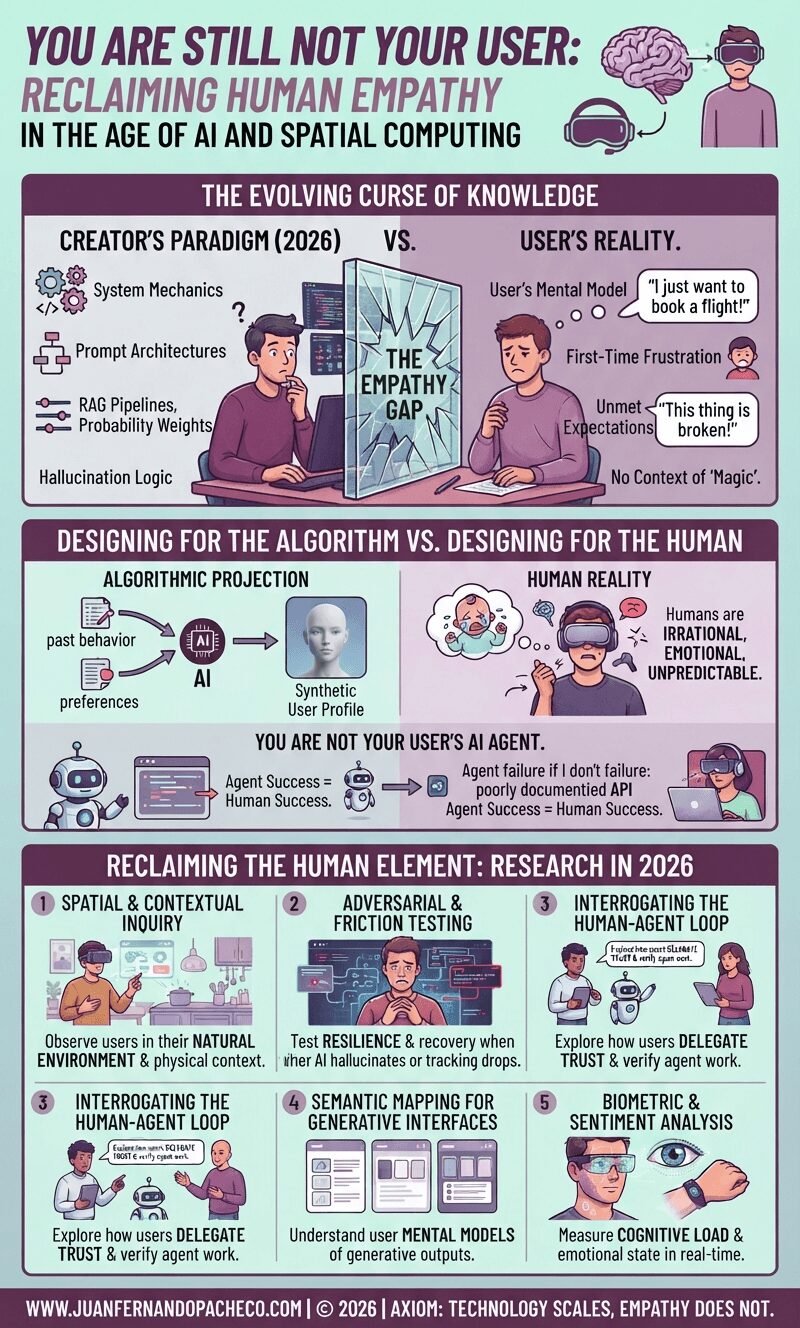
The Evolving Curse of Knowledge
To understand why this principle is so vital today, we must first look at how the “curse of knowledge” has mutated.
In the early 2010s, the curse meant that you, the designer, knew where the “Submit” button was hidden because you placed it there. You knew the information architecture because you built it.
In 2026, the curse is infinitely deeper. If you are designing a generative AI interface, you:
- Know the underlying prompt architecture.
- Understand the Retrieval-Augmented Generation (RAG) pipelines.
- Know how the system retrieves context, how it weighs probabilities, and why it hallucinates under certain conditions.
Because you understand the “magic” behind the curtain, you:
- Subconsciously expect the user to understand it too.
- Assume they know that they need to provide specific constraints in their prompt, or that the AI might need a moment to “think” before rendering a spatial 3D asset.
But your user doesn’t care about your transformer models or your spatial anchors.
They are coming to the product with the same fundamental mindset they have always had: they have a goal, and they believe your product will help them achieve it. When the generative interface outputs something unexpected, they don’t think,
“Ah, the temperature parameter on the LLM was set too high.” They think, “This thing is broken,” or worse, “This thing is lying to me.”
Your deep, intimate knowledge of the system’s mechanics blinds you to the user’s mental model. You are not your user, and you certainly do not share their paradigm.
Designing for the Algorithm vs. Designing for the Human
One of the most significant shifts in our industry over the last few years is the rise of adaptive and generative UI. Interfaces are no longer static; they change based on who is looking at them, what they are trying to do, and the context in which they are operating.
This is a massive leap forward for personalization, but it introduces a dangerous trap:
We start designing for the algorithm’s understanding of the user, rather than the user themselves.
When we rely heavily on predictive models to dictate the user experience, we risk creating a feedback loop of our own biases. The algorithm predicts what a user should want based on historical data, and we design the interface to serve that prediction. But humans are not merely the sum of their historical data points. Humans are irrational, emotional, easily distracted, and capable of sudden, unpredictable changes in intent.
If we are not careful, we end up building products that are perfectly optimized for a mathematical model of a user, but utterly frustrating for the actual human sitting on the other side of the screen—or wearing the headset.
Furthermore, we must now confront a reality that the original 52 Weeks of UX post could never have anticipated:
You are not your user’s AI agent.
In 2026, a significant portion of the “traffic” to our digital products isn’t coming from a human clicking a mouse. It is coming from autonomous AI agents acting on behalf of humans. Your user might have delegated the task of booking a flight, reconciling expenses, or researching a complex topic to a personal AI agent.
When an AI agent navigates your product, it does not experience “friction” the way a human does. It doesn’t get annoyed by a poorly labeled menu. It doesn’t feel the cognitive load of a cluttered dashboard. However, if your product’s API is poorly documented or if your generative UI lacks structured, machine-readable metadata, the agent will fail. And when the agent fails, the human user experiences frustration.
In this context, “knowing thy user” means understanding the symbiotic relationship between the human and their digital proxy. You must design for the human’s intent, but you must also build the structural integrity required for their agent to execute that intent flawlessly.
The Trap of Synthetic Empathy
Perhaps the greatest threat to the principle of you are not your user in 2026 is the allure of synthetic empathy.
With the advancement of large language models, we now have the ability to generate highly detailed user personas in seconds. We can simulate focus groups. We can run thousands of synthetic usability tests, having AI “personas” navigate our prototypes and generate heatmaps and feedback reports.
It is incredibly tempting to rely on this synthetic data. It is fast, it is cheap, and it scales infinitely. But it is also a profound illusion.
Synthetic users lack the physical, emotional, and contextual reality of human life.
An AI persona running a usability test on your new spatial computing application does not experience the physical fatigue of wearing a headset for two hours. It does not have a crying baby in the next room. It does not experience the anxiety of using a complex financial tool while commuting on a shaky train with a spotty neural-link connection.
The original 52 Weeks of UX post wisely noted that many users come to a product
“cautiously poking around, a little unsure due to previous experiences that left them confused and dissatisfied.”
Synthetic users do not carry the emotional baggage of past digital traumas. They do not have trust issues. They do not have bad days.
When we rely on synthetic empathy, we are ultimately just projecting our own logic, our own prompt engineering, and our own biases onto a machine. We are tricking ourselves into believing we have “known thy users“, when in reality, we have only known our own algorithms. Synthetic data is a powerful tool for identifying edge cases and stress-testing logic, but it is a terrible substitute for genuine human understanding.
Reclaiming the Human Element: Research in 2026
So, how do we practically apply the wisdom of you are not your user in a world dominated by AI and spatial computing?
We must update our research toolkit. The original post recommended user interviews, contextual inquiry, surveys, card sorting, and usability testing. These methods are still the bedrock of our practice, but they must evolve to meet the complexities of the modern era.
1. Spatial and Contextual Inquiry in the Real World
Contextual inquiry—observing users in their natural environment—is more critical than ever, but the “environment” has expanded. It is no longer just about watching someone sit at a desk. If you are designing for mixed reality, you need:
- Observe users in their living rooms, their workshops, and their offices.
- See how they navigate the physical-digital divide.
- Watch how they interact with a floating interface while they are simultaneously trying to cook dinner or hold a conversation.
The physical context dictates the digital experience in ways that a lab test can never capture.
2. Adversarial and Friction Testing
Traditional usability testing often focuses on the “happy path“—can the user complete the task? In 2026, because AI and predictive systems are so good at smoothing out the happy path, we need:
- Test the friction.
- Observe how users react when the generative AI hallucinates.
- See how they recover when the spatial tracking drops, or when the interface fails to understand their voice command.
Resilience is a key part of the user experience, and you cannot design for resilience if you only test for perfection.
3. Interrogating the Human-Agent Loop
User interviews must now explore the relationship between humans and their AI tools. When you sit down with a user, don’t just ask them how they use your product. Ask them:
- How they use their AI agents to interact with your product.
- What instructions do they give the agent?
- How do they verify the agent’s work?
Understanding this delegation of trust is crucial for designing products that serve both the human master and the digital servant.
4. Semantic Mapping for Generative Interfaces
Card sorting was traditionally used to establish the information architecture of a static menu. Today, we must use semantic mapping to understand how users conceptualize generative outputs. If your AI can generate a dozen different variations of a dashboard or a summary:
- How does the user categorize them?
- What mental models do they use to decide which variation is “correct”?
Understanding their semantic framework allows you to build better constraints and guidance into the generative process.
5. Biometric and Sentiment Analysis in Mixed Reality
Surveys and self-reported data have always been flawed; humans are notoriously bad at articulating how they actually feel.
In the era of spatial computing and advanced wearables, we have access to passive biometric data—eye tracking, pupil dilation, micro-expressions, and even heart rate variability. While this must be handled with the utmost respect for privacy and ethical consent, it provides an objective layer of data that reveals the cognitive load and emotional state of the user in real-time, bridging the gap between what they say and what they actually experience.
The Enduring Axiom
As we navigate the mid-2020s, it is easy to become intoxicated by the capabilities of our tools. We can generate code in seconds, simulate thousands of users in an afternoon, and build interfaces that adapt to the very gaze of the user. The temptation to retreat into the comfort of our own expertise—to assume that because we built the system, we understand the experience—is stronger than it has ever been.
But technology scales; empathy does not.
No matter how advanced our algorithms become, no matter how seamless our spatial computing environments feel, and no matter how autonomous our AI agents get, the fundamental truth of our profession remains unchanged. The people who use what we build are messy, unpredictable, physical, and deeply human. They do not share our knowledge, they do not share our context, and they certainly do not share our biases.
Socrates told us to know thyself. But as creators, our primary duty is to know our users. To do that in 2026, we must actively resist the comfort of synthetic data and the illusion of perfect prediction. We must step out from behind our generative dashboards, put on the headsets, go into the physical world, and watch real people struggle, adapt, and ultimately find value in what we have created.
You are not your user. You never were. And in a world increasingly mediated by machines, remembering that simple fact is the most human thing we can do.