This is the trick that will bankrupt you in … and the new framework to replace it.
Listen to me very carefully.
If you are still trying to use 2011 marketing tactics to sell in 2026, you aren’t just leaving money on the table. You are actively building a target on your back.
I was doing some deep-dive research last night, auditing the historical conversion rates of a legacy SaaS client. I ended up falling down a rabbit hole of old marketing forums and stumbled across a classic 2011 breakdown on something called black hat copywriting.
Back then, the internet was a completely different beast. It was the wild west of digital marketing. You could get away with murder if your funnel was slick enough and your server hosting was offshore.
The original article broke down a concept the author called the “Black Hat Inverted Pyramid.” It was a masterclass in deception, and it was making companies millions by exploiting human psychology.
But today? In the current landscape of June 2026?
If you try to pull the same trick, you won’t make millions. You will get your Stripe account banned, your ad accounts destroyed, and your reputation nuked from orbit.
Let me break down exactly what this was, why it worked, and, more importantly, the new 2026 framework you need to use instead.
The Anatomy of the 2011 “Black Hat” Trap
To understand where we are going, you need to understand where we came from.
The original article highlighted a UK-based credit score website. Let’s call them Credit Expert. Their entire business model was built on a single, deceptive piece of black hat copywriting.
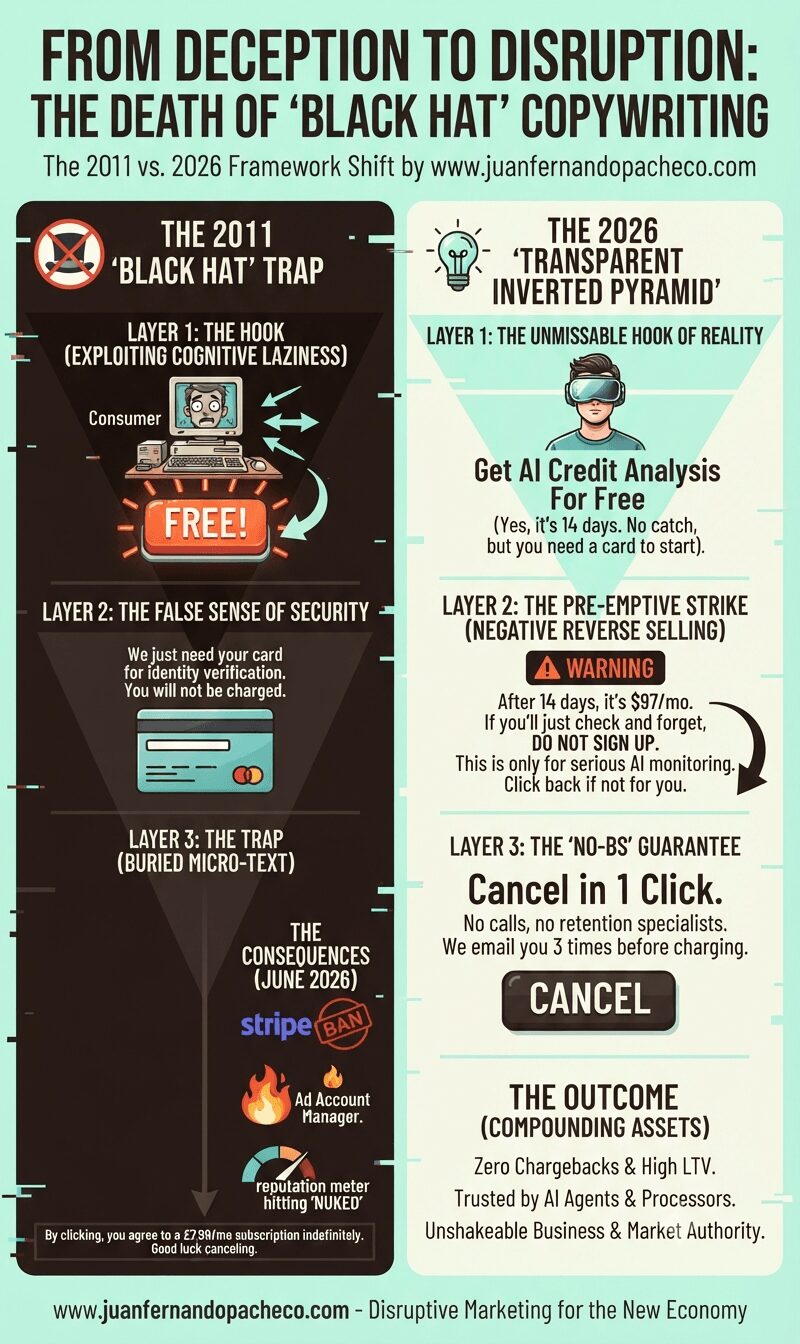
Here is exactly how the “Black Hat Inverted Pyramid” worked over the three layers below:
1: The Massive, Unmissable Hook
The top of the page screamed one word in giant, bold letters: FREE. They had big orange buttons. They had flashing arrows. The visual hierarchy of the page was designed to do one thing: get you to click that button.
2: The False Sense of Security
Once you clicked, you entered a wizard. They asked for your credit card details. Now, your brain naturally goes:
“Wait, I thought this was free? Why do you need my card?”
So, right above the credit card field, they placed a reassuring line of copy:
“We just need your card for identity verification. You will not be charged.”
Your brain exhales. The reptilian brain sees “FREE” and “NOT CHARGED.” It takes the path of least resistance. You enter your card.
3: The Trap (Buried in the Micro-Text)
Here is where the black hat copywriting element kicks in. Buried at the very bottom of the page, in a grey, size-9 font, was the actual truth: By clicking that button, you were agreeing to a 30-day free trial that automatically rolls over into a £7.99 per month subscription… indefinitely.
Unless you navigated a hidden maze of settings to cancel, they were going to bleed your credit card dry for years.
Did it work? Oh, it worked beautifully. The article pulled absolutely brutal consumer reviews. People were furious. They felt scammed. They were hit with unauthorized charges they forgot about.
But the company didn’t care. Because human beings are cognitively lazy. We scan pages at lightning speed. We don’t read the micro-text. The company weaponized our cognitive laziness to print money.
The 2026 Reality Check: Why This is Business Suicide Today
Now, fast forward 15 years. It is June 2026.
You might be sitting there thinking:
“Juan, that’s a brilliant funnel. The conversion rate on that must have been insane. I should tweak it and run it for my new AI SaaS.”
Stop. Right there.
If you try to use black hat copywriting today, you are not a genius. You are an idiot. Not because it’s morally wrong—though it absolutely is—but because the infrastructure of the internet has evolved to crush you.
Here is exactly what happens when you try to hide the catch in 2026:
1. You Are Fighting AI, Not Humans
In 2011, you were tricking a tired human scrolling on their iPhone. In 2026, consumers will have AI assistants and browser extensions that read the Terms and Conditions for them.
There are literal AI plugins that scan landing pages and highlight “dark patterns” in bright red. If your page has a “Black Hat Inverted Pyramid“, the consumer’s browser will literally flash a warning:
“WARNING: DECEPTIVE BILLING PRACTICE DETECTED.”
Furthermore, many users now employ personal AI agents to manage their subscriptions. If an AI agent reads your T&Cs and detects a hidden auto-renewal trap, it will automatically cancel the trial and flag your domain to a shared, global blacklist of deceptive merchants. You aren’t just losing one customer; you are getting blacklisted by the algorithms of millions.
2. The Payment Processor Algorithms Will Ban You Instantly
Do you think Stripe, PayPal, and the new 2026 fintech gateways are still using manual reviewers? No. They use advanced Large Language Models to scan your landing pages, your VSLs, and your checkout flows. Their AI is specifically trained to detect the exact linguistic patterns of black hat copywriting.
If it detects that your headline says “FREE” but your micro-text mentions an auto-renewing subscription, your merchant account is frozen before you process your first dollar. You are instantly unbankable.
3. The Ad Reviewers Will Torch Your Account
Meta, TikTok, and YouTube’s ad algorithms in 2026 are ruthless. They don’t just scan for policy violations; they scan for “misleading user experience“. If your ad promises a free tool, but the landing page uses deceptive inverted pyramid copy to hide a paywall, the ad AI will reject it. If you try to cloak it, they will permanently disable your Business Manager and ban your IP address.
4. The Chargeback Death Spiral
Let’s say you somehow use an AI cloaker to sneak it past the reviewers. You get the sale. But 30 days later, the customer realizes they are being charged. In 2011, they might have emailed support and waited on hold. In 2026, they don’t email you. They open their banking app and initiate a one-click chargeback. When your chargeback rate hits 1%, the card networks flag you. At 2%, they fine you. At 3%, they shut you down and hold your reserves for 180 days.
Black hat copywriting in 2026 isn’t a “hack.” It is a fast track to being digitally exiled.
The Psychological Shift: From “Cognitive Ease” to “Threat Detection”
So, does this mean the psychology of the inverted pyramid is dead? Does this mean we just write boring, corporate, honest copy and watch our conversion rates tank? Absolutely not.
Here is the secret that 99% of marketers miss.
The deception is dead. But the mechanism of the inverted pyramid is as powerful as ever.
You see, in 2011, the human brain’s primary survival mechanism online was “Cognitive Ease“. The brain wanted to save calories. It looked for the easiest path. “FREE” was the easiest path.
But in 2026, the internet is flooded with AI-generated spam, deepfake scams, and automated garbage. Because of this, the human brain’s primary survival mechanism has shifted.
It is no longer looking for “Cognitive Ease.” It is looking for “Threat Detection.”
The modern consumer’s BS Detector is calibrated to an all-time high. Their reptilian brain is constantly scanning for traps. When they see a page that tries to “sell” them too hard, or when they sense something is being hidden, their brain screams “DANGER.”
If you trigger that threat detection, they will bounce. It doesn’t matter how good your offer is.
So, how do we fix this?
You don’t throw away the inverted pyramid. You flip it.
You use the same psychological layering, but instead of hiding the trap, you use Radical Transparency as your ultimate weapon.
I call this the “Transparent Inverted Pyramid.”
The 2026 Framework: The “Transparent Inverted Pyramid”
In a world of AI spam and deepfake scams, the most disruptive, high-converting thing you can do in 2026 is be brutally, unapologetically honest.
When you tell the truth so aggressively that it shocks them, you instantly bypass their threat detection. You become their trusted advisor.
Here is how you build a 2026 funnel using this framework.
1st layer: The Unmissable Hook of Reality
You still need to lead with massive desire. You still need a big, bold headline. But you do not lie. And you do not omit the context.
If you have a free trial, you say it’s a free trial. But you attach the reality to it immediately.
Bad (2011 Black Hat):
“GET YOUR AI CREDIT REPORT FOR FREE!”
Good (2026 Transparent):
“Get Your Complete AI Credit Analysis For Free. (Yes, it’s actually free for 14 days. No catch, but you do need a card to start).”
See the difference? You still get the massive benefit. But you instantly neutralize the skepticism. You are speaking directly to the skeptic in their head.
2nd layer: The Pre-Emptive Strike
In 2011, the middle of the funnel was designed to lower defenses with false reassurances (“We just need this for identity verification”).
In 2026, the middle of your funnel must be a Pre-Emptive Strike. You must call out the “catch” before they even have the chance to think it. You use a technique called Negative Reverse Selling.
You literally tell them why they shouldn’t buy.
Example Copy:
“Look, after the 14 days, this service is $97 a month. I know that sounds expensive. If you are just going to check your credit once and forget about it, do NOT sign up. You will waste your money. This is only for the person who wants continuous, AI-driven monitoring every single week. If that’s not you, click the back button right now.”
Do you understand the psychological power of this?
When you tell a prospect not to buy, their brain instantly trusts you. Why? Because scammers never tell you to click the back button. By voicing your skepticism, you align yourself with them. You are no longer the predator; you are the protector.
3rd layer: The “No-BS” Guarantee
In 2011, the bottom of the inverted pyramid was a trap. The micro-text was designed to lock them in.
In 2026, the bottom of your funnel is your ultimate closer. You take the thing they are most afraid of—the cancellation process—and you make it ridiculously easy.
You don’t hide the cancellation policy in size-9 font. You put it in bold, size-14 font.
Example Copy:
“Here is my promise to you: If you don’t love this, you can cancel in exactly one click. You don’t have to call us. You don’t have to email us. You don’t have to talk to a retention specialist. You just click ‘Cancel’ on your dashboard, and it’s done. We will also email you 3 times before your trial ends so you never get accidentally charged.”
When you remove the fear of the trap, the conversion rate skyrockets.
The Real-World Math: Why Honesty Prints More Money
Let’s look at the actual business math of this shift.
Let’s go back to the 2011 Credit Expert model. They used black hat copywriting. They probably had a massive 15% conversion rate on their “free” offer. But because they tricked people, their chargeback rate was likely 20%. Their customer lifetime value (LTV) was a nightmare because everyone hated them and left terrible reviews. They had to spend millions on legal fees and PR to keep the business afloat.
Now, look at a 2026 company using the Transparent Inverted Pyramid. Because they are brutally honest about the price upfront, their initial conversion rate might drop to 8%.
But listen to me closely: Their chargeback rate is near 0%. Their customer LTV is massive because the people who do sign up actually want the service and aren’t angry about being tricked. Their ad accounts never get banned. Their payment processor loves them. Their AI agent partners whitelist their domain.
Which business would you rather own? The one that makes a quick buck and gets shut down in 6 months? Or the one that builds a compounding, unshakeable asset that prints money for a decade?
The Bottom Line
The era of black hat copywriting is over.
The internet grew up. The consumers got smarter. The algorithms got ruthless.
If you are still looking for “tricks” to hide your pricing, to deceive your prospects, or to manipulate the fine print, you are playing a losing game. You are trying to pickpocket people in a world where everyone has a security camera in their pocket.
Stop it.
Embrace the Transparent Inverted Pyramid. Lead with massive desire. Pre-emptively strike their skepticism. Guarantee their exit.
When you do that, you don’t just get a sale. You get a customer. And in 2026, a customer who trusts you is the most valuable asset on the planet.
Now get to work.