The ultimate guide to building products users actually love
As a UX designer with many years in the trenches, I’ve seen a brutal truth: Products built without UX research fail 80% of the time (Forrester).
UX research isn’t just “talking to users”—it’s the scientific engine powering human-centered design. Let’s dissect why it’s your most potent competitive weapon.
UX Research Defined: Beyond Surveys and Interviews
UX research is the systematic investigation of user behaviors, needs, and motivations to inform product decisions. Unlike academic research, it’s:
-
Action-oriented: Focused on immediate design impact
-
Iterative: Continuous throughout product cycles
-
Multimethod: Blends qualitative and quantitative approaches
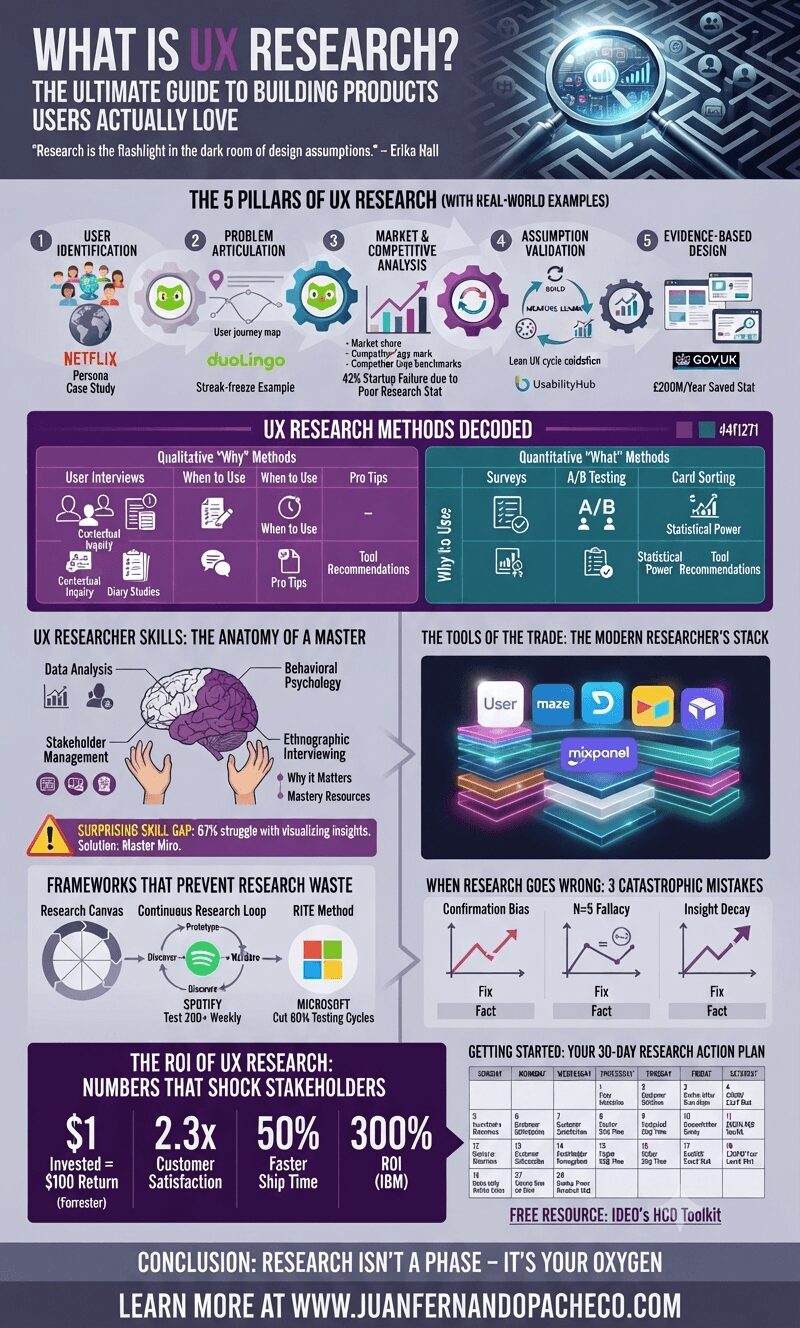
“Research is the flashlight in the dark room of design assumptions.” – Erika Hall, Author of Just Enough Research
The 5 Pillars of UX Research (With Real-World Examples)
-
User Identification
-
Creates data-driven user personas (not assumptions)
-
Tool: Xtensio for persona templates
-
Case Study: Netflix’s global personas revealed regional content preferences, driving localization strategy (Source: Netflix Tech Blog)
-
-
Problem Articulation
-
Uncovers unspoken needs via journey mapping
-
Framework: Service Blueprinting (NN/g Guide)
-
Example: Duolingo’s research found users felt “guilty” about skipped lessons – leading to streak-freeze features
-
-
Market & Competitive Analysis
-
Uses heuristic evaluation to benchmark competitors
-
Tool: SimilarWeb for traffic analysis
-
Stat: 42% of startups fail due to poor market research (CB Insights)
-
-
Assumption Validation
-
Tests hypotheses with rapid prototyping
-
Method: Concept Testing with UsabilityHub
-
Framework: Lean UX cycle (Build-Measure-Learn)
-
-
Evidence-Based Design
-
Replaces opinions with behavioral data
-
Tool: Hotjar for session recordings
-
Example: GOV.UK saved £200M/year by simplifying forms based on research (Government Digital Service)
-
UX Research Methods Decoded
Qualitative “Why” Methods
| Method | When to Use | Pro Tip |
|---|---|---|
| User Interviews | Early discovery phase | “Ask ‘What?’ before ‘Why?’” – avoid leading questions |
| Contextual Inquiry | Complex workflows (e.g., healthcare IT) | Record sessions (with consent!) |
| Diary Studies | Long-term behavior tracking | Use Dscout for mobile journaling |
Quantitative “What” Methods
| Method | Statistical Power | Tool Recommendation |
|---|---|---|
| Surveys | Validating feature demand | Typeform for branching logic |
| A/B Testing | Optimizing UI elements | Optimizely for enterprise tests |
| Card Sorting | Information architecture | OptimalSort for remote sorting |
Critical Insight: The best researchers use triangulation – combining 3+ methods (e.g., interviews + analytics + usability tests) for robust insights.
UX Researcher Skills: The Anatomy of a Master
Based on industry studies and my hiring experience:
| Core Skill | Why It Matters | Mastery Resource |
|---|---|---|
| Data Analysis | Finds patterns in chaos | Google’s Advanced Data Analytics Certificate |
| Behavioral Psychology | Predicts user decisions | Influencer by Robert Cialdini |
| Stakeholder Management | Sells research to executives | Articulating Design Decisions by Tom Greever |
| Ethnographic Interviewing | Uncovers subconscious needs | NN/g’s User Interview Course |
Surprising Skill Gap: 67% of researchers struggle with visualizing insights for designers (2023 UXPA Report). Solution: Master Miro for collaborative synthesis.
Tools of the Trade: The Modern Researcher’s Stack
-
Recruitment: User Interviews (for B2B panels), Respondent (for niche audiences)
-
Remote Testing: Lookback.io (live sessions), Maze (unmoderated prototype testing)
-
Synthesis: Dovetail (AI-powered tagging), Airtable (research repository)
-
Analytics: Mixpanel for behavioral flows, FullStory for frustration signals
Pro Tip: Build a single source of truth research repository. Atlassian saw 40% faster onboarding using Confluence for insights (Case Study).
Frameworks That Prevent Research Waste
-
Research Canvas (by UXPressia)
-
Aligns team on objectives, methods, and success metrics upfront
-
-
Continuous Research Loop
Discover → Prototype → Validate → Implement → Measure → Discover
-
Used by Spotify to test 200+ features weekly (Spotify Labs)
-
-
RITE Method (Rapid Iterative Testing and Evaluation)
-
Fix usability issues after one observed failure
-
Cut Microsoft’s testing cycles by 60% (Microsoft Research)
-
When Research Goes Wrong: 3 Catastrophic Mistakes
-
Confirmation Bias
-
Solution: Use blind testing where researchers don’t know the hypothesis
-
-
N=5 Fallacy
-
Fact: 5 users find 85% of usability issues (NN/g) – but 0% of market needs!
-
Fix: Pair usability tests with quantitative surveys
-
-
Insight Decay
-
Data: User needs shift 37% every 6 months (Gartner)
-
Solution: Quarterly research refreshes
-
The ROI of UX Research: Numbers That Shock Stakeholders
-
Every $1 invested in UX returns $100 (Forrester)
-
Research-driven products see 2.3x higher customer satisfaction (Qualtrics)
-
Teams using research repositories ship features 50% faster (McKinsey)
Case Study: After IBM embedded researchers in design teams, they saw a 300% ROI via reduced rework (IBM Design Research)
Getting Started: Your 30-Day Research Action Plan
-
Week 1: Conduct 5 “Why?” interviews with churned users
-
Week 2: Run a heuristic evaluation against top competitors
-
Week 3: Prototype one hypothesis using Figma
-
Week 4: Test with 5 users via Maze
Free Resource: IDEO’s Human-Centered Design Toolkit
The Future: AI’s Research Revolution
-
Synthetic Users: Test concepts instantly with AI personas (e.g., UserTesting AI)
-
Predictive Analytics: Tools like Heatmap.com forecast usability issues
-
Ethical Guardrails: UNESCO’s AI Ethics Framework for Responsible Research
Conclusion: Research Isn’t a Phase – It’s Your Oxygen
UX research transforms gut feelings into actionable intelligence. As Adobe’s VP of Design once told me: “Designers argue. Researchers prove.” In 2024, research isn’t optional – it’s the bedrock of product survival.
Recommended Reading:
-
Rocket Surgery Made Easy by Steve Krug
-
ResearchOps Community for scaling research