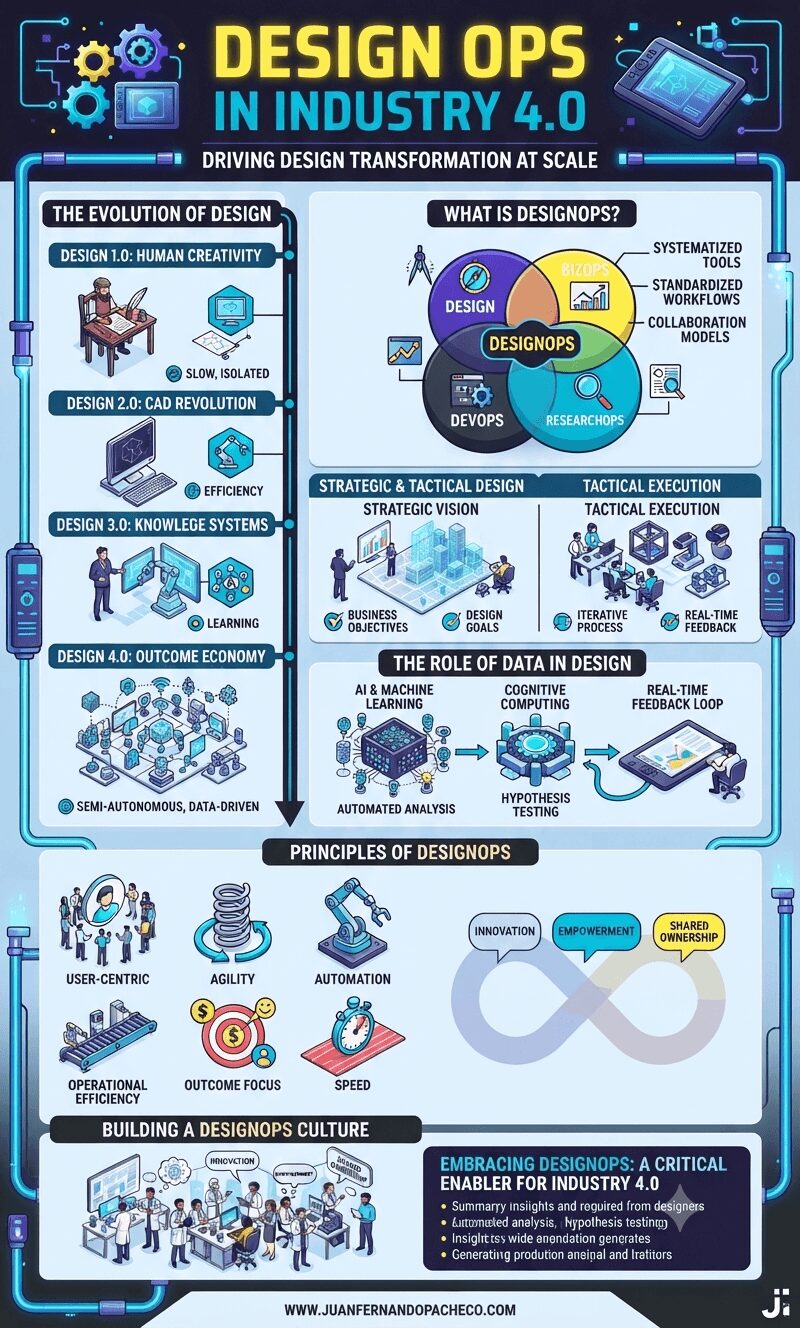
A comprehensive vertical infographic titled "Design Ops in Industry 4.0: Driving Design Transformation at Scale," with a new color palette of light blues, purples, teals, and yellow accents against a #edf5fc background. The infographic is structured in clear, stacked sections: "The Evolution of Design" (1.0 to 4.0), a central "What is DesignOps?" Venn diagram, "Strategic & Tactical Design," "The Role of Data in Design," "Principles of DesignOps" (User-Centric, Agility, Automation, Operational Efficiency, Outcome Focus, Speed), "Building a DesignOps Culture," and "Embracing DesignOps: A Critical Enabler for Industry 4.0." Small illustrations, icons, and connecting lines guide the eye. The bottom includes a reference to www.juanfernandopacheco.com.

As organizations navigate the complexities of Industry 4.0, DesignOps emerges as a critical enabler of success. By operationalizing design, fostering collaboration, and leveraging data, companies can deliver innovative solutions at scale.

Embracing DesignOps is not just about optimizing processes; it’s about transforming how businesses think, design, and deliver value in a rapidly changing world.
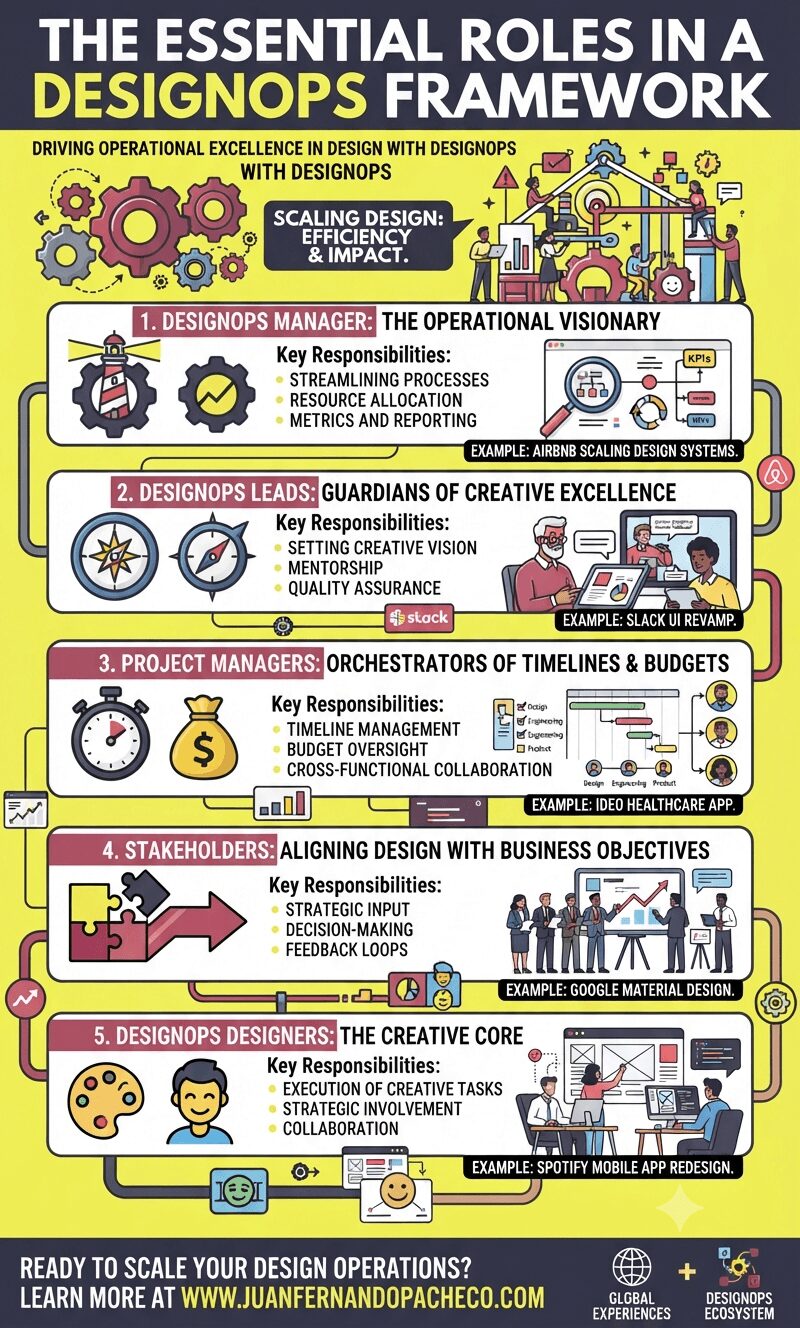
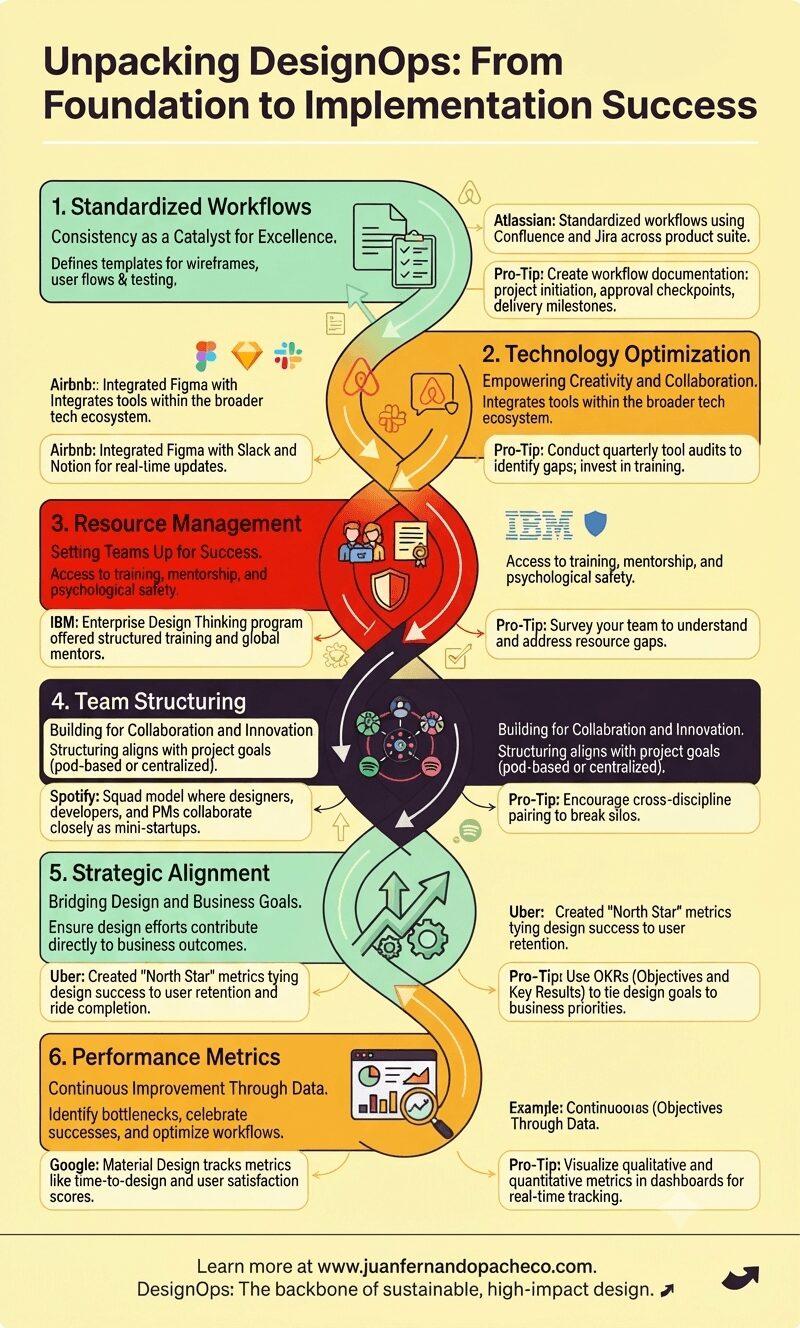
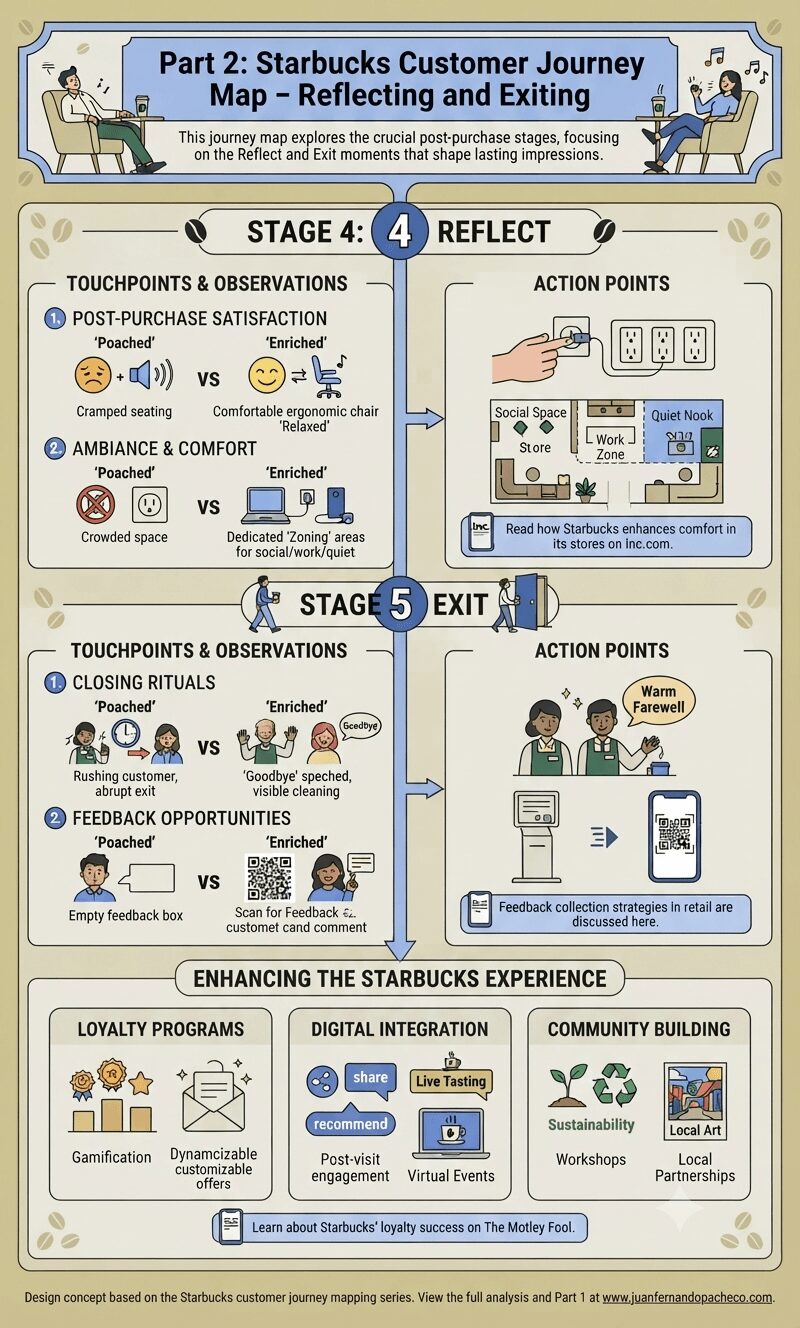
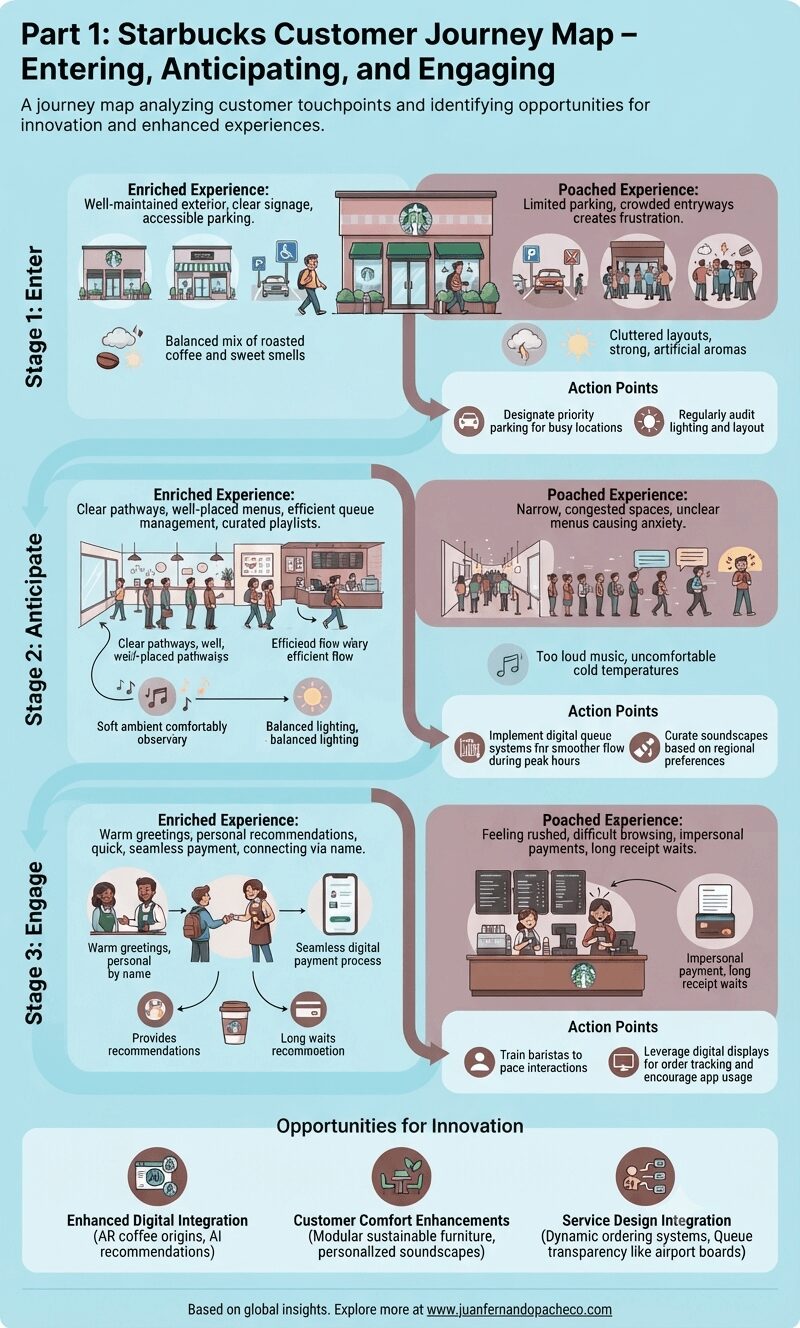
A vertical infographic titled "The Essential Roles in a DesignOps Framework" on a bright yellow background, detailing five key roles. From top to bottom: 1. DesignOps Manager (Lighthouse icon), responsible for processes, resources, metrics (with an Airbnb example). 2. DesignOps Leads (Compass icon), focused on vision, mentorship, quality assurance (with a Slack example). 3. Project Managers (Stopwatch icon), managing timelines, budgets, and collaboration (with an IDEO example). 4. Stakeholders (Puzzle piece icon), aligning design with business objectives (with a Google example). 5. DesignOps Designers (Palette icon), the creative core executing tasks and collaborating (with a Spotify example). The bottom features a call to action for www.juanfernandopacheco.com.

The rapid pace of digital transformation has propelled organizations to place greater emphasis on design as a strategic lever for innovation and customer satisfaction.

Yet, scaling design efforts across teams, tools, and workflows remains a formidable challenge. This is where DesignOps (Design Operations) emerges as a critical discipline, providing the scaffolding for designers to focus on what they do best: creating impactful experiences.

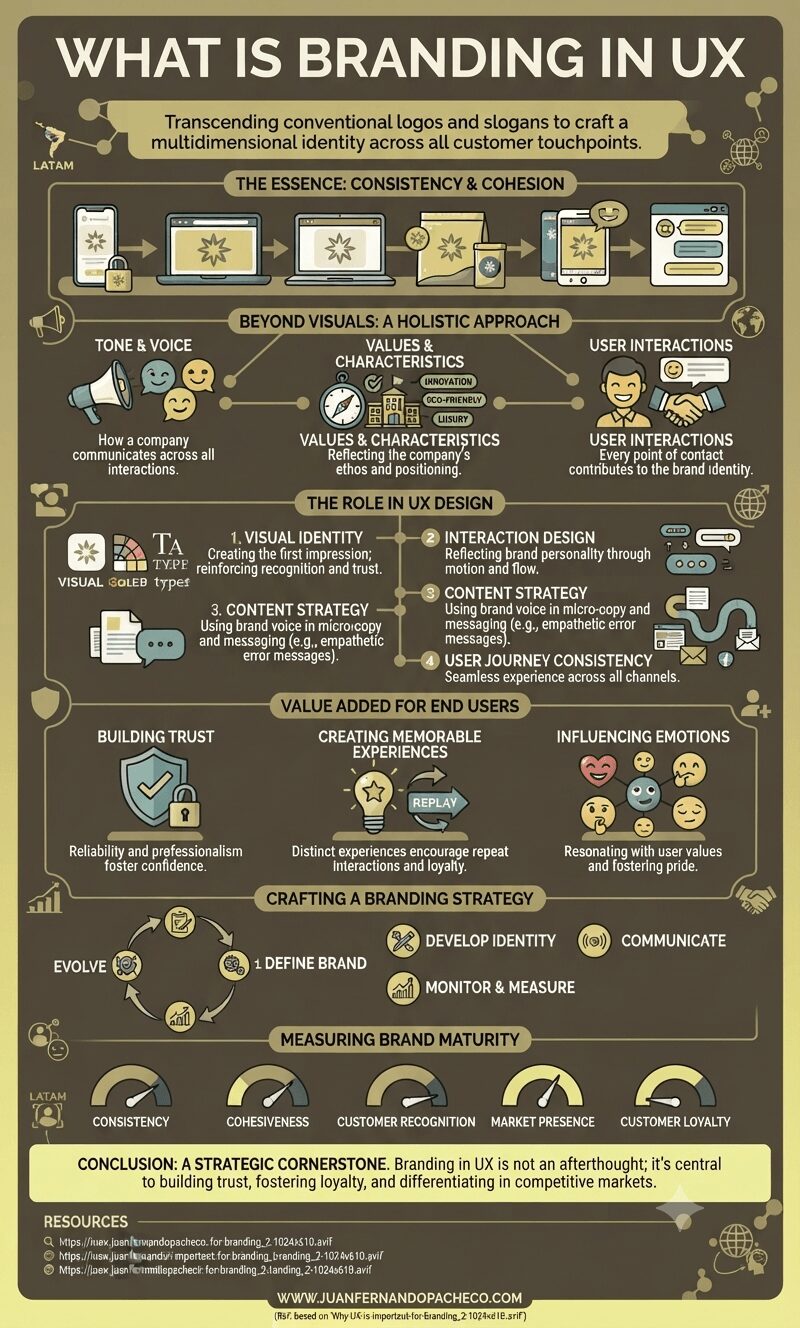
An expansive, dark-teal infographic titled "WHAT IS BRANDING IN UX" with a creative, illustrative layout. The design uses a color palette of olive, gold, and light yellow, featuring a central path and interconnected sections. Key areas include "THE ESSENCE: CONSISTENCY & COHESION" (with icons of devices and packaging), "BEYOND VISUALS: A HOLISTIC APPROACH" (tone, values, interactions), "THE ROLE IN UX DESIGN" (visuals, interaction, content, journey), "VALUE ADDED FOR END USERS" (trust, experiences, emotions), "CRAFTING A BRANDING STRATEGY" (a five-step circular flow), and "MEASURING BRAND MATURITY" (a series of gauges). The infographic includes the LATAM geo identifier, illustrative icons, and website reference: WWW.JUANFERNANDOPACHECO.COM.

Branding from a UX perspective is a strategic endeavor that goes beyond visuals. It’s about creating a consistent, cohesive, and memorable experience that resonates with users at every touchpoint. By integrating branding into UX design, companies can build trust, foster loyalty, and differentiate themselves in competitive markets.

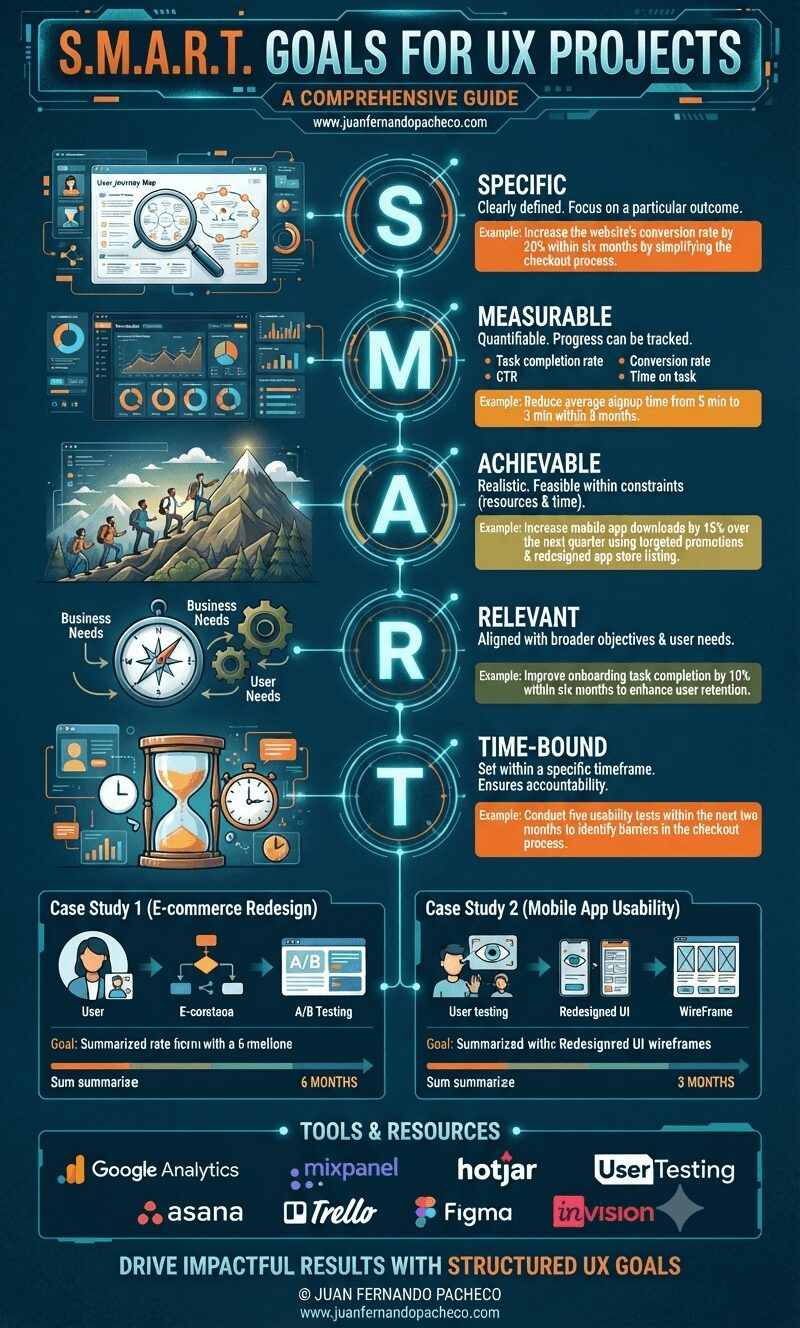
A comprehensive vertical infographic titled "S.M.A.R.T. Goals for UX Projects" on a dark teal background. It breaks down each S.M.A.R.T. component (Specific, Measurable, Achievable, Relevant, Time-bound) with definitions, icons, and real-world examples. The infographic also includes two UX case studies (E-commerce Redesign and Mobile App Usability), a list of "Tools & Resources," and branding for "juanfernandopacheco.com".

Setting clear, actionable, and achievable goals is critical to the success of any UX project.
Without defined objectives, measuring progress, evaluating outcomes, or ensuring alignment with user and business needs becomes challenging.

That’s where the S.M.A.R.T. framework comes in. In this post, we’ll explore how to write S.M.A.R.T. goals for UX projects and why this approach can dramatically improve project outcomes.

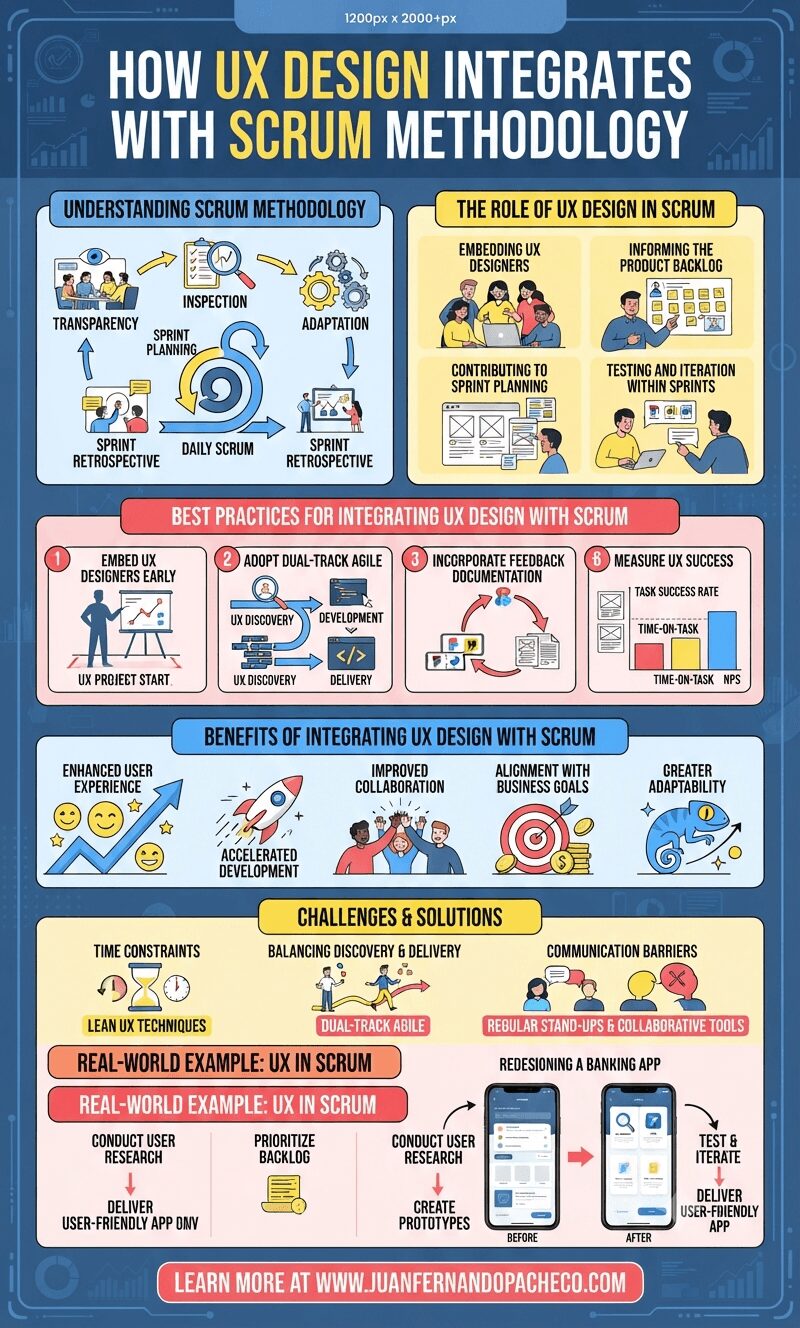
An infographic titled "How UX Design Integrates with Scrum Methodology," utilizing a color palette of blues, yellows, and reds on a dark blue background. The image is a comprehensive guide divided into sections: Understanding Scrum Methodology, The Role of UX Design in Scrum, Best Practices (including "Dual-Track Agile"), Benefits (Enhanced User Experience, Accelerated Development), Challenges & Solutions (Lean UX), a Real-World Example (Redesigning a Banking App), and a call-to-action URL.

Integrating UX design into Scrum is more than a best practice; it’s a necessity for delivering products that resonate with users. By embedding UX designers in teams, leveraging agile design methods, and prioritizing user feedback, organizations can achieve faster development cycles, improved collaboration, and superior user experiences.

As the demand for user-centric products grows, mastering the integration of UX design with Scrum will remain a critical skill for successful product teams.

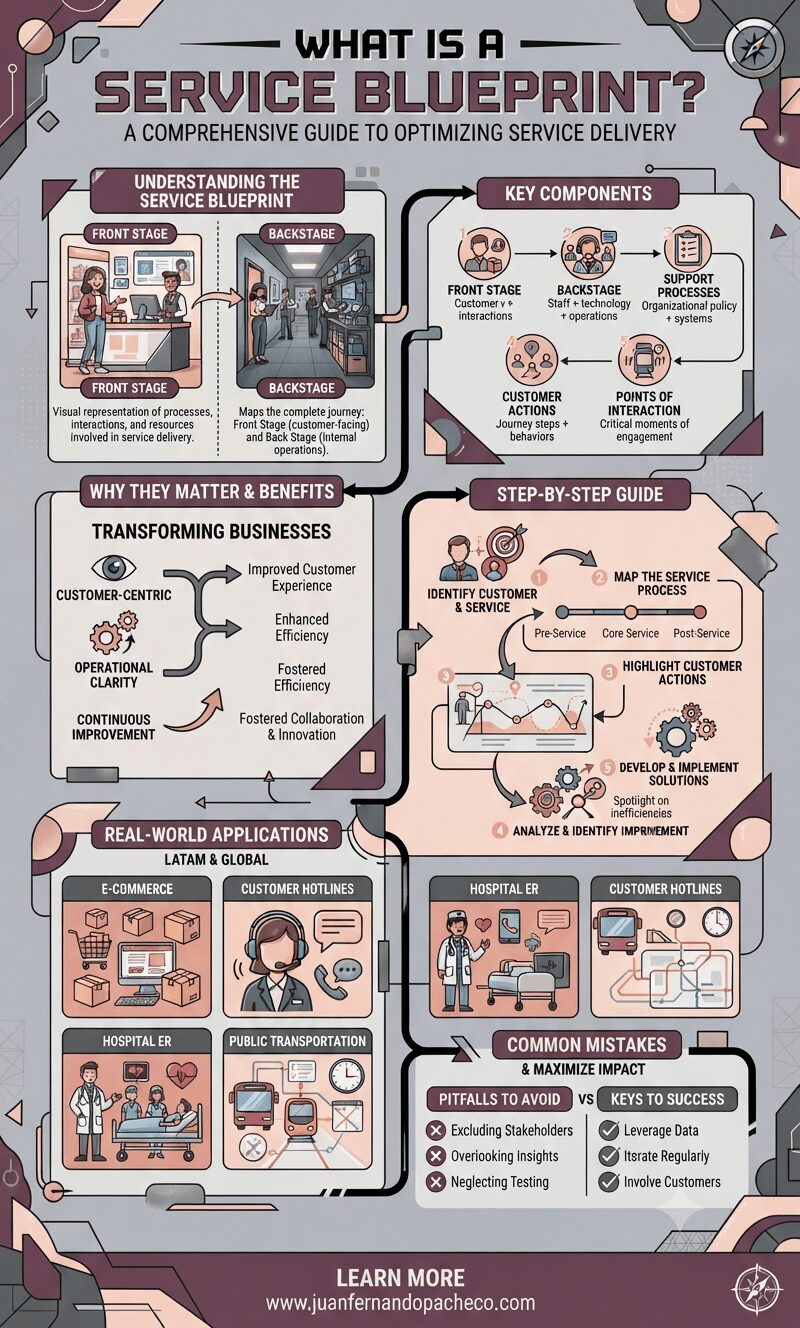
An illustrated infographic titled "What is a Service Blueprint? A Comprehensive Guide to Optimizing Service Delivery," featuring segmented sections on understanding, components, benefits, step-by-step creation, real-world applications in LATAM and global contexts, and common mistakes to avoid.

A service blueprint is an invaluable tool for organizations looking to optimize their service delivery. By providing a comprehensive view of the service process—from customer interactions to backend operations—it enables businesses to identify opportunities for improvement, foster collaboration, and innovate effectively.

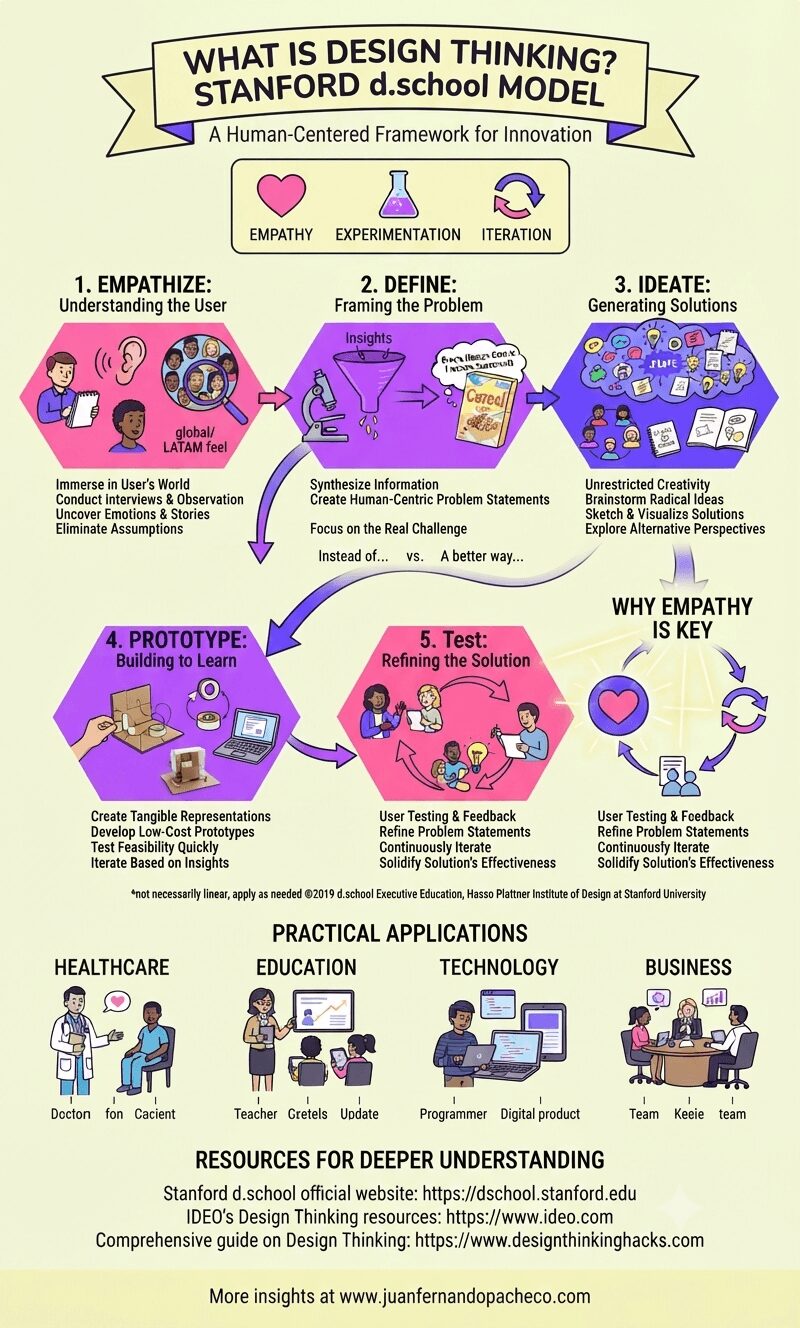
Infographic illustrating the five stages of the Stanford d.school Design Thinking model: Empathize, Define, Ideate, Prototype, and Test, presented as an interconnected, non-linear process with examples and applications for a global and LATAM context.

The Stanford d.school’s Design Thinking model is more than a methodology; it’s a mindset that fosters creativity, innovation, and human-centered problem-solving.

By emphasizing empathy, iteration, and flexibility, it equips teams to tackle complex challenges and deliver impactful solutions.

Whether you’re a seasoned designer or a newcomer to the field, embracing this model can transform how you approach problems, unlocking new possibilities for success.

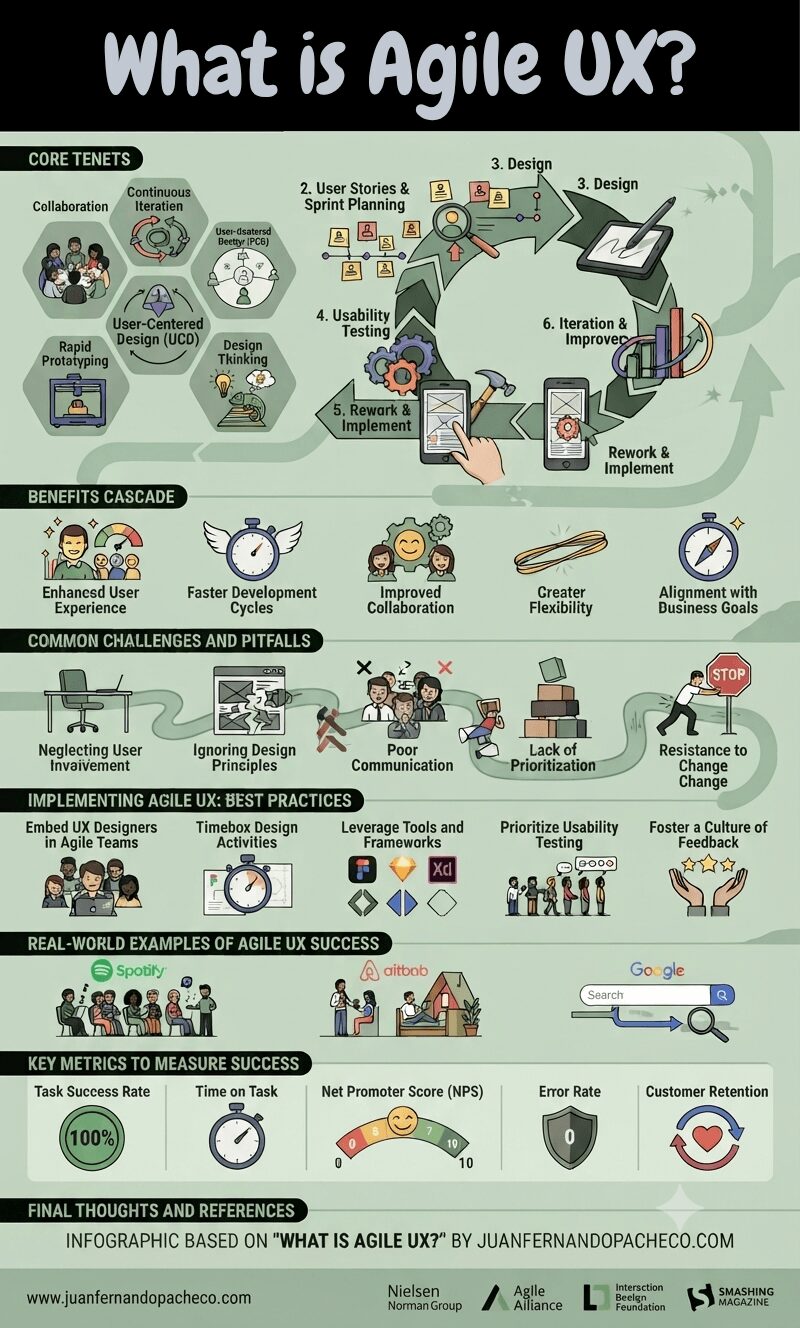
A detailed infographic titled "WHAT IS AGILE UX?" presented as a structured guide on a light green background. It covers six main sections: "CORE TENETS" (Collaboration, Continuous Iteration, User-Centered Design, Rapid Prototyping, Design Thinking, Design), the "AGILE UX PROCESS" (a 6-step circular flow from Planning to Iteration), "BENEFITS CASCADE" (User Experience, Development Cycles, Collaboration, Flexibility, Business Goals), "COMMON CHALLENGES AND PITFALLS" (Neglecting User Involvement, Ignoring Principles, Poor Communication, Lack of Prioritization, Resistance to Change), "IMPLEMENTING AGILE UX: BEST PRACTICES" (Embed Designers, Timebox Activities, Leverage Tools, Prioritize Testing, Foster Feedback), "REAL-WORLD EXAMPLES" (Spotify, Airbnb, Google), "KEY METRICS TO MEASURE SUCCESS" (Success Rate, Time on Task, NPS, Error Rate, Retention), and "FINAL THOUGHTS AND REFERENCES."

Agile UX is a user experience design methodology that integrates seamlessly with Agile software development principles.
It emphasizes collaboration, flexibility, and continuous iteration to create user-centric and high-quality products.