Unpacking the critical differences that drive product success
In today’s digital battleground, user experience (UX) isn’t just a buzzword—it’s the make-or-break factor separating industry leaders from forgotten failures.
While “UX” is often used as a blanket term, it houses two distinct, equally vital roles: UX Researcher and UX Designer. Though their work is deeply interconnected, conflating these roles is like mistaking a cartographer for an architect. One charts the terrain; the other builds the structures. Let’s dissect their differences, synergies, and why both are indispensable.
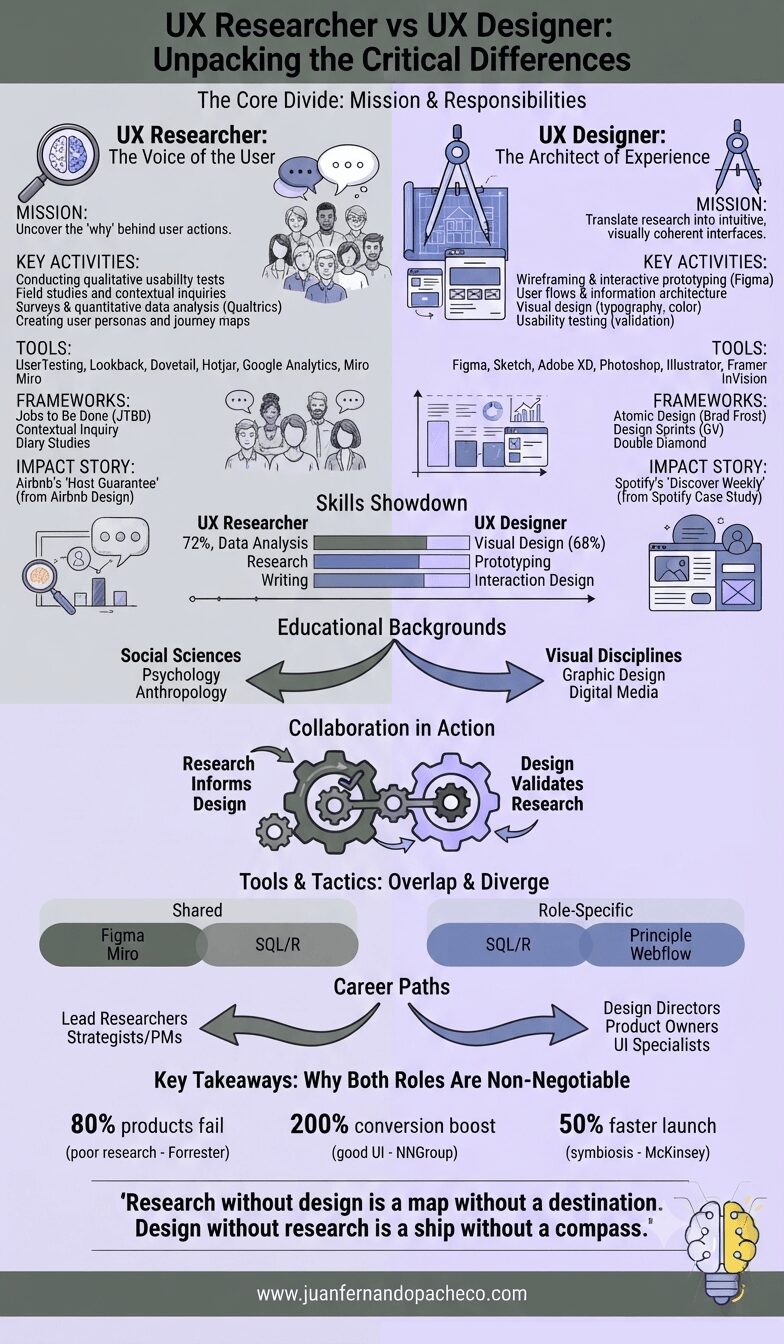
The Core Divide: Mission & Responsibilities
UX Researcher: The Voice of the User
UX Researchers are behavioral scientists. Their mission: uncover the “why” behind user actions. They translate human complexities into actionable insights.
Key Activities:
-
Conducting qualitative usability tests (e.g., observing users navigate a prototype).
-
Field studies and contextual inquiries (studying users in their natural habitat).
-
Surveys and quantitative data analysis (e.g., using tools like Qualtrics).
-
Creating user personas and journey maps (synthesizing research into archetypes).
Tools of the Trade:
-
Research Platforms: UserTesting, Lookback, Dovetail.
-
Analytics Tools: Hotjar, Google Analytics, Maze.
-
Synthesis: Miro for affinity mapping, Notion for repository management.
Frameworks & Methodologies:
-
Jobs to Be Done (JTBD): Identifying core user “jobs” (e.g., “I need to share files securely”).
-
Contextual Inquiry: Immersive observation (NN/g recommends this for complex workflows).
-
Diary Studies: Longitudinal tracking of user behavior.
Real-World Impact: At Airbnb, researchers discovered hosts felt anxious about damage. This led to the “Host Guarantee” feature—reducing friction and boosting trust (Source: Airbnb Design).
UX Designer: The Architect of Experience
UX Designers are solution engineers. They transform research insights into intuitive, visually coherent interfaces.
Key Activities:
-
Wireframing and interactive prototyping (e.g., using Figma).
-
Crafting user flows and information architecture.
-
Visual design (typography, color systems, UI components).
-
Usability testing for design validation (collaborating with researchers).
Tools of the Trade:
-
Prototyping: Figma, Sketch, Adobe XD.
-
Visual Design: Photoshop, Illustrator, Framer.
-
Collaboration: InVision, Zeplin.
Frameworks & Methodologies:
-
Atomic Design (Brad Frost): Building UIs from modular components.
-
Design Sprints (GV): Rapid prototyping in 5 days.
-
Double Diamond: Divergent/convergent thinking for problem-solving.
Real-World Impact: Spotify’s “Discover Weekly” leveraged designers to translate data (from researchers) into a personalized UI, driving 40M+ user engagements weekly (Source: Spotify Case Study).
Skills Showdown: Where Their Talents Diverge
(Data sourced from industry studies)
| Skill | UX Researcher | UX Designer |
|---|---|---|
| Most Desired Skill | Data Analysis (72%) | Visual Design (68%) |
| Top Skills | Research, Writing, Public Speaking | Prototyping, Visual Design, Research |
| Key Differentiators | Statistical literacy, Ethnographic interviewing | Interaction design, UI aesthetics, Motion design |
Why It Matters: Researchers thrive in ambiguity (e.g., interpreting open-ended interview data). Designers excel in structured creativity (e.g., translating a user flow into a pixel-perfect layout).
Educational Backgrounds: Paths to Mastery
-
UX Researchers: Often hail from social sciences (psychology, anthropology) or humanities. Degrees emphasize critical analysis, ethics, and human behavior.
-
UX Designers: Typically trained in visual disciplines (graphic design, digital media) or product design. Education focuses on form, function, and technical execution.
Industry Shift: Bootcamps like General Assembly and CareerFoundry now bridge gaps, teaching designers research basics and researchers prototyping skills.
Collaboration in Action: The Yin and Yang of Product Development
When researchers and designers sync, magic happens:
-
Research Informs Design:
-
Researchers identify a user pain point (e.g., “checkout takes too long”).
-
Designers prototype solutions (e.g., a one-click purchase flow).
-
-
Design Validates Research:
-
Designers create an A/B test (e.g., Button A vs. Button B).
-
Researchers analyze results to guide iterations.
-
Case Study: At Dropbox, researcher-design duos reduced sign-up friction by 10% by pairing field study insights with iterative prototyping (Source: Dropbox Design).
Tools & Tactics: How They Overlap and Diverge
Shared Toolkit:
-
Figma: Researchers use it for usability test prototypes; designers for high-fidelity mockups.
-
Miro: Collaborative synthesis (researchers) and wireframing (designers).
-
User Interviews: Both conduct sessions, but researchers focus on why, designers on how.
Role-Specific Arsenal:
-
Researchers: SQL for data mining, R/Python for statistical analysis.
-
Designers: Principle for animations, Webflow for no-code development.
Career Paths: Where Can These Roles Take You?
-
UX Researchers → Lead Researchers, UX Strategists, Product Managers.
-
UX Designers → Design Directors, Product Owners, UI Specialists.
Hybrid Roles Emerge: “UX Unicorns” (researcher-designers) thrive in startups, while larger firms favor specialization.
Key Takeaways: Why Both Roles Are Non-Negotiable
-
Researchers prevent costly missteps: 80% of products fail due to poor user research (Forrester).
-
Designers drive engagement: Good UI can boost conversion rates by 200% (NNGroup).
-
Symbiosis beats silos: Teams with dedicated researchers AND designers launch products 50% faster (McKinsey).
Conclusion: Building Bridges, Not Silos
UX Researchers and Designers aren’t rivals—they’re co-pilots navigating the same destination: user delight. Researchers illuminate the path with data; designers pave it with ingenuity. In an era where user expectations skyrocket daily, investing in both isn’t optional—it’s existential.
“Research without design is a map without a destination. Design without research is a ship without a compass.”
Further Reading:
Tools Deep Dive:
-
Research: Dovetail, UserTesting