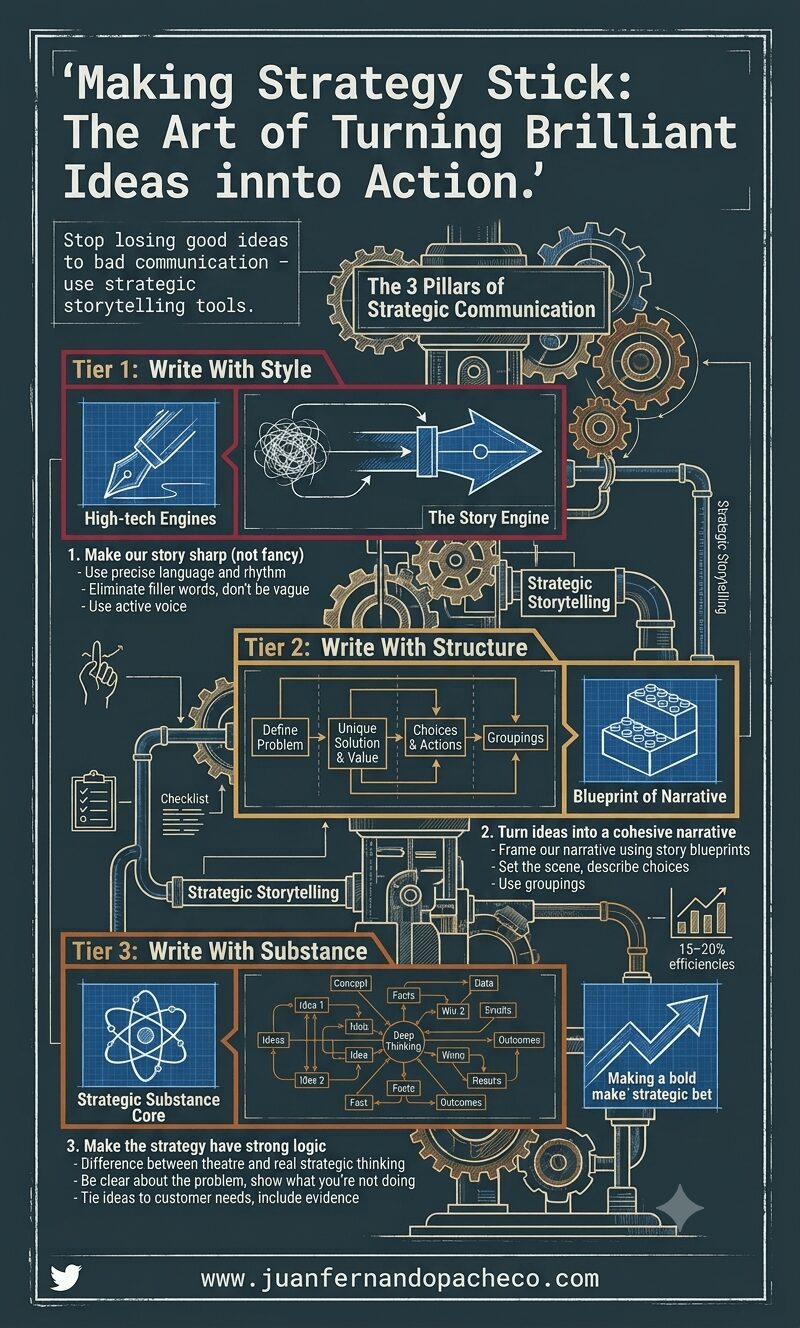
A detailed, schematic-style infographic presented as a technical blueprint with the title "Making Strategy Stick: The Art of Turning Brilliant Ideas into Action." Near the top, text states, "Stop losing good ideas to bad communication - use strategic storytelling tools." The visual is organized into three interlocking tiers, labeled "The 3 Pillars of Strategic Communication," all integrated with mechanical gears, pipes, circuits, and flowcharts against a dark background. Tier 1: Write With Style (orange box) includes visual analogies of "High-tech Engines" and "The Story Engine," with steps like "Make our story sharp (not fancy)" and "Use active voice." Tier 2: Write With Structure (yellow box) features a flowchart "Blueprint of Narrative" with steps for "Define Problem" and "Groupings," and steps like "Turn ideas into a cohesive narrative." Tier 3: Write With Substance (blue box) shows a complex nested mind-map diagram, "Strategic Substance Core," with a "Deep Thinking" schematic, and steps like "Make the strategy have strong logic" and "Tie ideas to customer needs." The image uses blueprint icons like an atom, flowcharts, and a gear network to illustrate a complete strategy-to-action engine.

Great strategies fail when communication fails. Discover the three essential pillars—style, structure, and substance—that transform complex ideas into clear, actionable narratives that drive results in enterprise deals and organizational change.

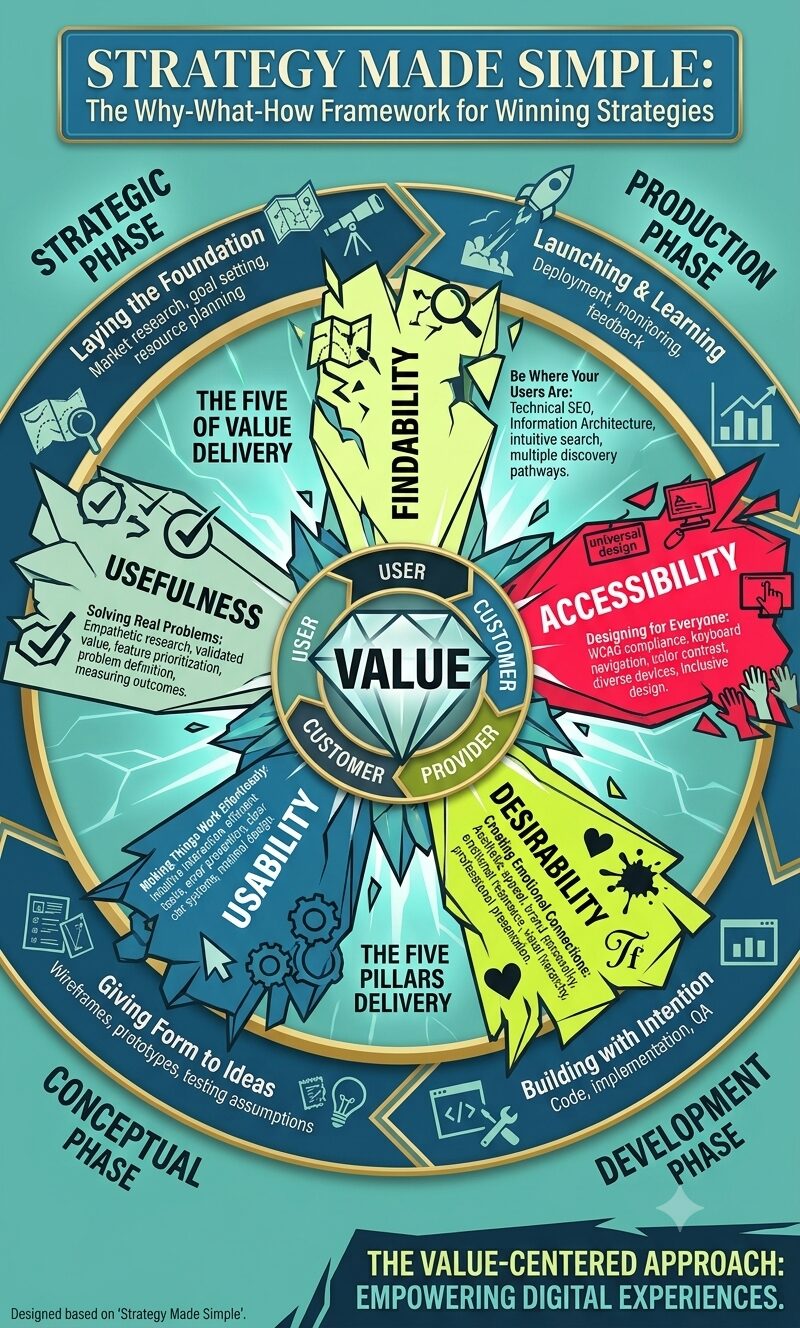
An infographic designed for the post "Strategy Made Simple: The Why-What-How Framework for Winning Strategies," presented in a vertical, 1,200 x 2,000 pixel format. The infographic utilizes a high-contrast color palette of teal, blue, yellow-green, red, and black, against a teal (#70C1B3) background. The central element is a large, fractured-style wheel labeled 'VALUE' at the very core, with text segments 'User, Customer, Provider' connecting to it. Radiating from this center are five angular, crystalline spokes representing the 'Five Pillars': Findability, Accessibility, Desirability, Usability, and Usefulness, each containing brief descriptive text. Surrounding this central wheel is a multi-layered, shattered ring with jagged edges, segmented into the 'Four Phases' of the framework, labeled in clockwise order: 'STRATEGIC PHASE: Laying the Foundation', 'CONCEPTUAL PHASE: Giving Form to Ideas', 'DEVELOPMENT PHASE: Building with Intention', and 'PRODUCTION PHASE: Launching & Learning'. Each segment includes 3-4 bullet points from the text description, linked by stylized energy lines. The overall style is modern and digital, with glowing effects, dynamic typography, and a powerful, almost explosive composition that visualizes interconnected strategy. The main post title, "STRATEGY MADE SIMPLE," is at the top in large, bold letters, and the framework title, "THE WHY-WHAT-HOW FRAMEWORK FOR WINNING STRATEGIES," is below it. The bottom of the image shows a call to action: "EMBRACE THE VALUE-CENTERED APPROACH. CREATE MEANINGFUL DIGITAL EXPERIENCES."

Discover a comprehensive approach to creating digital products that deliver real value by balancing findability, accessibility, desirability, usability, and usefulness. This timeless framework guides teams through strategic, conceptual, development, and production phases to build experiences that matter.
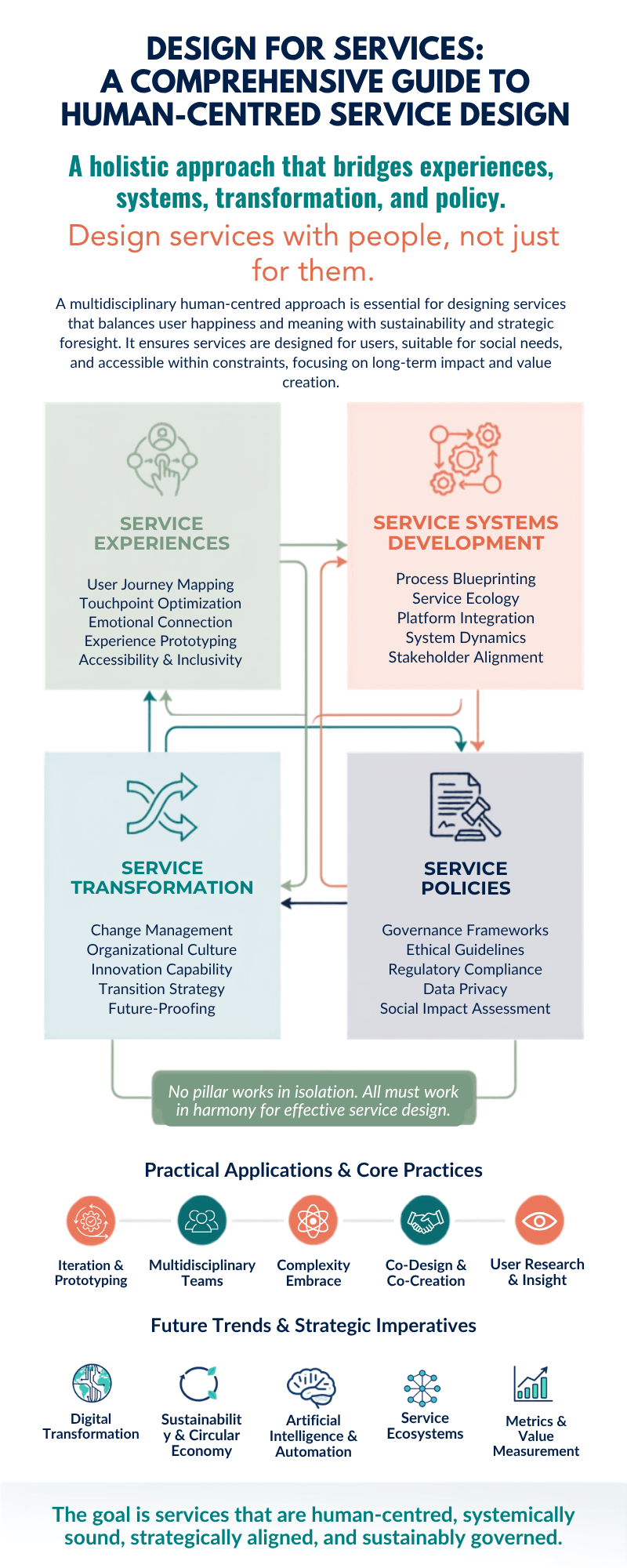
Infographic showing Design for Services framework with four interconnected pillars: Service Experiences (user journey mapping, touchpoint optimization, emotional connection, experience prototyping, accessibility & inclusivity), Service Systems Development (process blueprinting, service ecology, platform integration, system dynamics, stakeholder alignment), Service Transformation (change management, organizational culture, innovation capability, transition strategy, future-proofing), and Service Policies (governance frameworks, ethical guidelines, regulatory compliance, data privacy, social impact assessment). Below are five practical applications: iteration & prototyping, multidisciplinary teams, complexity embrace, co-design & co-creation, and user research & insight. Five future trends shown: digital transformation, sustainability & circular economy, artificial intelligence & automation, service ecosystems, and metrics & value measurement.

xplore the comprehensive framework of design for services through a human-centred lens. Learn how the four pillars of service design—experiences, systems development, transformation, and policies—integrate multiple disciplines to create meaningful, sustainable solutions that put people at the heart of innovation.
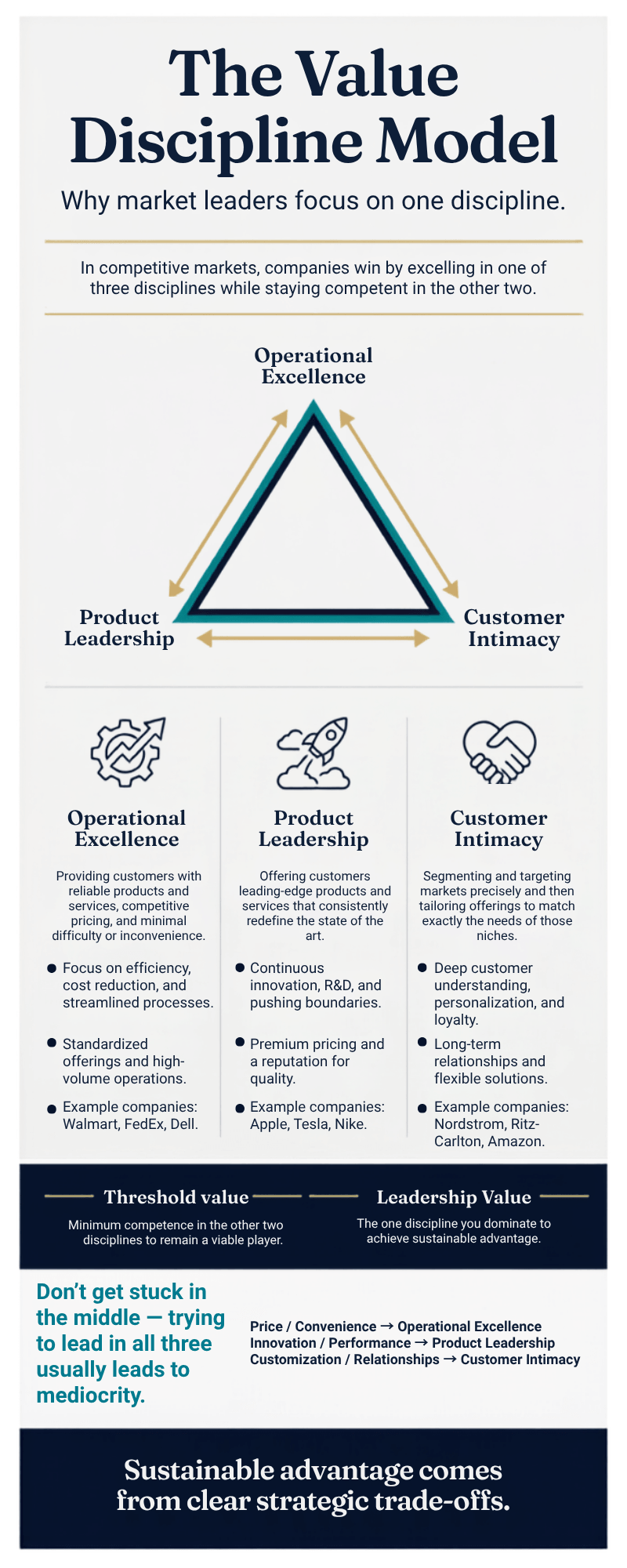
The Value Discipline Model triangle showing three strategic paths to market leadership: Operational Excellence (efficiency and cost reduction), Product Leadership (innovation and quality), and Customer Intimacy (personalization and relationships). Diagram illustrates threshold value versus leadership value with example companies like Walmart, Apple, and Nordstrom.

Discover how the Value Discipline Model helps organizations achieve market leadership by excelling in one of three strategic areas: Operational Excellence, Product Leadership, or Customer Intimacy. Learn which path fits your business and how to dominate your industry.
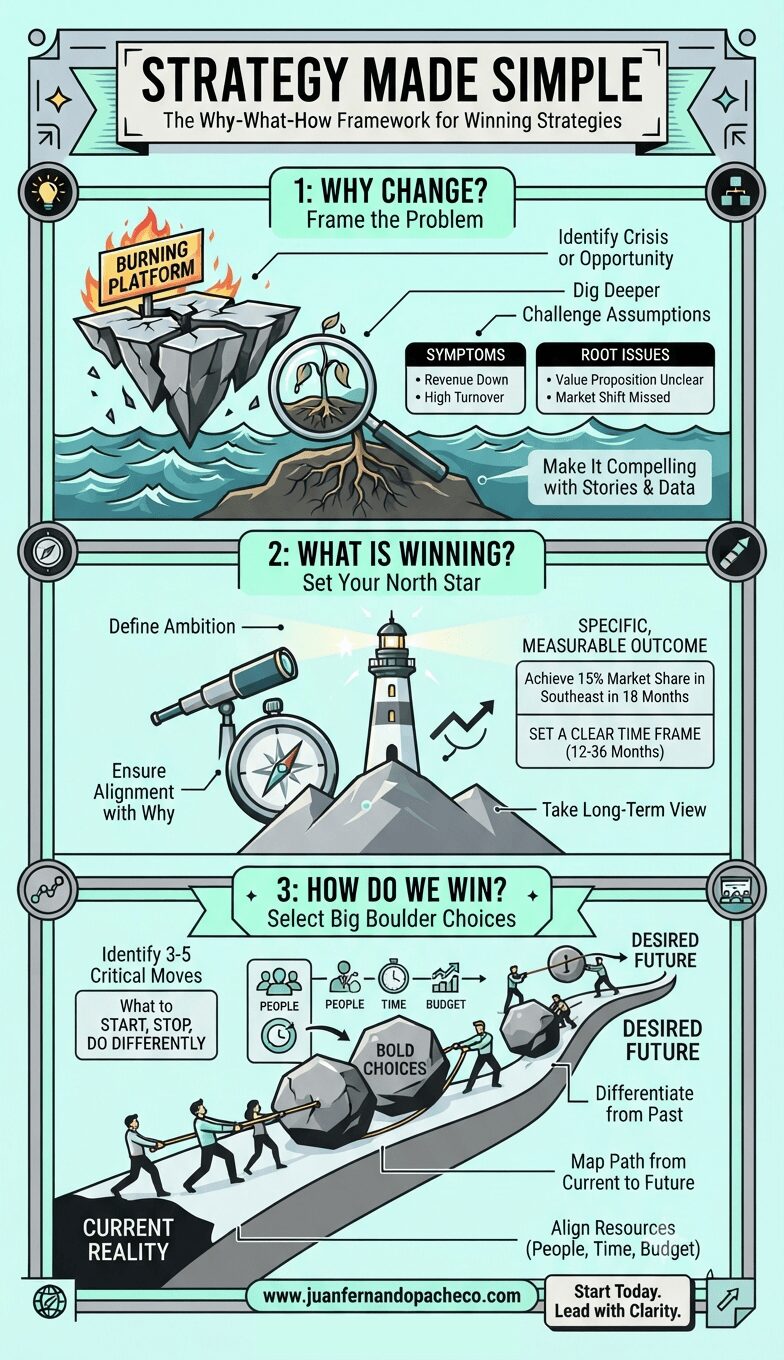
A vertical infographic titled "Strategy Made Simple" presented in three distinct, stacked sections. Section 1, "Why Change?", shows a cracked, burning platform and a plant root system under a magnifying glass to illustrate root causes. Section 2, "What Is Winning?", features a lighthouse acting as a North Star and a telescope. Section 3, "How Do We Win?", depicts people pushing large boulders along a path labeled "Bold Choices" toward a "Desired Future," with icons for aligning "People, Time, Budget."

Strategy doesn’t have to be complicated. Start with why. Define what winning looks like. Make bold choices about how you’ll get there. Communicate with clarity. Execute with discipline.

That’s it. That’s the formula.

The question isn’t whether this framework works—it does. The question is whether you’ll have the courage to use it. To make the hard choices. To say no to the good so you can say yes to the great. To lead your organization from where it is to where it needs to be.
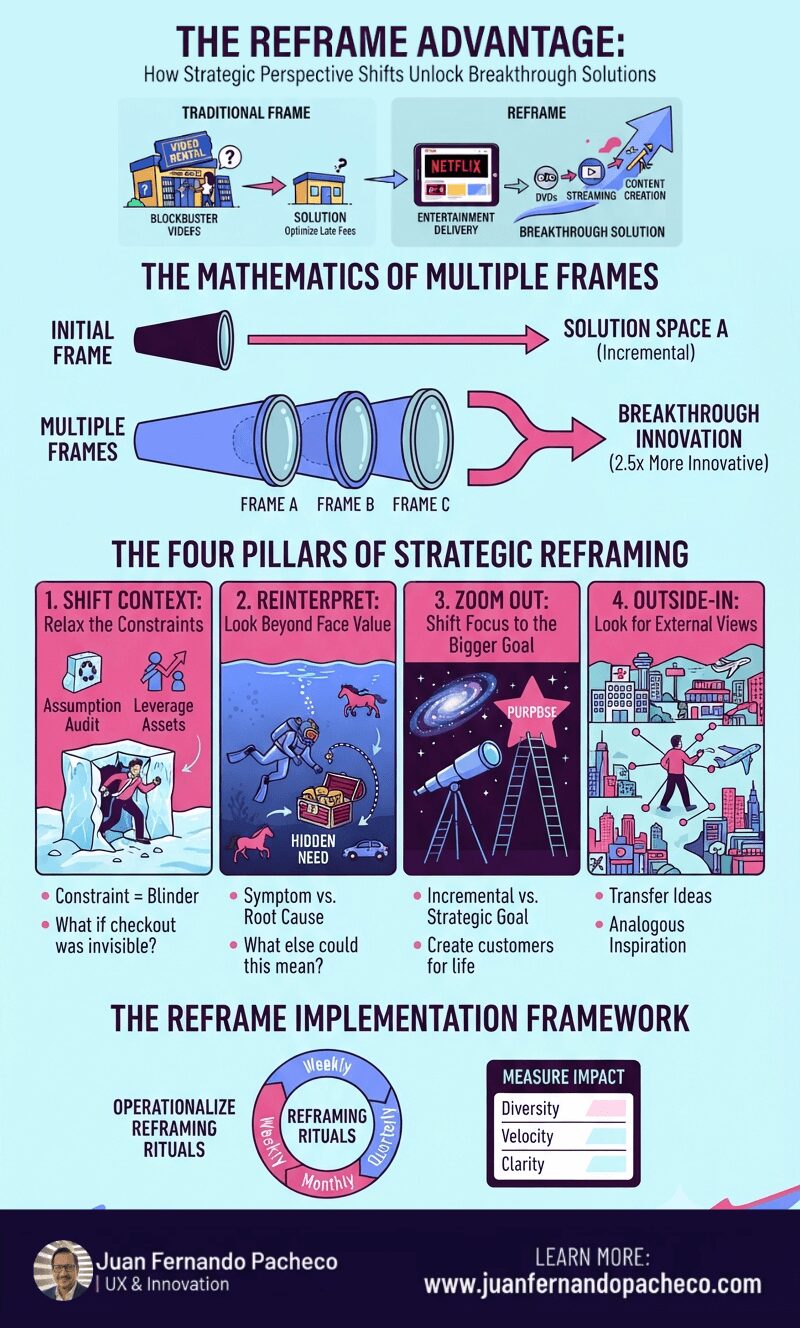
An infographic titled "The Reframe Advantage" with a pale cyan background, illustrating how strategic perspective shifts unlock breakthrough solutions, featuring the Netflix vs. Blockbuster example, "The Mathematics of Multiple Frames" diagram, "The Four Pillars of Strategic Reframing," and "The Reframe Implementation Framework," concluding with the URL www.juanfernandopacheco.com.

In a world where competitors can copy features, replicate processes, and hire away talent, your ability to see problems differently remains a sustainable competitive advantage. Reframing isn’t just a technique—it’s a strategic capability that compounds over time.

The teams and leaders who master reframing don’t just solve problems better; they solve better problems. They escape the trap of incremental optimization and unlock breakthrough innovation. They achieve more with less because they’re working on the right challenges from the start.
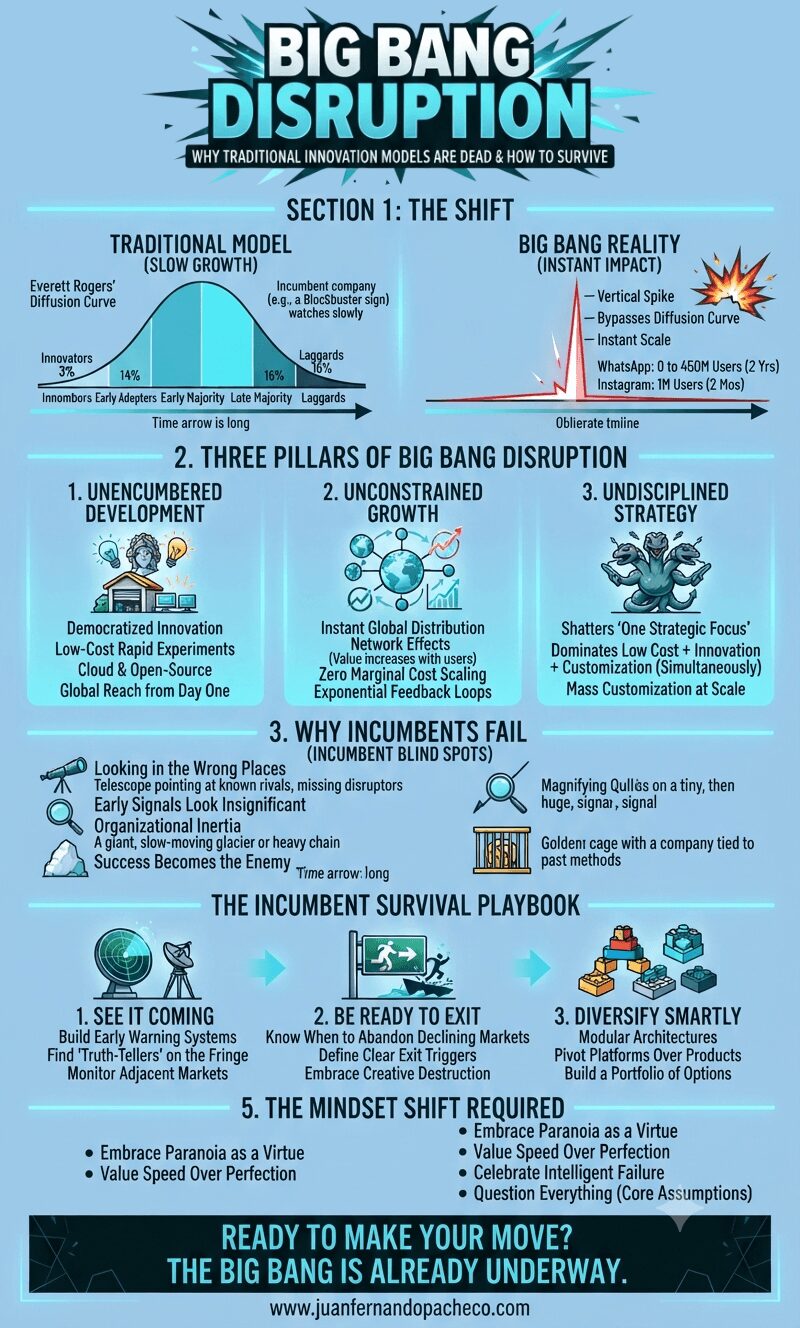
A vertical infographic titled 'Big Bang Disruption: The Death of Predictable Innovation' detailing the shift from traditional, gradual innovation models to instantaneous Big Bang disruptions. The graphic compares Rogers' diffusion of innovations curve with the vertical spike of Big Bang reality, highlights the three pillars (Unencumbered Development, Unconstrained Growth, Undisciplined Strategy), lists incumbent blind spots, and provides a survival playbook with three strategies. Includes illustrative data and a final call to action.

Discover why modern disruptions happen faster than ever, bypassing traditional adoption curves. Learn the three defining features of Big Bang Disruption and proven strategies to protect your business from being obliterated overnight